


Ladies and gentlemen…Roger Goodell.
Boo! Boo! Boo!
That’s pretty much the standard reaction when the NFL Commissioner gets before a crowd. It has rained boos with Goodell on the stage at the NFL Draft, during cameos at NFL stadiums and shoot, a few weeks ago in Canton, even when he popped over for a photo op with more than 100 Hall of Famers on hand for enshrinement ceremonies.
Advertisement
No, it’s probably nothing personal. It’s just that Goodell, 67, is the face of Big Football – the league that prints its own money while so many of the worker bees wind up with broken bodies or worse, battered brains. And your fantasy team stinks while your parlay tanked.
Sure, he gets paid big bucks, as in reportedly at least $64 million-per-year in compensation, to steer the ship and serve as a human heat shield for NFL owners when it comes to absorbing shots and criticism from all angles. Good that Goodell, who hit the 20-year milestone in his post on Tuesday, has some thick skin to go with his polished persona.
It comes with the territory. The dude just attracts a lot of jeering.
Unless, of course, he’s working for you.
Advertisement
“He’s done what we all hoped,” Dallas Cowboys owner Jerry Jones told USA TODAY Sports this week. “It’s not the same Roger. I’m not talking about the guy in the mailroom. I’m talking about the guy who stepped in as commissioner. He’s much more seasoned, knowledgeable about things. He has such an overall sense of where our touchpoints are in the NFL.
“That’s not Roger anymore. That’s Roger Goodell.“
NFL revenue has soared under Roger Goodell’s leadership
Of course, nothing measures the success Goodell has had quite like the bottom line.
Art Rooney II, the Pittsburgh Steelers owner, remembers sitting in the session during the NFL owners meeting in Orlando in March 2010 – with the longest lockout of players in NFL history coming the next year – when Goodell made a bold projection.
Advertisement
He declared a goal for the NFL to generate $25 billion in revenues by 2027.
At the time, the league collected about $8 billion in revenues.
“It seemed ambitious at the time, for sure,” Rooney told USA TODAY Sports. “I didn’t roll my eyes or anything, but it certainly sounded ambitious. But it was typical of Roger to put a goal out there that you’d have to reach for.”
With the league surpassing $23 billion in revenue for the 2024 fiscal year, the NFL could reach the goal before 2027. The growth has included more enormous media rights deals as the league, in the midst of agreements worth $110 billion over 11 years, has expanded its array of partners to capture streaming networks. Corporate sponsorships (including some from the gambling industry), merchandising, licensing and the expansion into international markets have also been significant in boosting revenues.
Advertisement
And labor peace helps. Since the lockout in 2011 disrupted the offseason but did not result in the loss of regular season games, the NFL and NFL Players Association (NFLPA) have struck mega-length labor pacts of 10 and 11 years – surprisingly long when compared historically, yet so beneficial in allowing the league to reach long-term media rights deals.
“Roger deserves a lot of credit,” Rooney said. “Those are the two biggest pieces of the puzzle for us. I don’t think you can fault him for anything regarding that. The most important things on his plate, he’s done an outstanding job.”
Challenges during Roger Goodell’s NFL tenure
Goodell’s tenure has certainly had missteps, and there are ongoing issues that haunt him such as the long-term effects of head injuries and the shabby track record for NFL teams in hiring Black head coaches that links to the class action lawsuit led by Brian Flores against the NFL and several teams, alleging sham interviews. There’s the stain left on the league, too, for the fact that Colin Kaepernick never landed another job in the NFL after his national anthem protests in 2016 over police brutality and systemic racism – which looked even worse when, in a video message after the killing of George Floyd, Goodell admitted the league should have done a better job listening to its players expressing social concerns.
Advertisement
Bountygate. Deflategate. Goodell’s history is not complete without those controversies. But worse than anything was his handling of the Ray Rice domestic violence case in 2014 – which resulted in a light, initial two-game suspension until a video emerged that showed the Baltimore Ravens running back knocking his then-fiancé unconscious by slugging her in an elevator and then dragging her limp body out of the elevator.
In determining his weak punishment, Goodell actually had a meeting with Rice and his now-wife Janay Palmer in his office – which domestic violence experts insist should never happen – and heard appeals from Ravens officials.
Rooney, who met Goodell when he started as an intern at NFL headquarters during the 1980s and watched him climb the ladder, said he learned much about the commissioner through the adversities.
“He could make a mistake and bounce back from it,” Rooney said. “Let’s put it that way. Ray Rice may have been the best example of that. Learning from something that we could have done better.”
Advertisement
Roger Goodell has “plenty of bite”
Jones, meanwhile, points to Goodell’s wherewithal in dealing with NFL owners as significant. Paul Tagliabue, who stepped down in 2006 after 17 years as Goodell’s predecessor, told me a few weeks before his Hall of Fame induction in 2021 that he could have lasted longer in the post but was soured by the task of settling disputes between owners. The toll on Tagliabue was substantial.
Goodell doesn’t give off the vibe that he’s worn down in dealing with owners, but it happens behind closed doors. Jones, who threatened to sue Goodell in 2017 over Ezekiel Elliott’s six-game suspension, acknowledged the challenge.

NFL commissioner Roger Goodell (left) and Dallas Cowboys owner Jerry Jones on Aug. 7, 2026, at the Pro Football Hall of Fame in Canton, Ohio.
“I bet there’s not a team in the league that hasn’t had a rough spot with the commissioner. Not a team,” Jones said.
Advertisement
“Let me say this: There was an illusion early, when he started, that his youth and demeanor might not have the punch needed to make some hard decisions against the ownership. His people skills should never be confused with whether he has bite. I know him to have plenty bite.”
DeMaurice Smith, the former NFLPA executive director, can attest to that from a different perspective. Smith succeeded the late Gene Upshaw in 2009 and was immediately thrust into a full-fledged labor battle. Just the nature of their respective positions at that time put Smith and Goodell at odds.
“For the first four or five years the relationship was built on two people at war,” Smith told USA TODAY Sports this week. “I’d say we became very good at going to war against each other.”
And the lockout was just one issue. Looking back now, Smith, whose book, “Turf Wars”, was released in 2025, speaks highly of Goodell and recognizes the mutual respect that resulted in the two extended labor agreements.
Advertisement
No, that doesn’t guarantee much for the next round of labor talks, with the NFL eyeing an 18-game season. Yet there’s no denying incentives for both sides when it comes to long-term labor peace. The current deal ensures that players receive 48% of total revenues and that teams spend 95% of the salary cap. The salary cap for 2026, by the way, is a record $301.2 million per team. By comparison, in the 2011 season after the lockout, the was slightly more than $120 million.
Beyond that, the two sides found a way to play the complete 2020 and 2021 seasons amid the pandemic. Smith said that working relationship flowed from trust that was built years earlier, after contentiousness from the lockout thawed.
“I think his constituents came to an understanding that war didn’t have to be the modus operandi, day in and day out,” Smith said, referring to NFL owners. “And I think the person who convinced them of that was Roger.”
Rooney hardly disputes that characterization.
Advertisement
“I think he’s always understood and over time even more so, the importance of the players, and the relationships with the players and the Players Association,” Rooney said. “He needs to work that side of the street pretty hard.”
When will Roger Goodell retire?

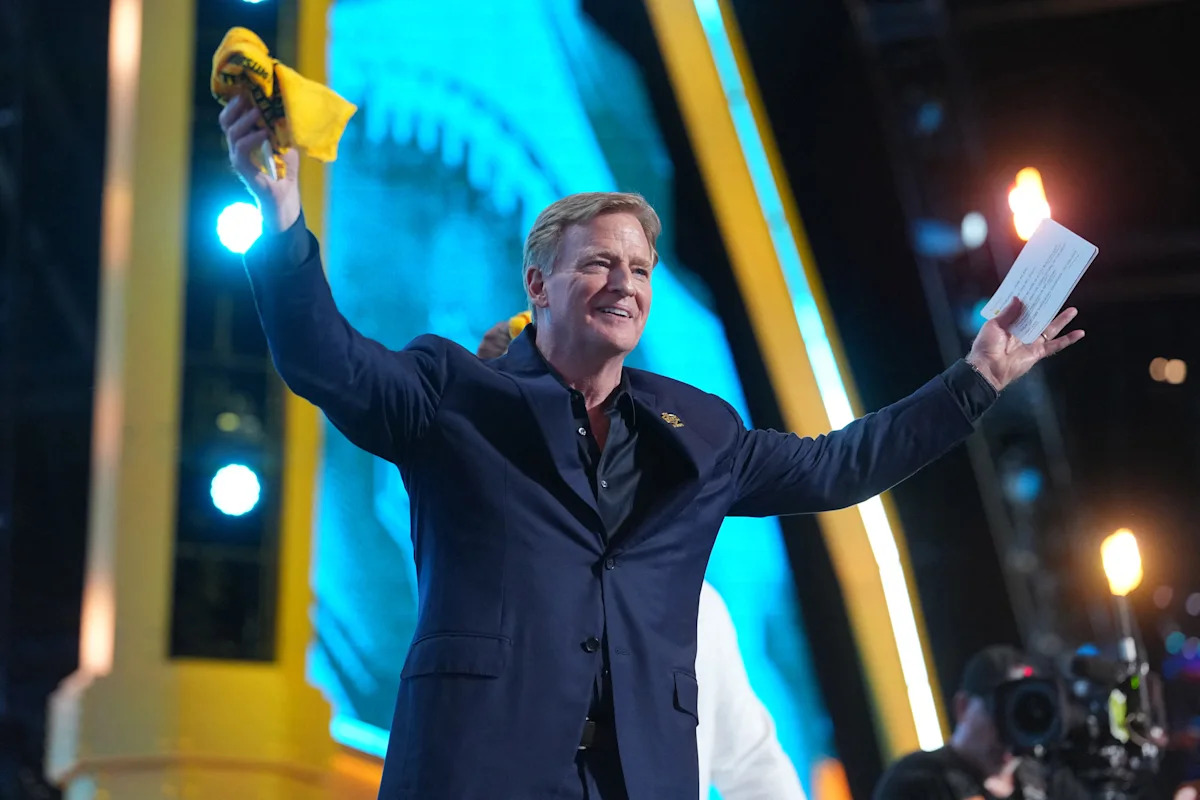
NFL commissioner Roger Goodell holds a Terrible Towel during the 2026 NFL Draft on Apr. 23, 2026, at Acrisure Stadium in Pittsburgh.
Before the next labor deal, though, another contract looms for Goodell. With his current rate dwarfing commissioners in other sports leagues – his compensation reportedly doubles the combined pay for the commissioners of the NBA, the NHL and MLB – an extension is considered imminent.
Will the next contract be the last one for Goodell? Given his lengthy tenure and the toll of the job, it’s not a stretch to think that if he steers the NFL to another long-term labor deal and long-term media rights packages – the two most important items on his plate – it would be a perfect time to step away.
Advertisement
We’ll see. But Jones, 83, wants to hear none of that.
Said Jones, “As far as I’m concerned, he’s a puppy.”
With just enough bite – and plenty of bank.
Follow Bell on X: @JarrettBell
All the NFL news on and off the field. Sign up for USA TODAY’s 4th and Monday newsletter.
This article originally appeared on USA TODAY: ‘Not the same Roger.’ 20 years in, Goodell’s NFL is bigger than ever | Opinion
Read the full article here


