





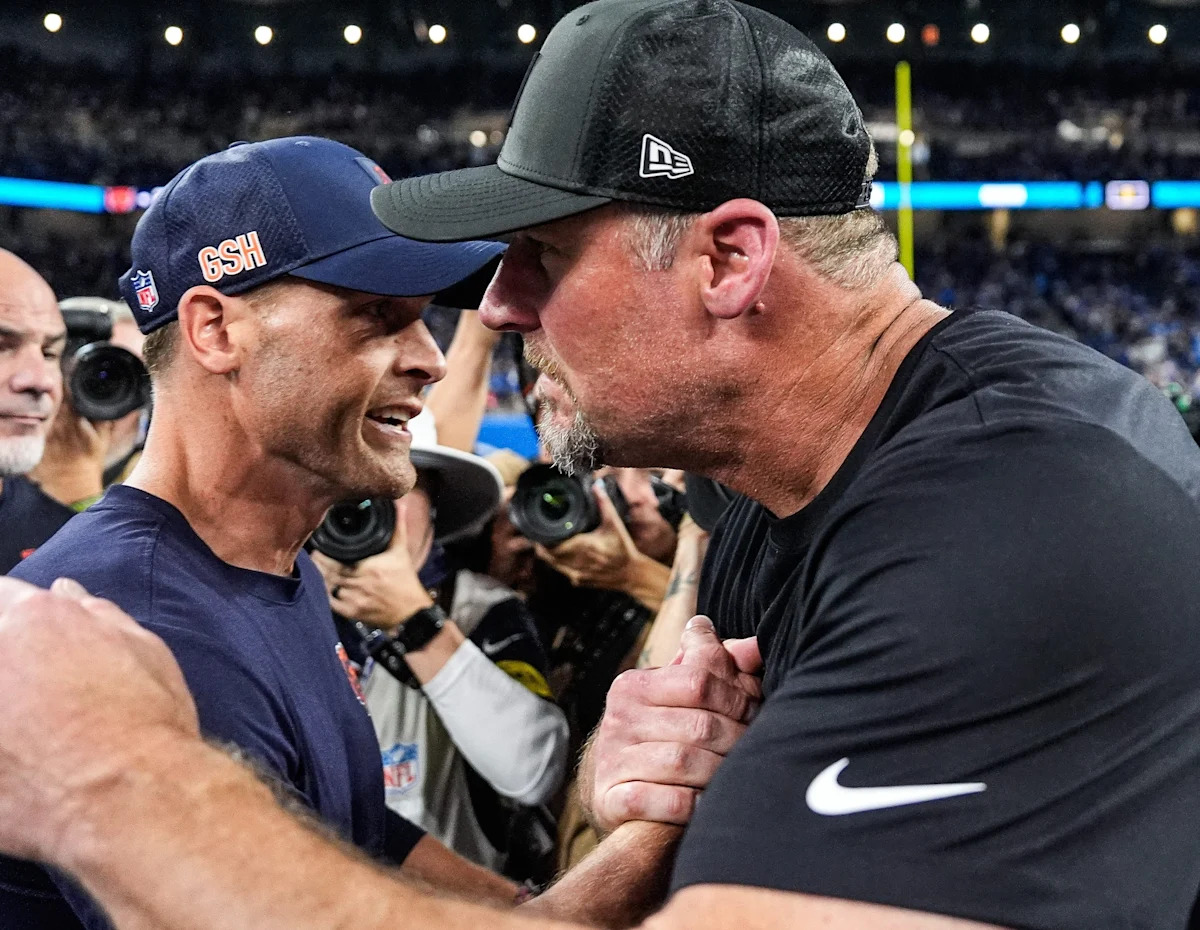
The 2025 season became the first time in NFL history that all four teams in the same division finished with a winning record, which, of course, was the NFC North. Despite another competitive season from start to finish in one of the deepest divisions in football, the Chicago Bears found a way to become one of the two teams in the NFL to go from worst-to-first over the course of one season.
While the offseason might not have made headlines for any of the four teams in the division, one could argue that the moves made have created the most competitive situation we’ve seen in quite some time. Although the offseason is always played out on paper, the results can produce a different reality. Since we’re still three months away from the kickoff of the 2026 NFL regular season, we’ll take a deeper dive into each of the NFC North’s offseasons and which direction they are trending heading into the new season in our new installment of Stock Up, Stock Down.
Advertisement
Chicago Bears
Following a disastrous 2024 campaign, last season was a breath of fresh air for Bears fans everywhere. Not only did they land the most sought-after head coaching candidate, but they turned around an (0-2) start into an 11-6 regular season and their first NFC North title in seven years. The core of their roster is young, but the front office did a nice job of insulating that group with a host of proven veterans who helped them take things to the next level. 2025 felt like a year of cleansing in many ways, and although many saw it as a “year too early” arrival, expectations will be drastically different heading into the upcoming season.
Key Moves
S Coby Bryant LB Devin Bush
Advertisement
S Dillon Thieneman (1st Round) C Garrett Bradbury
C Logan Jones (2nd Round) DT Neville Gallimore
WR Kalif Raymond TE Sam Roush (3rd Round)
For the first time since the rebuild started during the 2022 offseason, it’s easier to classify their approach this offseason as “business as usual” rather than trying to reinvent the wheel. While that might have led to a more “boring” approach on paper, it could also be taken as a sign that flipping 50-60% of their roster is a thing of the past. Continuity is always a focus for contending teams, and that’s exactly how Chicago chose to approach things during the acquisition period. They did make a few bigger moves, including Bryant and Bush, but the front office leaned on the draft and the hope of development from their current young core of players, who experienced an impressive 2025 campaign. Any time a borderline contender like the Bears fails to make a big splash, there will always be questions about their approach, but it’s clear that the organization feels like the key pieces are in place to take the next step.
Advertisement
Notable Losses
WR DJ Moore C Drew Dalman (Retirement)
S Kevin Byard LB Tremaine Edmunds
S Jaquan Brisker CB Nahshon Wright
DB C.J. Gardner-Johnson WR Olamide Zaccheaus
Due to their cap constraints and general manager Ryan Poles’ unwillingness to drastically impact their future cap flexibility, plenty of difficult decisions needed to be made during free agency. The first big move came when they traded Moore to the Buffalo Bills in exchange for a second-round selection. The surprise retirement of Dalman might have hurt more than any other move, but it was a mild surprise that they did not bring Byard back into the fold. The rest of their departures were widely anticipated, but it’s fair to wonder if the total checks and balances resulted in a net positive on paper for this roster.
Advertisement
Biggest Remaining Question
Will the defense be good enough to make them Super Bowl contenders?
If you talk to most Bears fans, they’ll echo the same few thoughts. There’s excitement and optimism surrounding Year 2 of Ben Johnson’s offense and the overall growth that quarterback Caleb Williams has experienced heading into his third year in the league. There’s no question that the offense took a big step forward in 2025 and is in line for another one heading into this season. That said, the team’s Achilles’ heel for most of last season was their defense. Despite a league-high 33 takeaways, the overall results weren’t what anyone had hoped for. While better health could aid this unit moving forward, the biggest concern(s) remain in the trenches. They’ll be counting on healthy seasons from Dayo Odeyingbo and Shemar Turner, but will it be enough? The blueprint for a Super Bowl winner is there, and although a high-scoring offense can get you into the playoffs, a top-tier defense with a deep defensive line is the key to winning it all.
Stock Status
Advertisement
Leaning Up (With some risk)
The upward trend of Williams and this offense should provide enough of a ceiling for them to be repeat customers into the playoffs. That said, there’s valid (and potentially serious) concerns about their viability as a Super Bowl contender. While the floor feels relatively safe, the ceiling depends on how much defensive coordinator Dennis Allen can get out of his defense in Year 2 at the helm. Speed has been a primary focus on both sides of the ball, but it’s fair to question whether or not they have the horses up front on defense to beat the good teams in January and potentially February consistently. The good news is that it’s only June and a splash move is just one trade away. The not-so-good news is that the Bears haven’t shown a willingness to expand their cash budget, leading many to believe that what you see now is what you’ll get during the regular season when it comes to the defensive depth chart.
Five years ago, most Lions fans would have considered a (9-8) finish a success. That, in a nutshell, shows just how drastically Detroit’s standard has changed since general manager Brad Holmes and head coach Dan Campbell took over. To be fair, the NFC North is the only division in football where a winning record could lead to a last-place finish. Even so, the organization believes that a disappointing 2025 campaign does not signal the end of their competitive window, but simply a bump in the road that everyone has learned from. On paper, this is still a vastly talented roster. That said, the 2026 season feels like a make-or-break time for how this team will be viewed moving forward.
Advertisement
Key Moves
C Cade Mays OT Blake Miller (1st Round)
DE Derrick Moore (2nd Round) CB Roger McCreary
DE D.J. Wonnum iOL Juice Scruggs
OL Larry Borom CB Keith Abney (5th Round)
Looking at the majority of the Lions’ bigger moves, the objective was clear: Focus on the trenches. The interior offensive line was an issue for most of last season, but following the release of veteran left tackle Taylor Decker, tackle became a top need early on. Adding Mays and Miller into the starting rotation should be a big boost, as well as depth from Scruggs and Borom. The defensive line also got a boost with Moore in the second round and Wonnum. Detroit’s overall talent level should not be questioned. Although they didn’t make any splash moves per se, they improved a few starting spots, while fortifying depth in key areas, including the trenches and cornerback.
Advertisement
Notable Losses
LT Taylor Decker RB David Montgomery
iOL Graham Glasgow LB Alex Anzalone
DT D.J. Reeder DE Al-Quadin Muhammad
DT Roy Lopez WR Kalif Raymond
In the matter of a week, Decker’s status went from potential retirement, to a needed return, to a surprising release. The veteran left tackle was one of the longest-tenured players on the team, but money became a factor for both sides. Montgomery was another piece from a financial standpoint that no longer made sense, especially with the full-time emergence of Jahmyr Gibbs and a pending lucrative extension. The biggest losses, outside of the two top names, came along the defensive line with Reeder, Muhammad, and Lopez departing in free agency. Anzalone is another overlooked loss. Overall, they lost some familiar faces, but in terms of impact, it’s fair to argue that they at least “broke even” in the win/loss department.
Advertisement
Biggest Remaining Question
Did they find their replacement for Ben Johnson in Drew Petzing, his good friend?
Last year around this time, Lions fans had convinced themselves that Campbell and John Morton were the true architects of Detroit’s offense and that the loss of Johnson wouldn’t be a noticeable impact. A few games into the season, it became apparent that Campbell had made the wrong hire. This will be his fourth offensive coordinator in six seasons, two of which didn’t last a full season in that role. Petzing is coming off a strange end to his tenure in Arizona, but there’s no denying that the talent he’ll have in Detroit trumps anything he had with the Cardinals. Although it’s easy to argue that Campbell is on more than solid ground regarding his job security, a third failed hire in this spot could shine an unwanted spotlight. If you can’t have Ben Johnson, might as well hire one of his good friends!
Stock Status
Advertisement
Up (Banking On Positive Regression)
A year after a league-high 15 wins (and a disappointing divisional round playoff exit), the Lions not only missed the playoffs but barely broke the .500 marker. It’s easy to overreact year-to-year in the NFL, but the chances are much higher than Detroit experienced a down year rather than completely falling off a cliff. While it’s easy to argue that 2026 is a “put up or shut up” year, the talent is there, and many of their 2025 issues have at least been addressed. Much of the Lions’ outlook relies on how you view last year’s results. Assuming last year was more about regression too far to one side, this year should even out, even if it doesn’t produce another 15-win season.
Following back-to-back years of first-round playoff exits, the Packers have been left searching for answers on how to get back to the next level. Over the last three decades, Green Bay has been one of the more consistent teams in the league, but the pressure has mounted after going all-in in a trade to land Micah Parsons from Dallas last August. With Parsons expected to miss the first month-plus of the season while he rehabs his way back from a late-season ACL tear and a new defensive coordinator, they find themselves in a spot where a solid start will be needed. The youthful talent is there, but with the continual need for “more”, the pressure will be on the Packers for 2026.
Advertisement
Key Moves
LB Zaire Franklin DT Javon Hargrave
CB Brandon Cisse (2nd Round) CB Benjamin St. Juste
DT Chris McClellan (3rd Round) QB Tyrod Taylor
DE Dani Dennis-Sutton (4th Round) K Trey Smack (6th Round)
Following two years of active free-agent periods (at least by their operating standards), the Packers took a more guarded approach throughout the offseason. Adding Franklin at linebacker gives them more veteran presence, and Hargrave gives them another pass-rushing option on the interior defensive line. The focus in the draft was heavily slanted toward the defensive side of the ball, even without a first-round pick. Even though a big move wasn’t made at cornerback, Cisse and St. Juste help raise the floor of a group that needed some help. Trading out McManus for Smack was also needed, even if rookie kickers can be unpredictable, as the Packers well know.
Advertisement
Notable Losses
WR Romeo Doubs DE Rashaan Gary
LT Rasheed Walker LB Quay Walker
C Elgton Jenkins QB Malik Willis
CB Nate Hobbs K Brandon McManus
Although the Packers had a mild acquisition period, the losses, at least from a name-value perspective, are notable. Doubs took a big deal in New England, while both Gary and Jenkins were moved on from following disappointing seasons on big contracts. Speaking of disappointing players being released, Hobbs’ one-year tenure in Green Bay was forgettable… Rasheed Walker’s market was much weaker than expected, but with former first-round pick Jordan Morgan ready to take over at left tackle, it made sense to let him walk. Quay Walker and Willis’ departures were much more financially related, with both receiving lucrative deals elsewhere. The McManus release almost felt like a “must” after how last season ended, but as we’ve talked about, relying on a rookie kicker can be a rollercoaster.
Advertisement
Biggest Remaining Question
Is a healthy Micah Parsons enough to take the defense over the top?
For the first half of last season, there weren’t many defenses in the league better than Green Bay. The results started to tail off before Parsons’ injury, but the entire unit fell off a cliff once he was lost for the season. With Gary off to Dallas and Engebare in New York, the depth off the edge is a serious concern. The hope is that with an improved secondary and more juice on the interior, they can scheme around it. One of the least-talked-about aspects of this unit is the transition from Jeff Hafley to Jonathan Gannon. Schematically, they couldn’t be much different. We’ll see if the change pays off for them. This should be an above-average unit if healthy, but where they land in the grand scheme of things will be important to how they finish as a team overall.
Stock Status
Advertisement
Holding Steady (Could go either way)
Any real skepticism surrounding this team relies on how they finished last season, which is understandable. That being said, this is still a very talented team with plenty of upside in the right spots. Quarterback Jordan Love has solidified himself as a Top 10 quarterback, and there’s plenty of speed at receiver. Getting tight end Tucker Kraft back to health will be vital for this offense. Although the offensive line is somewhat in question, most of the pressing questions are on the defensive side of the ball. 2026 feels like a year that could go either way, but the last thing they can afford is to stay stagnant.
Following a 14-win 2024 campaign, last year couldn’t be categorized as anything less than a disappointment. After allowing quarterback Sam Darnold to depart in free agency, the Vikings’ high expectations for J.J. McCarthy were not rewarded, despite another high-level year from the defensive side of the ball. As the team continues to retool their roster on the fly, the hope is that head coach Kevin O’Connell can get his group back on track with a better quarterback room. In what is expected to be another tightly contested divisional race, it’s fair to wonder if Minnesota did enough to get themselves back into contention for a potential division title in 2026.
Advertisement
Key Moves
QB Kyler Murray WR Jauan Jennings
DT Caleb Banks (1st Round) CB James Pierre
LB Jake Golday (2nd Round) OT Ryan Van Demark
DT Domonique Orange (3rd Round) P Johnny Hekker
Although injuries played a role in last season’s disappointing results, the primary focus heading into March revolved around the quarterback position. The start to McCarthy’s career has been rocky, and while the team shouldn’t give up on his development quite yet, the signing of Murray was much needed. At the very worst, the former Arizona Cardinal gives this group a considerably higher floor than a year ago. That said, history has shown that O’Connell’s best work has been done with resurrecting veterans’ careers. Adding Jennings, especially to their third-down offense, only helps put both arms in a better position to succeed. The primary focus, at least in the draft, was on the defensive side of the ball. On the surface, that might appear confusing to some, but considering who they lost this offseason, it’s easier to understand the approach. As they showed last year, this team will go as far as its quarterback play takes them, which is why all roads lead back to the shrude signing of Murray.
Advertisement
Notable Losses
DE Jonathan Greenard S Harrison Smith
DT Javon Hargrave DT Jonathan Allen
WR Jalen Nailor OT Justin Skule
CB Fabian Moreau P Ryan Wright
Losses are a part of every offseason, but it was clear from the start that the Vikings needed to shed payroll while remaking some of their defense. It started with the releases of Hargrave and Allen, and later with the trade away of Greenard during the draft. On paper, they lose two of their better pass rushers, but luckily for the Vikings, they have plenty of depth in the trenches. Although Greenard was a good player, the emergence of former first-round pick Dallas Turner over the second half of the season helped facilitate a trade that brought future cap relief and a third-round pick in return. Nailor was a quality role player, but ultimately, he was paid much more in Las Vegas than Minnesota was willing to give. Although Smith is still technically a free agent, the expectation is that he’ll ultimately retire after an impressive 14-year career, all with the Vikings.
Advertisement
Biggest Remaining Question
Can Murray be the difference-maker Minnesota is hoping he can be?
When J.J. McCarthy was drafted, many believed that head coach Kevin O’Connell would be able to get the most out of his development. Following a completely lost rookie season and a concerning Year 2, with multiple injuries in between, bringing in Murray feels like more than just “competition”. Assuming both players stay healthy, Murray is the heavy favorite to win the job, and it’s worth wondering if he can parlay a long-term deal in Minnesota with a bounce-back year in 2026. It’s been a while since the Vikings developed a young quarterback, but they’ve done a great job remaking veteran quarterbacks’ careers. With better quarterback play, the Vikings should be right back in the playoff mix.
Stock Status
Advertisement
Up (But all dependent on quarterback play)
It’s hard to envision a scenario where the Vikings receive worse quarterback play than they did last season. Whether that’s because Murray comes in and elevates the play or the competition is enough to bring out the best in McCarthy, the overall floor (and ceiling) for this team should be more stable in 2026. That said, the Vikings did show some additional warts last season, and they’ll be working with a very different defensive line. The talent is there, but the same could be said for every team in the division. Of all the teams, the Vikings do feel like the ones with the lowest ceiling, but as we’ve seen, anything is possible in a new season.
Which teams do you think are trending up and which are trending down?
Read the full article here