





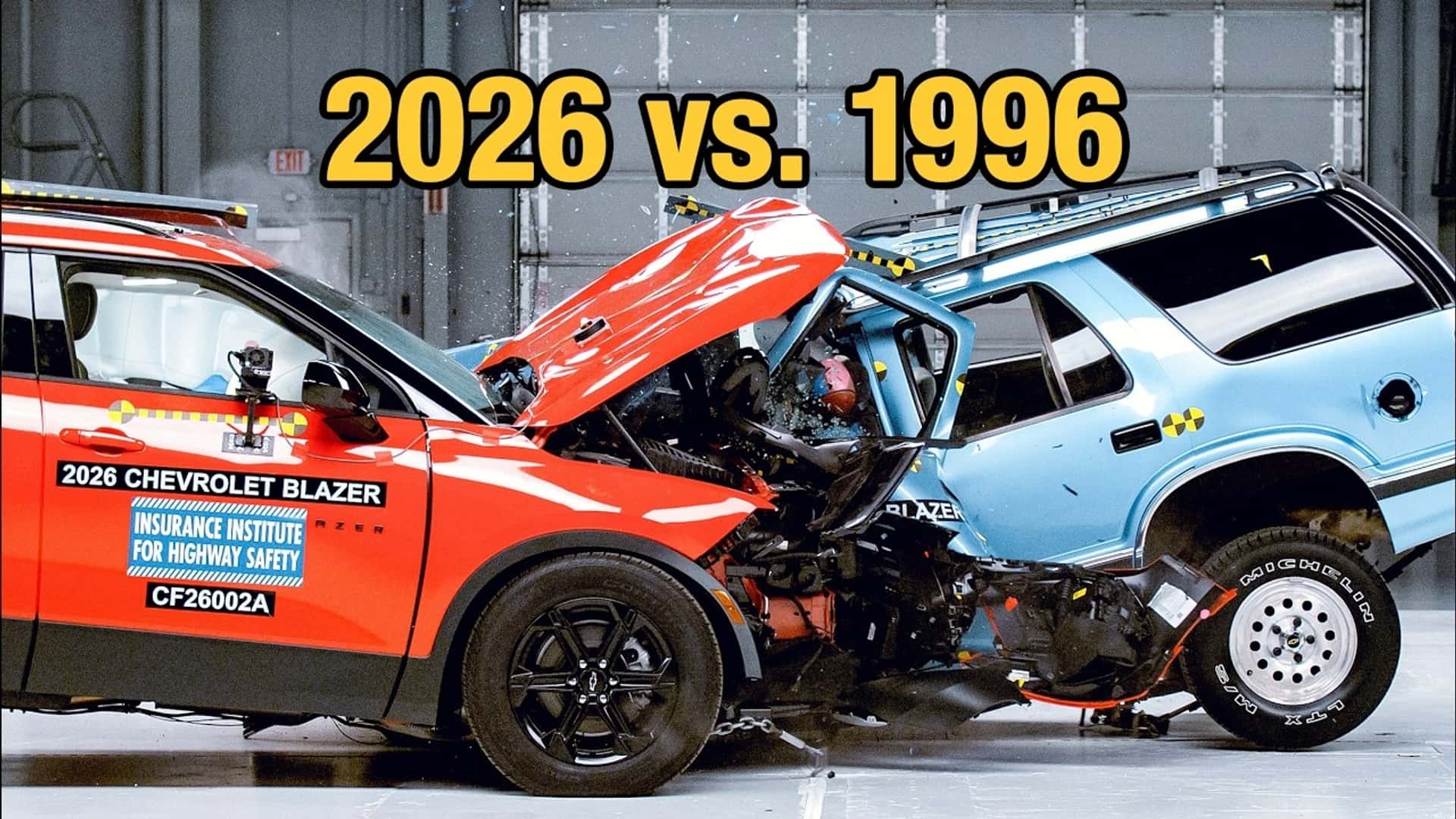
- The IIHS crash-tested a 1996 Chevrolet Blazer against its modern equivalent to mark 30 years since the agency began evaluating vehicle safety.
- The newer Blazer’s driver likely would have received only minor injuries, while the 1996 Blazer’s could have been seriously hurt or killed.
- The 40-mph moderate-overlap crash test highlights how far vehicle safety has come in 30 years.
Vehicle safety has come a long way in the past 30 years. Drivers benefit from the widespread adoption of airbags, traction and stability control, and stronger body structures, while active safety advances like automatic emergency braking and driver monitoring aim to prevent crashes from occurring in the first place.
As a result, the per-capita US road fatality rate has fallen in over 20 out of the last 30 years according to NHTSA data, despite an alarming rise in pedestrian deaths since 2010, potentially linked to the increased prevalence of larger trucks and SUVs.
The Insurance Institute for Highway Safety (IIHS) has been conducting independent collision tests since 1995. To mark 30 years of its crash testing program, the IIHS recently ran a 2026 Chevrolet Blazer into a 1996 model.
The test conducted was a moderate-overlap front crash test, where two vehicles traveling just under 40 miles per hour hit each other head-on with a 40% frontal overlap. The results are predictable, but watching the crash unfold is chilling.
From the moment the two vehicles collide, the 1996 Blazer’s cabin begins to deform. The old Blazer’s roof and driver’s door crumple like a tin can in the impact, leaving minimal space for the driver’s body. Seen from inside the car, the steering column and dashboard surge toward the driver, slamming them back into the seat in a harsh secondary impact. According to the IIHS, this person would’ve suffered “serious, potentially fatal injuries.”
It’s a different story in the 2026 Blazer. The car’s crumple zone performs as it should, absorbing the impact and channeling it around the passenger compartment rather than through it. The driver’s door looks like it could be opened without too much difficulty, and cabin intrusion is minimal. According to the IIHS, this driver “would likely have walked away with bumps and bruises.”
The IIHS has done this sort of thing before, running a 1959 Chevy Bel Air into a 2009 Malibu to mark the organization’s 50th birthday. But it’s somehow more shocking to see a relatively modern SUV with air bags perform so poorly. The average car on American roads is nearly 13 years old, with plenty still kicking at double that, so this is a fairly realistic scenario that could play out on the road.
The IIHS estimates that vehicle safety advances driven by its testing have saved nearly 50,000 lives since 1995. “These results highlight the role of IIHS ratings in driving many of the key vehicle safety improvements of the past 30 years,” IIHS chief operating officer Joe Nolan said. “The difference between the two vehicles could not be clearer.”
Motor1’s Take: This demonstration shows just how far vehicle safety has come in 30 years. You’re much safer behind the wheel of a modern Chevy Blazer than a 1996 model, despite what anyone says about older cars being “built like tanks.”
Read the full article here