




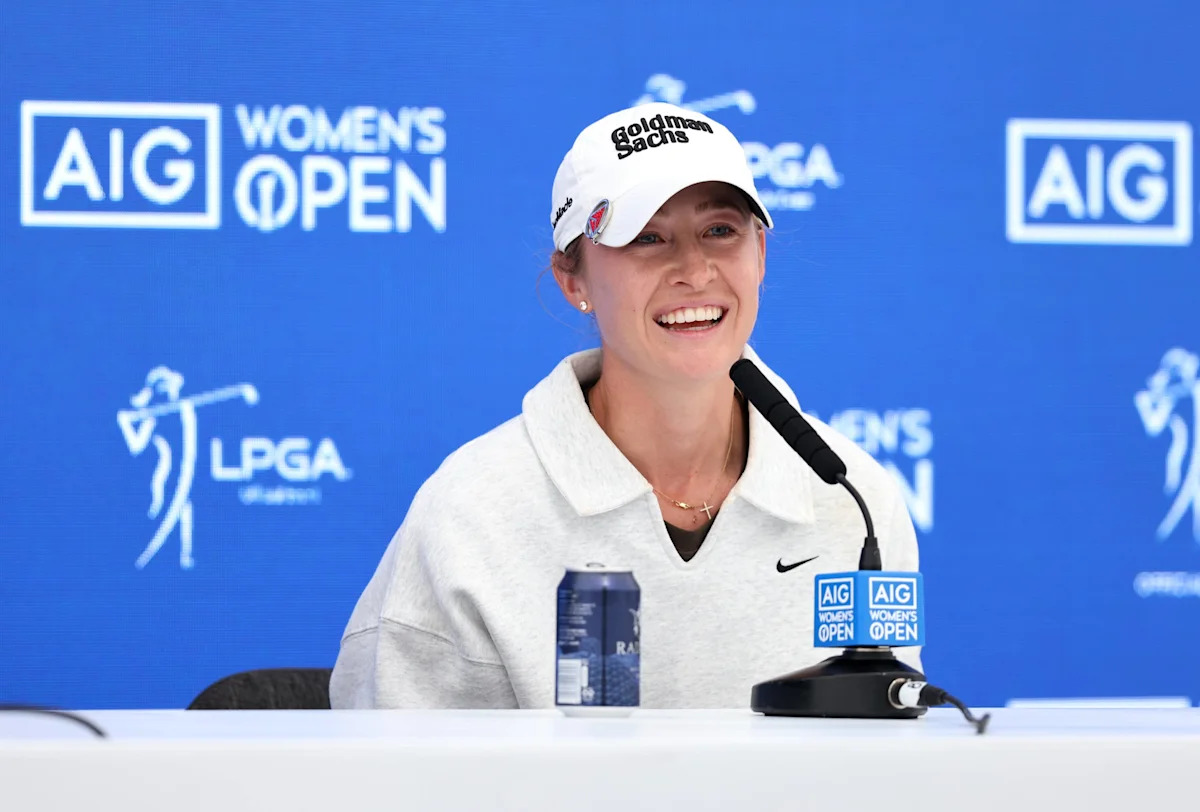
A day after celebrating her birthday with nine holes and a quiet dinner, Nelly Korda sat for her pre-championship press conference at Royal Lytham & St Annes and described a week built largely around subtraction.
Fewer drivers. Fewer conventional targets. Fewer fights with the unpredictable bounces that define links golf. Perhaps most importantly, fewer attempts to become the version of Nelly Korda that other people expect her to be.
Advertisement
Korda enters the 50th AIG Women’s Open as the world No. 1 and a four-time major champion after winning the Chevron Championship and U.S. Women’s Open earlier this season. A victory Sunday would give her three of the five women’s majors played in 2026.
Yet her most revealing answers Wednesday were not about trophies or dominance. They were about learning where to place her energy, particularly when a golf course, a schedule and a public profile keep asking for more of it.
“My attitude this week is control what you can control,” Korda said. “Sometimes with links golf you can kind of get pretty agitated with the bounces that you get.”
Advertisement
That phrase can sound like standard athlete language until Korda explains what it now means to her. At Royal Lytham, control is not the ability to dictate every outcome. It is the discipline to accept how many outcomes remain beyond her reach.
Royal Lytham Demands Restraint, Not Dominance
Korda expects to hit driver no more than four or five times during a round, a significant adjustment for one of the longest and most athletic players in the women’s game.
Advertisement
Royal Lytham’s bunkers create that decision. A tee shot struck with additional speed does little good if it brings the wrong hazards into play or leaves a poor angle into one of the course’s guarded greens.
Korda has also added a 4-iron after testing it at the KPMG Women’s PGA Championship. She has generally favored a hybrid because of her naturally lower ball flight, but the iron gives her another option for navigating firm turf, wind and the specific demands of this links.
The important part is not simply which club she selected. It is her willingness to adapt.
Advertisement
Links golf frequently asks players to abandon the decisions they make during most of the LPGA Tour season. A fairway hit is not automatically the proper play. Korda even described situations in which she might deliberately choose the rough because it provides a better line to the green and removes certain bunkers from consideration.
That is not careless course management. It is the kind of strategic calculation Royal Lytham rewards.
Korda also spoke about choosing among low-running shots with a 54-degree wedge, 9-iron or 8-iron. On a traditional links, trajectory, landing point and ground movement can matter more than making technically perfect contact with a stock yardage.
Advertisement
“I love being creative,” Korda said. “There are so many different shots you can hit when you play links golf, and I think that’s what’s really fun.”
The contradiction is part of the championship’s challenge. Korda enjoys the imagination links golf requires, but she has not always enjoyed the consequences when a quality shot takes an unfriendly turn.
This week, she is trying to separate the two.
AIG Women’s Open Strategy
Advertisement
Nelly Korda’s Royal Lytham Blueprint
Korda’s plan reflects the demands of a links course where position, trajectory and angles can matter more than raw distance.
Driver Usage
4 or 5
The maximum number of drivers Korda expects to hit during a round.
New Addition
4-Iron
A club Korda tested at the KPMG Women’s PGA Championship and placed in the bag this week.
Primary Concern
Pot Bunkers
Targets will be selected around hazard placement rather than the conventional goal of finding every fairway.
Advertisement
Shot Selection
Stay Creative
Low flights, stingers and running shots with several different clubs will all be part of the equation.
Korda Is Protecting More Than Her Scorecard
The same idea surfaced when Korda was asked about becoming a flag bearer for women’s golf.
“If you asked me two years ago, I maybe would’ve lied up here and said I’m fine with it,” she said. “But I think that I’m at a stage in my career and at a stage where I’m just going to be myself. If people don’t like it, that’s fine.”
Advertisement
Korda was not dismissing the responsibility that comes with her position. She said she wants to inspire the next generation and understands the opportunities her success has created.
What has changed is her willingness to let those expectations determine her direction.
“I’m going to go the direction I want and be very authentic,” she said. “I feel like when I’m not, it drains my battery a lot, doing what I don’t want to do.”
Advertisement
That may have been the most important admission of the press conference.
The public sees tournament rounds, trophies, endorsement campaigns and carefully scheduled appearances. It does not always see the accumulation of travel, preparation, media obligations and decisions that have to be fitted around the work required to remain No. 1.
Korda said her parents regularly encourage her to take more time off. Her response is usually that she wants to keep working. Eventually, however, the physical and mental fatigue becomes harder to ignore.
Advertisement
That fatigue matters at a links major because patience is not an abstract virtue. It affects decisions.
A player who is fresh may laugh off a ball that caroms into a pot bunker. A tired player may carry the frustration into the recovery shot, the next tee and several holes beyond it. Korda acknowledged that she becomes more susceptible to that agitation during the condensed major portion of the schedule.
Her 2025 season helps explain the shift. Korda made all 19 cuts and recorded nine top-10 finishes but did not win. The results were objectively strong, yet she said she became frustrated by divots, bounces and outcomes that felt unfair.
Advertisement
Eventually, she decided the attitude was costing more than the bad breaks themselves.
The Pressure Shift
What Korda Is Learning to Control
Her press conference connected links strategy, public expectations and competitive fatigue around one central question: Where is her energy best spent?
“I’m going to go the direction I want and be very authentic.”
Nelly Korda
Preparation
Club selection, rest, recovery and the quality of her work.
Response
Advertisement
Whether a poor bounce becomes one bad outcome or several.
Authenticity
Which opportunities she accepts and how she uses her platform.
Outside Her Control
Unpredictable bounces, other players’ scores and public expectations.
The Reset Matters More Than the Rebound
Korda’s missed cut at the Amundi Evian Championship could have followed her to England. Instead, she said she put it behind her quickly.
She did not claim she played terribly. She also did not search for a larger explanation.
Advertisement
“You’re going to have weeks you just don’t have it,” Korda said. “That’s the reality of it. I feel like I’ve done this long enough where I’ve missed enough cuts that it’s just about the bounceback.”
The response was not indifference. It was proportion.
Even the best player in the world will miss cuts, receive poor bounces and lose tournaments after playing well. The danger begins when each outcome becomes evidence that something larger is wrong.
Advertisement
Korda has already shown that she can contend at an AIG Women’s Open. At St Andrews in 2024, she led after 36 holes and was two shots ahead midway through the final round before finishing tied for second behind Lydia Ko. Korda said the disappointment still carried value because it proved she could handle major pressure on a links course.
Royal Lytham presents a different examination.
Korda will begin the opening round at 8:42 a.m. local time alongside Haeran Ryu and Lydia Ko, a grouping that includes the winners of all five women’s majors since the beginning of 2026. Korda and Ryu have divided the first four of this season, while Ko won the 2024 AIG Women’s Open.
Advertisement
The strategic plan appears clear. Korda will use driver selectively, rely on the new 4-iron and embrace the creativity required to move through Royal Lytham’s bunkers and angled landing areas.
The harder part begins when the first well-struck shot receives a bad bounce.
Korda acknowledged as much when she described her new approach.
“It’s easy to say; harder to do,” she said. “I think what I learned is I just need to take a step back and hit the reset button sometimes.”
Advertisement
Royal Lytham will test Korda’s ball flight, patience and imagination. It may also reveal how much progress she has made in learning that control sometimes begins by leaving an unlucky bounce exactly where it landed.
PGA of America Golf Professional Brendon Elliott is an award-winning coach and golf writer who serves as Athlon Sports Senior Golf Writer. Read his recent “The Starter” on R.org, where he is their Lead Golf Writer. To stay updated on all of his latest work, sign up for his newsletter or visit his MuckRack Profile.
Advertisement
Related: Royal Lytham Is the Great Equalizer at the AIG Women’s Open
Related: The Monday Mowdown: Detroit Rebuilt, Royal Lytham Goes Robotic
Related: Jenny Shin Ends 10-Year Wait With Scottish Open Win
This story was originally published by Athlon Sports on Jul 30, 2026, where it first appeared in the Golf section. Add Athlon Sports as a Preferred Source by clicking here.
Read the full article here


