





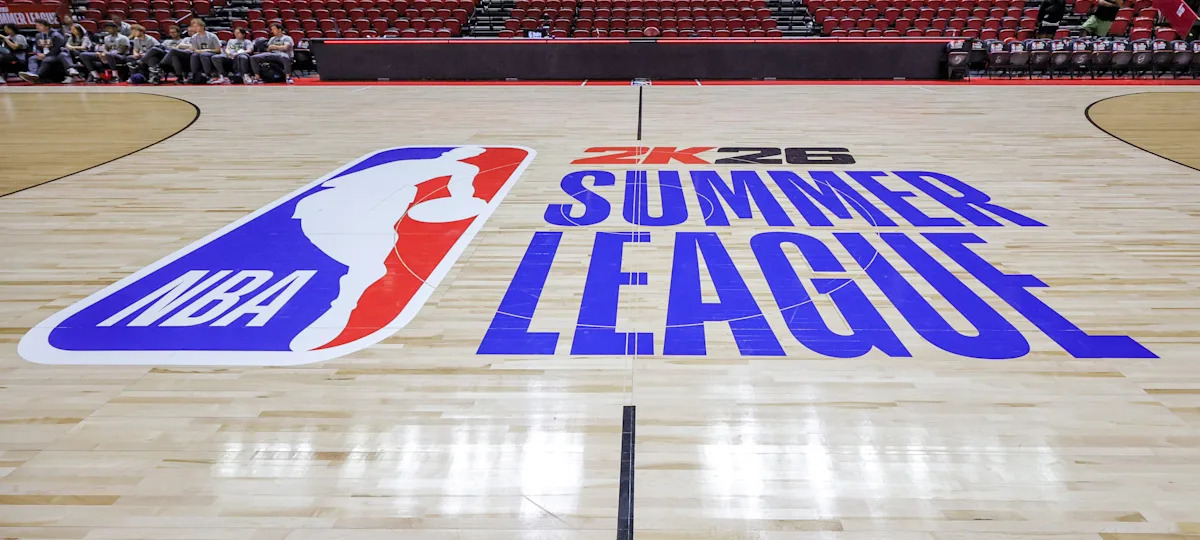
The NBA summer leagues are a breeding ground for experimentation, and not just for the participating teams and their shapeshifting lineups. That period of trial and error is useful for the league, too.
This year, it’s capitalizing by testing a “one free throw rule” that’s been deployed in the G League to improve game flow since the 2019-20 season.
Advertisement
Under this rule, any foul that would normally lead to one, two or three free throws instead results in a single free-throw attempt, except during the final two minutes of the fourth quarter and throughout overtime. In those late-game instances, standard NBA free-throw rules apply.
When the rule is in effect, the single attempt a player takes from the charity stripe is worth the same total number of points as the free throws it replaces. It reduces the time players spend at the free-throw line and therefore speeds up game play.
Time will tell if the rule makes it to the NBA. Other rules have been sampled in the NBA summer leagues and G League before making their debut at the highest level. The coaches’ challenge and the 24-second shot clock resetting to 14 seconds following an offensive rebound are in that category, as chronicled by The Associated Press.
Advertisement
But as Yahoo Sports’ Tom Haberstroh noted on “The Kevin O’Connor Show,” the one free throw rule could worsen the load management epidemic in the NBA.
“I think I like this on paper, but in application I’m worried, Haberstroh said. “I’m worried about the physical downside of this rule.”
He later added: “I think a downstream negative externality of this new rule if they implement it at the NBA level, I do worry that we’re going to see more DNP rests and more resting for NBA player superstars. … These breaks, the free throws, are basically a way for them to recharge their batteries. And if they’re only getting one free throw instead of three free throws in the instance of a fouled 3-point shot, I think these guys are going to be a lot more fatigued.”
Additionally, “the connected basketball” will be tested at this year’s NBA summer leagues. It’s a basketball that carries an embedded sensor, which tracks ball contact without changing the makeup of the ball. The data gained from the ball this summer could inform future officiating applications, according to NBA PR, including last-touch out-of-bounds calls. Back in May, NBA commissioner Adam Silver said the league will eventually adopt an AI-automated system to review out-of-bounds calls.
Summer league action will take place this month in Northern California, Salt Lake City and Las Vegas, starting on Saturday with the California Classic and Salt Lake City Summer League.
Read the full article here