







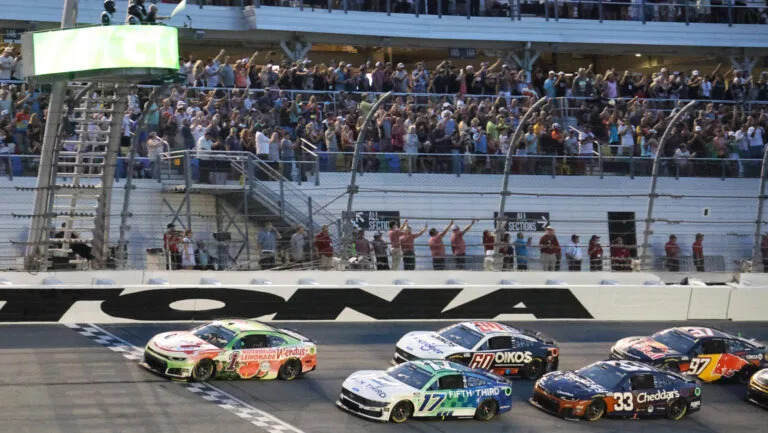
NASCAR didn’t make a subtle adjustment before its regular-season finale at Daytona International Speedway.
It took a swing.
After years of trying to improve the racing produced by the Next Gen car on superspeedways, NASCAR arrived at Daytona with a dramatically shorter rear spoiler and less horsepower. The objective was to put more of the race back into the drivers’ hands by making the cars less planted, creating separation within the pack and giving drivers a better chance to manufacture runs.
Advertisement
Four hundred miles later, NASCAR got something it hasn’t always had after tinkering with its superspeedway package: evidence that it may be moving in the right direction.
What it didn’t get was anything resembling a consensus.
Some drivers climbed from their cars believing Saturday night’s Coke Zero Sugar 400 was noticeably better. Others thought NASCAR had changed a lot on paper without changing much of anything on the racetrack. And one of the very problems the package was supposed to address, fuel saving, remained firmly part of the race.
The result was less a verdict on NASCAR’s experiment than the beginning of a much more interesting debate over what comes next.
Advertisement
NASCAR’s Changes Produced Something Drivers Had Been Missing
NASCAR cut the rear spoiler from seven inches to four and reduced horsepower from 510 to 465 for Daytona.
Reducing horsepower sounds counterintuitive if the goal is better racing, but it worked in conjunction with the smaller spoiler to reduce downforce and alter the aerodynamic behavior of the cars. NASCAR wanted drivers to have greater opportunities to build runs and make moves instead of spending long stretches trapped in tightly packed lines.
There were moments Saturday when that happened.
Chase Elliott and Zane Smith, in particular, demonstrated an ability to generate momentum and challenge for the lead without simply waiting for an entire line of cars to move with them.
Advertisement
Elliott noticed it from behind the wheel.
“It seemed like you could do more with runs when you had them,” Elliott said. “The cars were definitely edgier as the runs would go on, like really, really easy to get out of shape. But I thought the overall ability to kind of get momentum … it seemed like it was better to me.”
Daniel Suárez saw an improvement, too. After finishing second to Ryan Preece, Suárez credited NASCAR for being willing to make such a significant change.
“I think it was definitely better,” Suárez said. “You could build runs a little bit easier by yourself, and also the handling was worse. The car was more sensitive when it comes to aero. So, a huge credit to NASCAR for gambling on something like this because you never know how it’s going to go.”
Advertisement
Chase Briscoe went even further.
“I thought the package was way better,” Briscoe said. “Who knows if there’s still more to go, but I thought compared to what we had it was really good. You could make moves and make passes. It was more like traditionally how you would race here.”
Those aren’t insignificant endorsements.
The ability to create runs independently and make handling matter are precisely the kinds of characteristics NASCAR has been trying to restore to its superspeedway product.
But Daytona also exposed the other side of the experiment.
Christopher Bell Had a Very Different View
If Briscoe represented one end of the spectrum, Joe Gibbs Racing teammate Christopher Bell wasn’t anywhere close to joining him.
Advertisement
“It wasn’t any different at all, which I was really disappointed in because I really bought into it,” Bell said. “I thought it was going to be a lot different, and it didn’t play out any different at all. The cars drove the exact same. So, very perplexing.”
Bell’s frustration gets to the heart of why evaluating Saturday’s race isn’t as simple as counting passes or lead changes.
NASCAR changed the aerodynamic equation, but it didn’t eliminate the strategic incentives that have helped shape superspeedway racing in the Next Gen era.
Fuel saving remained a major part of Saturday night.
Advertisement
Teams still had reason to sacrifice outright speed to shorten their time on pit road, and the lengths of the stages again helped create windows in which saving fuel could be more valuable than running flat-out.
Bell’s assessment was particularly harsh.
“It turned into even more fuel saving and we just haven’t figured it out yet,” he said.
Erik Jones came away with a similar complaint.
“Unintended consequences, more fuel saving than ever,” Jones said. “We took so much power away that we could make every stage. Kind of a bummer. I didn’t think the racing was any better. It was still super hard to pass and the cars just drove more terrible.”
Advertisement
That creates an important distinction.
NASCAR may have improved the ability of drivers to create runs under certain circumstances without eliminating the incentive for teams to spend portions of the race conserving fuel.
Those are two different problems, and Daytona suggested changing the car alone may not solve both.
Some Drivers Weren’t Convinced Much Changed at All
Then came Brad Keselowski.
While some of his competitors debated whether the package was better or worse, Keselowski wasn’t convinced it was substantially different.
“Honestly, I could not tell a difference,” Keselowski said. “I couldn’t tell they changed the rules at all. My car drove almost identical to what it did.”
Advertisement
Austin Cindric landed closer to the middle, describing himself as “fairly neutral” about the package.
Ryan Blaney was more encouraged, but his assessment sounded less like a victory lap for NASCAR than an argument for continuing the experiment.
“I think it’s something to learn from, for sure, and hopefully we can adjust a little bit and continue to try to find newer ways to keep improving,” Blaney said. “But I thought it was a step in the right direction.”
Denny Hamlin reached a similar conclusion.
“I didn’t think it was quite as log jammed as what it was in the past,” Hamlin said. “If you wanted to get to the front I felt like you could. Just the way the stages worked out was interesting. In stage 2 and 3 fuel saving came into play.”
Advertisement
That might be the fairest assessment of Daytona. Not fixed. Not failed. Different enough to keep working on.
Daytona Gave NASCAR a Reason to Keep Experimenting
The temptation after any major rules change is to decide immediately whether it worked.
Daytona didn’t provide that luxury.
The new package produced several things NASCAR wanted. Drivers could create runs that weren’t always possible under the previous configuration. Cars became less comfortable as runs progressed. Handling mattered. At times, the field wasn’t compressed into the same relentless gridlock that has frustrated drivers.
Advertisement
But the race also demonstrated that NASCAR’s superspeedway problem isn’t purely aerodynamic.
Fuel mileage still dictated portions of the event. Drivers remained divided over how much passing actually improved. And competitors couldn’t even agree on whether the cars felt substantially different.
The package was initially approved for Daytona, with Talladega looming on Oct. 25 as the logical next test if NASCAR was satisfied enough with what it saw.
One race shouldn’t settle the debate.
It did, however, give NASCAR something useful: a clearer picture of what changed, what didn’t and where the next adjustment may need to come from.
Advertisement
Even Saturday night’s winner wasn’t interested in conducting much of a technical postmortem.
“I mean, yeah, I won,” Preece said. “I like it. Did you like it?”
For Preece, the answer was easy. For just about everyone else, Daytona made the question more interesting.
Read the full article here


