CORONADO, Calif. — Ben Kennedy, NASCAR‘s chief operating officer, drove. Capt. Loren Jacobi, commanding officer of Naval Base Coronado, rode shotgun.
They zipped around Qualcomm Circuit, the purpose-built track they had spent the last two years planning and honing and fine tuning, and now, finally, they barreled across it.
Advertisement
They sped downhill and hung a hard left at Turn 2. What they saw when the car straightened out was unprecedented in NASCAR history: the USS Carl Vinson, 100,000 tons of diplomacy, a 1,092-foot-long aircraft carrier parked in the water just outside the race wall.
Kennedy pointed the nose of the car at the ship, and before ripping a hard left at Turn 3, he had just enough time to notice details. A giant 70 was painted on the ship‘s island superstructure (which houses the bridge) like a number on a race car. An open bay door yawned before him, and inside fans mingled in the cool San Diego breeze. He was close enough to discern one person from another.
When Kennedy first pitched Jacobi about running a NASCAR race on the base, he framed it as far more than just a sporting event. He sold it as a chance to share the rich history of Naval Base Coronado with a wide audience. That hooked Jacobi. A career Navy man who is the son of a career Navy man, he loves to hear and tell the stories of his base, the Navy, and America‘s servicemen and women.
RELATED: Photos from Naval Base Coronado race weekend
As Jacobi stood on pit road on Friday, he cast his eyes around Coronado. He was smack in the middle of living a huge story and ticked off even more worth telling. Coronado (an umbrella term encompassing nine installations) houses fighter jets and three nuclear-powered aircraft carriers and Naval Special Warfare, including Navy SEALs — and if the general public knows that, it‘s barely.
Advertisement
Having a NASCAR race here, with tens of thousands of fans, lots of media coverage and personal interactions uncountable, was a chance to change that. “There‘s a lot of great storytelling here,” Jacobi said.
Those stories cover the personal and professional, embrace love and laughter, evoke the sad and sacrificial.
The same is true, of course, in NASCAR.
And after one of the most highly anticipated, memorable and, frankly, fun weekends in recent NASCAR history ended with an unbelievable finish, both organizations came away with new stories to tell — stories about an incredible first-time winner, about the vibe this gutsy idea produced, and about the 250th birthdays of the Navy and United States.
Advertisement
And they overlapped in surprising ways.
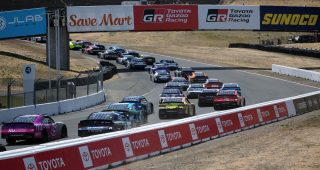
A general view of racing during the NASCAR Cup Series Anduril 250 at Naval Base Coronado on June 21, 2026 in San Diego, California.
The origin story — or, when old school and new school converge, magic happens
The cars purred on the last parade lap. Jacobi — call sign Wookie, because he‘s as hairy as one — stood near the start-finish line with his wife and two kids, waiting, waiting, waiting for the cars to go roaring by as they took the green flag. The noise exploded and so did Jacobi‘s smile. With the cars a blur and Jacobi‘s summer whites sharp, a photographer snapped a family photo whose back story will make the greatest Christmas card update ever.
It‘s a helluva NASCAR story, and a helluva Navy story, too.
Advertisement
Just as Jacobi is a career Navy man and the son of one, so is Ben Kennedy in NASCAR. Indeed, he is as old school as NASCAR gets. The great-grandson of NASCAR founder Bill France and the grandson of Bill France Jr., the man who made NASCAR into a giant, Kennedy is also a former driver who won at famed short tracks Bowman-Gray Stadium and Bristol Motor Speedway.
And yet as old school as he is, he also has led a new-school revolution in the way NASCAR creates its schedule.
And nothing shows that dichotomy like the origin story of this weekend‘s race.
RELATED: How Naval Base Coronado evolved into NASCAR’s newest track
That story starts on an airplane high over central Alabama, just east of Birmingham, in the 1960s. In that plane were France and Rev. Hal Marchman, who gave the invocation at the Daytona 500 for decades. They soared over a vast forest. “I looked down there, and I saw trees,” Marchman later told Ken Martin, director of historical content for NASCAR Studios. “Bill looked down there and saw a race track.”
Advertisement
That vision became Talladega Superspeedway.
In identifying the streets of Chicago and Naval Base Coronado for NASCAR to race on, Kennedy, like his great-grandfather before him, had a vision for speed where nobody else did … though Kennedy used Google Earth instead of an airplane to pick out the locations. He used Google Earth‘s tools to measure the length and width of the streets before hiring iRacing to lay out details of what became the 16-turn track.
“We‘re cheating a little bit,” he joked.
That same old school blending with new school theme applies to the base, too. The Navy started its first aviation squadron here, utilizing planes built by the Wright Brothers. Today some of the most sophisticated flying machines on the planet are based and/or train here.
Advertisement
Wearing sunglasses, a NASCAR baseball hat and comfortable walking shoes because he put miles on his feet every day, Kennedy fit right in among the throng of fans. In a 20-minute walk on Saturday — covering in real life what he first saw digitally — nobody recognized him. All around him the best kind of chaos reigned, with fans bouncing to and fro. It felt like an hour before the Daytona 500, and it was actually four hours before a June O‘Reilly Auto Parts Series race.
According to Kennedy, 67 percent of those fans were attending their first NASCAR race. They were more female (plus 11 percent) and more Hispanic (triple the usual number) than a typical NASCAR race. And they were apparently more willing to spend money. Kennedy said merchandise sales the first day were double what was expected.
As he toured the grounds, he wrestled with the tension between allowing himself to enjoy the energy of the moment and obsessively taking notes about myriad details. “I try to take every opportunity that I can to soak it in,” he says.

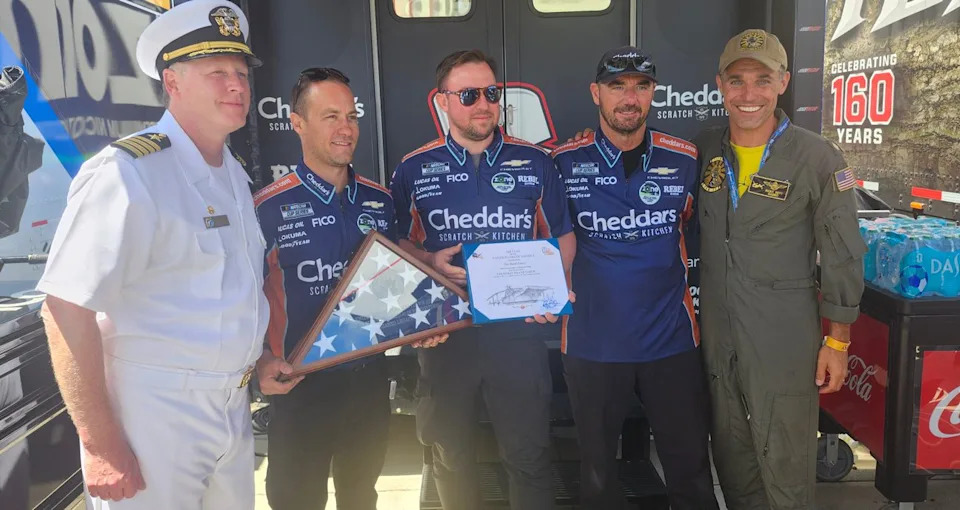
Capt. Kyle Thomas, commanding officer of the Navy Reserve Center on North Island, and Lt. Cmdr. Ricky Hoyt present Austin Hill
The vibe, the osprey, and the heartfelt flag ceremony
There was something to soak in everywhere you looked.
Advertisement
Here was a merchandise tent as full as the fire marshal would allow, with a line 117 people deep snaking across the grounds. There was a woman halfway through that line, dancing in joy even as she waited to get in.
Here was Goodyear Race Event Operations Manager Art Clever and Craftsman Trucks Series team founder Al Niece returning to the base where they were stationed 41 and 58 years ago, respectively. There was Clever, choking up as he visited his decommissioned hangar to sign the wall.
Here was Construction Mechanic 2nd Class Shukema Wilson and CM2 Kevin Neal, winning the pit crew challenge and getting carded for beers a few minutes later. There was a NASCAR fan paying for those beers, because ain‘t no way two sailors would have to buy their own drinks after winning that competition.
“Gimme Three Steps” by Lynyrd Skynyrd blared out of a speaker to the left and “You Give Love a Bad Name” by Bon Jovi rumbled out of a speaker on the right. Fans posed for photos. This exact scene unfolds every week in NASCAR. What was different this time: The Navy parked a CMV-22B, commonly known as an Osprey, right there in the fan area, one of many marvels of modern technology placed in fan areas.
Advertisement
Standing next to the Osprey was Lt. Cmdr. Ricky Hoyt, a lifelong NASCAR fan, former go-kart and motorcycle racer, and Navy aviator for a dozen years, including the last six flying the Osprey, which he calls “mankind‘s closest thing to a transformer” because it takes off like a helicopter and flies like an airplane.
Hoyt, call sign Rabbit because he eats a lot of vegetables and runs fast, engaged fans from his Osprey post all weekend, telling the Navy‘s story just as Jacobi envisioned. “How can you not love this?” Hoyt asked, his bright blue eyes framing a wide smile. “Airplanes and race cars: The two greatest things ever.”
Over the last few weeks, Hoyt watched as the airfield he typically flies out of became a race track. He wasn‘t skeptical, exactly, though he would believe it when he saw it. “I fly here,” he says. “You don‘t race cars here.”
And yet here he was, standing on pit lane, and he couldn‘t believe his eyes … or his nose.
Advertisement
“Smelling rubber and gas here, the smell of NASCAR and racing, that fires you up. On par with the smell of jet exhaust is this stuff right here.”
On Sunday, Hoyt joined Capt. Kyle Thomas, commanding officer of the Navy Reserve Center on North Island, at the hauler of Austin Hill, who took over the No. 8 car after Kyle Busch died of sepsis brought on by pneumonia in May. Each driver had been assigned to a command, and the Navy Reserve Center was Busch‘s.
To honor Busch, Thomas and Hoyt presented to three of Busch‘s crew members a flag that had flown over the USS Makin Island (LHD-8). Its flag was chosen because of the significance of that number as the one Busch drove for Richard Childress Racing.
They did the flag presentation in front of Busch‘s former hauler, where the back door still says 8.
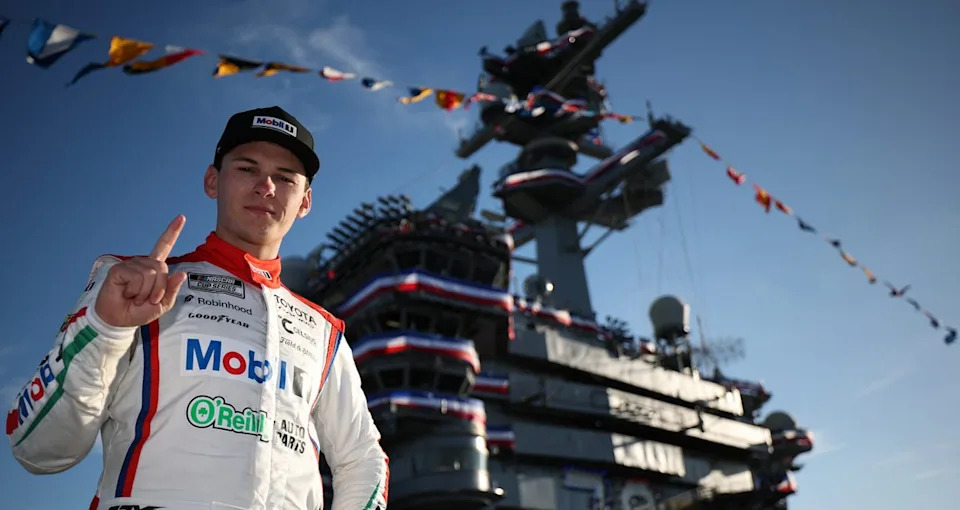
Corey Heim, driver of the No. 67 Mobil 1/O
The kid and the vet who showed him respect
Rookie driver Corey Heim will race full time for 23XI Racing next year, and he‘s considered a can‘t-miss talent. But rookie drivers are not supposed to win, certainly not on custom-built street courses that turn out to be nothing like the simulation their teams created. Heim toured the track on foot Thursday, and he said everything he thought he knew about it turned out to be wrong.
Advertisement
Nothing about the lead-up to this race suggested Heim would visit Victory Lane, especially considering last year he failed to qualify for the Chicago Street Race, which he called one of the worst days of his career. “I‘ve never been a guy who gets it right away,” Heim says. “But when I get it, I get it. When it clicks, it clicks hard.”
And it clicked hard in the closing laps of the Anduril 250.
As he followed in the tracks of his teammate, Tyler Reddick, he wondered why Reddick, a four-time road-course winner and the season points leader, wasn‘t disappearing ahead of him. Is he toying with me? Heim wondered.
RELATED: Heim’s stunning victory captures hearts at Naval Base Coronado
Apparently not. Heim, making just his 13th career start, inched forward, hoping to pressure Reddick into screwing up. He did, and Heim pounced. A back-and-forth battle followed, with Reddick scooching back ahead after he slammed the right side of his car into Heim‘s left side.
Advertisement
It looked like the vet had outmuscled the kid.
Then something amazing happened.
Reddick slammed on the brakes.
He gave the lead back to his teammate.
He didn‘t want to have to tell a story about dumping his teammate for a win.
So instead, Heim gets to tell one about his first win coming in the first NASCAR race ever held on an active military base.
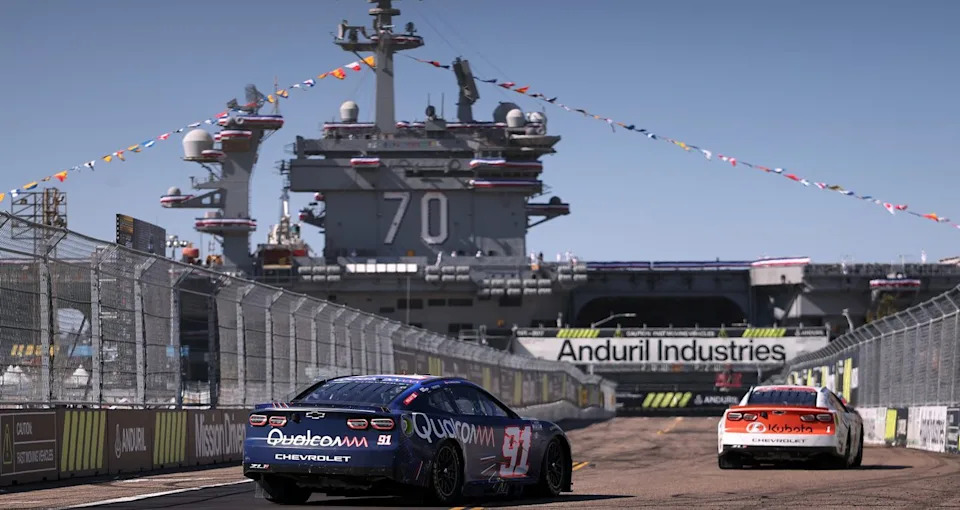
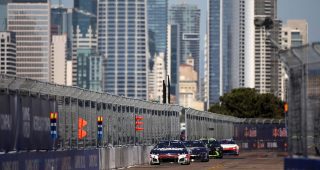
Kevin Magnussen, driver of the No. 91 Qualcomm Chevrolet, drives during the NASCAR Cup Series Anduril 250 at Naval Base Coronado on June 21, 2026 in San Diego, California.
The view, the jump, and men who fly
Pilots are not race car drivers, and race car drivers are not pilots. But it‘s a safe bet both think they can (and secretly desire to) do the other task.
“We‘re pulling from the same pool of people — the same personalities that come into naval aviation are the same personality types that you end up seeing here,” says Jacobi, a former motorcycle racer. “They‘re dedicated to their craft, dedicated to their trade and they‘re willing to make massive sacrifices in order to get there. You take a pilot and put him in a car, and they could follow that same career path.”
Advertisement
The drivers got a taste for flying all weekend, as the cars went airborne coming out of Turn 1. “It‘s bump, bump, bump,” says driver Zane Smith, “and then you‘re floating.”
The subsequent landing (and other bumps throughout the course) led Chase Briscoe to say it felt like his brain smashed into his spine. After the jump, drivers had just enough time to catch their breath before they mashed the brakes and turned left at Turn 2 … at which point they entered the story both Kennedy and Jacobi delighted to tell — racing right at an aircraft carrier.
Who doesn‘t want to hear about that?
MORE: Photos of the track build at Naval Base Coronado
At slow speed the view was incredible, as the gray and muscular ship dominated your attention. Where else would you look? At high speed, a few drivers noticed the same details as Kennedy — the open bay, the 70, people on the deck.
Advertisement
Others were so focused on hitting their marks that they barely noticed the ship.
Jimmie Johnson saw a window into his past.
He grew up in nearby El Cajon, and when he was a boy, he walked the shores of San Diego Bay with his grandfather, Floyd “Gene” Dunnill, who told the future seven-time champion stories of his days as a Navy captain in the Korean War, during which he worked as a safety officer on an aircraft carrier much like the Vinson.
The future will tell a new story
Just as Hoyt watched the track come together in steps, so, too, has Kennedy‘s willingness to change the schedule been a progression. It started with existing facilities (Road America, Nashville and Circuit of The Americas). It progressed to holding a race inside an existing facility that wasn‘t a race track (Los Angeles Coliseum). The next step was a street course in Chicago, and now a street course on an active military base.
Advertisement
What‘s next? Kennedy was non-committal when asked if NASCAR would return to Coronado. The early returns were mostly positive. It appears the only thing holding up a decision is the same thing that made this such a shock when it was announced in the first place: it‘s a ton of work and a big disruption to hold a race on an active military base.
All three races were slowed by red flags. Traffic remains a thorny issue, as getting thousands of cars onto and off an island will always be difficult. Food and merchandise stands drew long lines all weekend; that‘s “a good problem to have,” as Kennedy put it, and it‘s also the kind of detail that he made notes about all weekend.
Whether the sport returns to Coronado or not, Kennedy will continue to seek out new places to race. His Google Earth search history shows he‘s been looking at the Northeast, the Pacific Northwest and the Denver area. If he‘s close to deciding on any of those, he won‘t say yet. But no idea is too far out there to consider.
“I don‘t think I‘ve heard an idea that‘s crazy enough yet,” he said. “I‘m still waiting to hear it. These are the types of events that create storylines.”
Read the full article here