





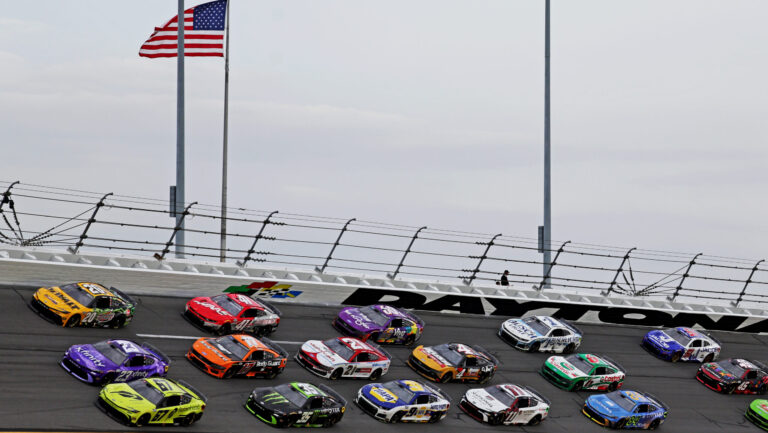
For years, superspeedway racing has delivered some of NASCAR’s most memorable finishes. It has also drawn one of the sport’s most persistent criticisms.
Many fans and drivers have questioned races that become dominated by fuel-saving strategy and track position, leaving competitors with few opportunities to make meaningful passes until the closing laps.
Advertisement
With the regular-season finale at Daytona International Speedway approaching, NASCAR believes it has a solution worth testing.
On Wednesday, the sanctioning body announced a revised superspeedway competition package that will debut at the Coke Zero Sugar 400 on Aug. 29. Rather than simply adjusting technical specifications, NASCAR hopes the changes will produce more side-by-side racing and encourage drivers to stay on the offensive throughout an event.
NASCAR wants drivers racing instead of saving fuel
The revised package centers around two major changes.
NASCAR will reduce the rear spoiler from seven inches to four inches while lowering horsepower from 510 to 465. Officials anticipate single-car speeds will increase by roughly 3 mph, while pack speeds should remain largely unchanged.
Advertisement
The objective isn’t to make the cars dramatically faster.
Instead, NASCAR hopes the revised package will create more opportunities for drivers to build momentum, pull out of line and complete passes rather than spending long stretches conserving fuel and maintaining track position.
Three-time Daytona 500 winner Denny Hamlin, who served on the working group that helped develop the package, said NASCAR’s vision is rooted in another track entirely.
“What we’re essentially trying to recreate is Atlanta at Daytona and Talladega,” Hamlin explained during an appearance on Inside the Race.
He pointed to Atlanta’s current style of racing, where drivers are forced to attack throughout a run instead of spending much of it saving fuel.
Advertisement
“It happens organically at Atlanta, the space between the cars, because the cars themselves are grip-limited, and the fuel-mileage (racing) really doesn’t happen because you have to be on offense constantly. If you watch the pack, there is no saving. Guys are dicing it up the entire race.”
Hamlin believes NASCAR’s simulation data suggests the package represents a significant step forward.
“From the numbers that I’ve seen, it’s going to be roughly a 33% gain in the right direction.”
NASCAR believes the revised package can reward aggressive racing
Former championship-winning crew chief Steve Letarte, another member of the working group, said the current superspeedway package often leaves drivers with nowhere to go once they catch the leader.
Advertisement
“When I watch superspeedway racing currently, it seems like the leader is basically at terminal velocity. It’s very easy to get a run on the leader and very hard to do anything with it.”
According to Letarte, reducing the spoiler should make it easier for trailing cars to build runs and complete passes instead of becoming trapped in line.
Hamlin also argued the revised package could lessen the emphasis on fuel-mileage strategy that has shaped many recent superspeedway races.
“I can tell you from the driver’s seat what happens for us is that we spend the entire race fuel-mileage saving all for that last pit stop. We basically know you have to be in the top four inside that last fuel window, unless there’s a big wreck, to have a shot at winning.”
Advertisement
Because the Coke Zero Sugar 400 serves as the final race before the Cup Series playoffs begin, Daytona provides NASCAR with a high-profile opportunity to evaluate whether the revised package delivers the style of racing officials are targeting.
If it succeeds, the changes could help address one of the most frequently discussed aspects of modern superspeedway racing while shaping how NASCAR approaches Daytona and Talladega in the future.
Read the full article here