





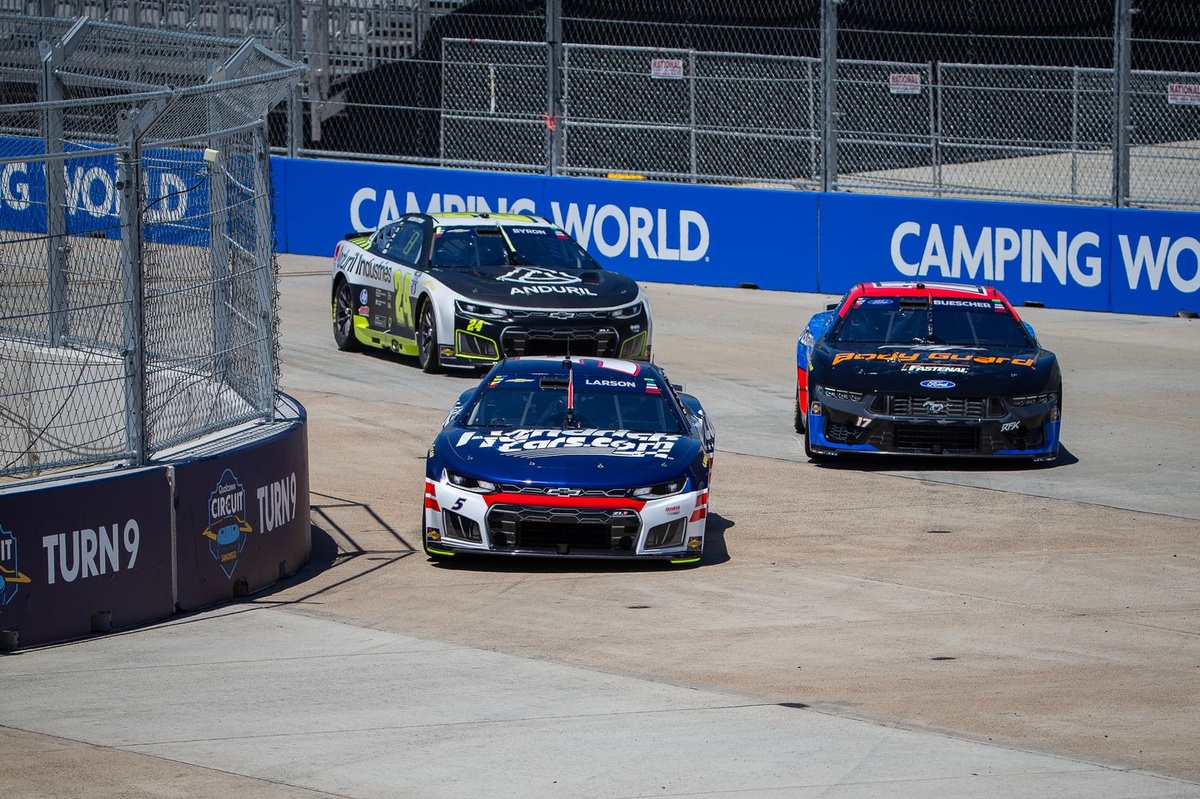
NASCAR enthusiasts are familiar with what happens to tires at Bristol when the ambient temperature drops below 60 degrees — the tires get chewed-up and it becomes a beach of marbles on both sides of the racing surface.
As it turns out, the same thing is happening this weekend at Naval Air Station North Island, as better articulated by Chase Briscoe.
Advertisement
“It’s as if Darlington and old Atlanta had a kid.”
Ricky Stenhouse Jr. agreed with the Bristol comparison.
“I think so,” Stenhouse said. “I think so because there are a lot of new concrete sections, and if you look at those sections, it’s a lot like Bristol when it doesn’t take rubber. There are a lot of marbles there, and you have to be careful when you drive through there, and we’ve made a lot of adjustments to take care of our rear tires better.
Advertisement
“I don’t know that we did enough, or took grip away from our car as a result, and I don’t know if getting two or three more laps out of a set of tires does any good or not. We need to go at least 10 (laps) in that first stage, and I don’t even know what this means for trying to flip the stage, because some did in the Truck Series race with no issue. It’s going to be crazy to see how this plays out.”
And that’s exactly it.
No one really knows what to expect because the track could start to take rubber after the O’Reilly Series race on Saturday. The expected dynamic could change now that engineers have had 24 hours to optimize their set-ups.
Advertisement
One thing about the NASCAR Cup Series garage is that everyone tends to end up at the same place from very different starting points.
Ross Chastain said, even without any set-up changes, he’s optimized his lap just through trial and error.
“I know where I need to do a better job,” Chastain said.
He also said this tire, the same one used at the Charlotte Motor Speedway ROVAL, is reacting the same way this weekend at the base so that’s only going to help said optimization.
Advertisement
But still, teams are going to go through tires on Sunday, which is why NASCAR gave them an extra set of tires. All told, teams will have six sticker sets and one set of qualifying scuffs for the race on Sunday.
Austin Cindric said he was showing cords six laps into the race.
“But at the same time, six laps is 21 miles, and it is a fresh surface and I think these O’Reilly Series cars are going to lay down a lot of rubber, and even talking to the Truck Series guys, they didn’t have the fall off in the race they expected.”
Advertisement
So, who knows.
“We’ve seen this happen with these tires too, at the ROVAL, where it does lay down rubber eventually but early on, it is a marble beach everywhere. If you get off line, it’s going to be sketchy.”
And when the tires marble, that also narrows the race track, because driving on the marbles eliminates the grip capacity going into a corner. AJ Allmendinger, who has experienced this in Indy cars and Stock Cars, says this is the appeal of street racing.
Advertisement
“It’s narrow, fast and slick in a few places, but from a Cup Series standpoint, we’re the best of the best and that’s why you didn’t see as many crashes in our practice compared to the other two series,” Allmendinger said. “We were all prepared for it after watching them turn laps.”
Stenhouse echoed a sentiment made by several drivers on Friday that the marbles actually gave drivers a cheat sheet for the fastest line around the race track, but it gets sketchy once they drive over the granulated rubber.
“There are a handful of areas on the track where can’t see the marbles, so when you open up your entry, you stick half a tire patch over the marbles and now you feel like you have a flat,” Stenhouse said. “It’s like IndyCar street course racing where it makes passing difficult.
Advertisement
“NASCAR does a really good job of cleaning that rubber off and we do a really good job behind the wheel, when we’re riding around, to hit it a little bit and pick it up, just so it gives us a little bit more racing room.
“Starting double file will help and if we stay double file, that will keep the track wider than it will be once we go single file and start shredding the tires.”
To read more Motorsport.com articles visit our website.
Read the full article here