





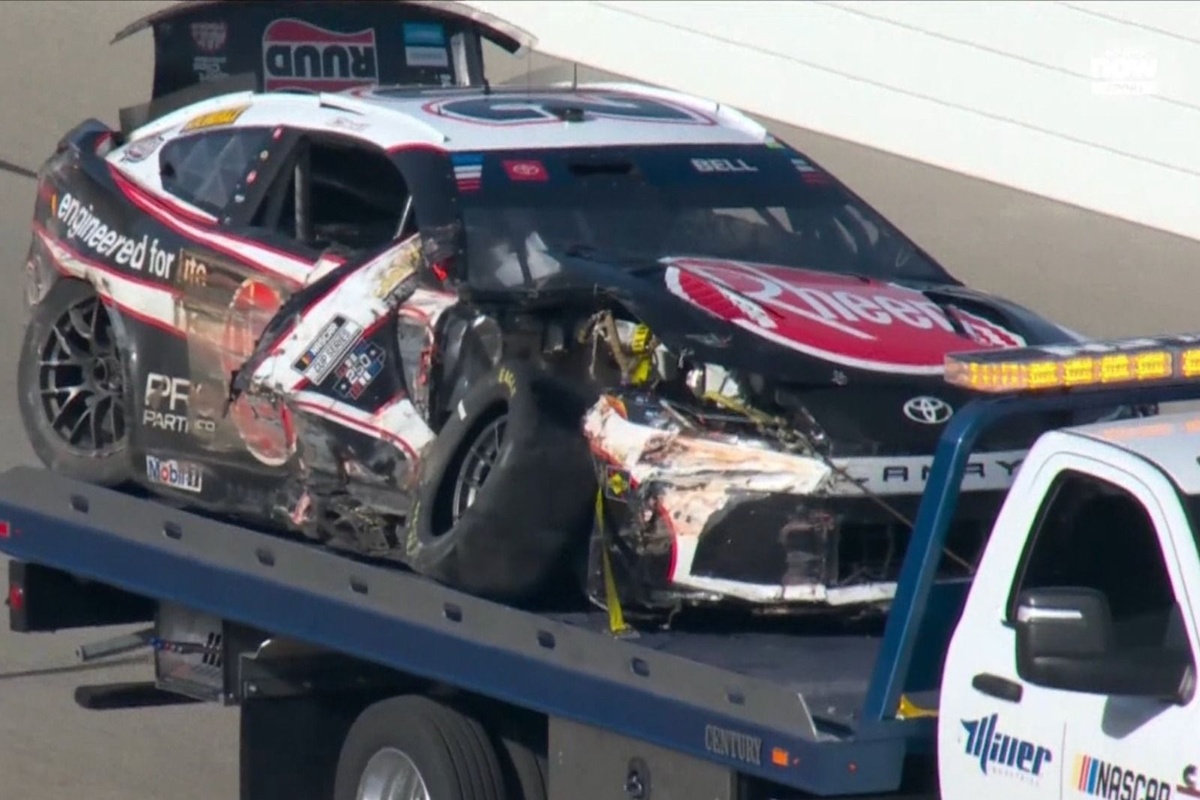
Christopher Bell endured the hardest impact in the four-plus-year history of the NextGen car during his crash on Lap 148 of the NASCAR Cup Series at Michigan International Speedway.
The incident transpired when Chase Elliott broke traction over a bump in Turn 3 and slid up into Bell while racing for second. The contact shot Bell into the wall, that impact resulting in a 21-minute SAFER Barrier repair, but also a secondary shot when Elliott came back up the track into the left side of Bell’s car.
Advertisement
On the latest episode of the official NASCAR Hauler Talk podcast, communications executive Mike Forde revealed that Bell’s impact was the worst since this car debuted in 2022, but also the worst dating back to 2015 when Matt Harper, NASCAR’s managing director of safety systems, joined the company and collected data using his methodologies.
This crash was measured in Delta-v, which measures a change in velocity.
“Delta-v is the measure of speed lost in an incident,” Forde said. “So if you’re going 200 mph and then all of a sudden you come to a stop because you hit a wall and scrub off X amount of speed, that difference is what the Delta-v is. I can’t give out the Delta-v number for Bell. That data is proprietary in a way. We share that with the team and the driver, and that’s their data to do with what they want. But we can confirm that it was the largest number we’ve seen in the Next Gen era.”
Advertisement
So how is Delta-v different than impact in GS? Forde asked both Harper and vice president of safety engineering John Patalak for an explanation.
Patalak: Well, it’s complicated but … a G is a unit of acceleration. You’re better talking about acceleration than G. Acceleration is how fast the velocity of something changes. You can come off a stop sign on I-85 in five seconds and have a peak of five G and a Delta-v, which is a change of velocity, of 60 miles per hour. Or, you can hit a wall and go from 60 to 0 in .1 second and a peak at 50 G. The Delta-v is the same. Both measures matter. The reason acceleration matters is mass x acceleration equals force.
Harper: We also usually call out the peak G. That is not a constant load through the crash, just the highest value. Which is also important because if you talk about peak G, that number may seem massive, but when you’re talking about injury potential, it’s the length of time you are at a high G level.
Advertisement
Patalak: You could also have a really large peak G but without a descent Delta-v, it isn’t injurious or interesting.
Read Also:
NASCAR halts Michigan race to repair wall after vicious Elliott, Bell crash
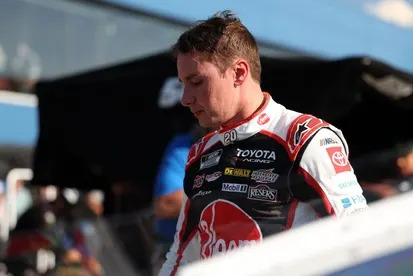
Christopher Bell diagnosed with left wrist fracture but cleared to race
Also, NASCAR has disclosed to Joe Gibbs Racing what those numbers were, both the Gs and the Delta-v, but it is up to the team and Bell to disclose that publicly. The Sanctioning Body also visited the JGR shop at 9 a.m. on Monday morning to complete a safety review of the car.
Advertisement
NASCAR also did an immediate walk through of the car immediately after the crash, but also the SAFER Barrier before repairing it.
Bell suffered a fracture of his left wrist, and also undisclosed ankle injuries, but has been cleared to compete this weekend at Pocono Raceway by his doctor.
“He needed to have a follow-up visit with his physicians,” Forde said. “Once we got the clearance from them, we would then clear him to race … and he has received that clearance. …
Advertisement
“How that works is Christopher will see his personal physicians, that physician will work with our medical team to clear him so that clearance does come from his doctors and they have to be board certified, so on and so forth, the right credentials. They work with us and say ‘we examined him and we feel comfortable he can be in the race car’ and once we get the clearance from them, we give him the clearance.”
Harper conducted the Monday morning safety review at JGR.
“A big priority is being put around the head surround foam,” Forde said. “We keep updating this part of the rule book as we learn more and more. The thickness of the head surround is so important. And because we were pleased with how the head surround supported Christopher in this incident, we did a lot of measurements of the type of foam he used, the softness and the thickness. We want to see, ‘Hey, is this sort of the magic number? Is this something that other drivers may want to look at? Because this was the biggest hit we’ve ever seen in the Next Gen era, and by and large, Christopher came out of it pretty well. So that’s one of the things we’ll be studying as we move forward.”
Advertisement
Chase Brashears, NASCAR director of track services, also appeared on the podcast to discuss the immediate safety protocols.
Read Also:
This is Denny Hamlin’s final form
Winners and losers from a destructive NASCAR Cup race at Michigan
To read more Motorsport.com articles visit our website.
Read the full article here