




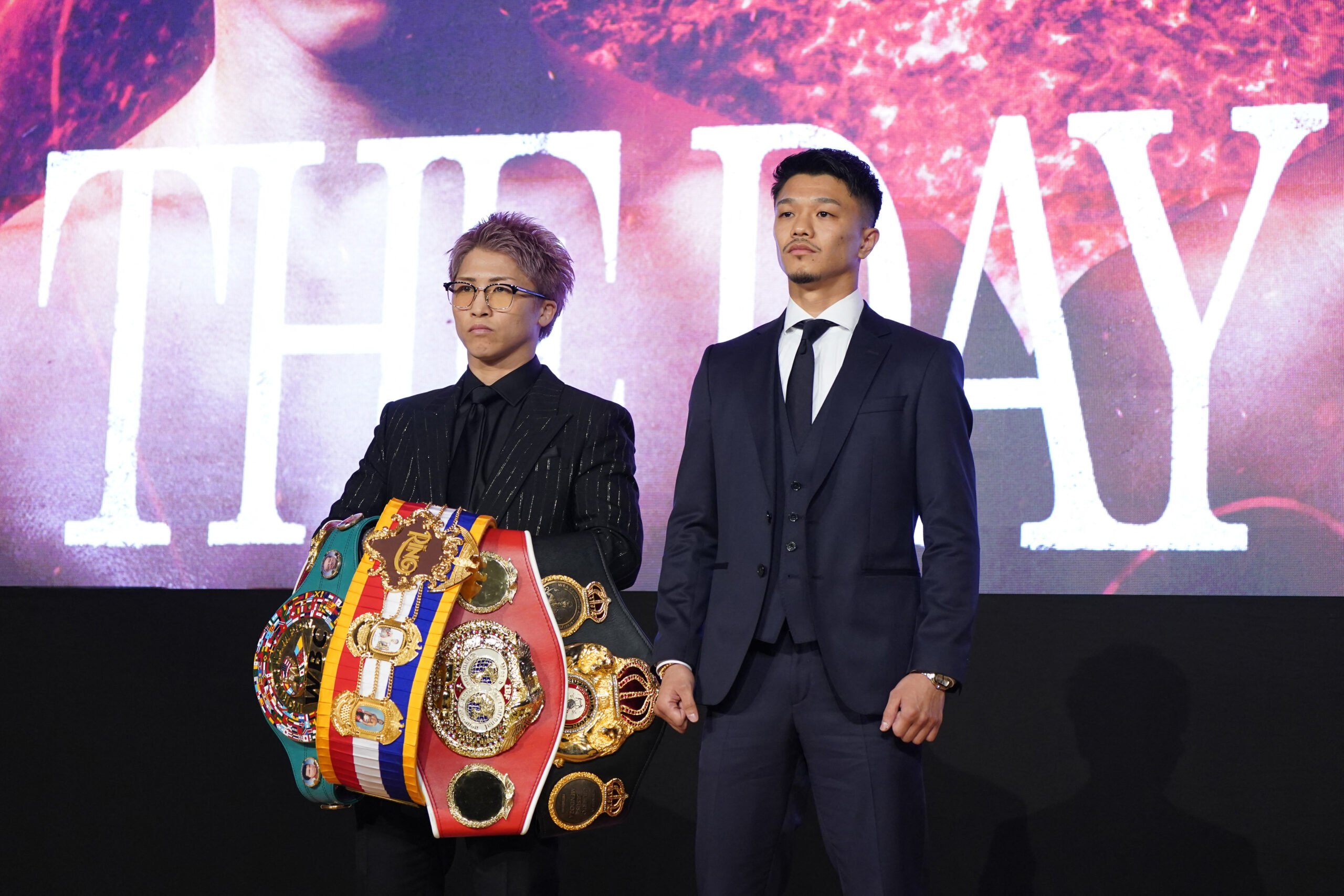
Naoya Inoue went through Mexicans, Americans, a Frenchman, two Englishmen, a Dominican, a Puerto Rican, more than one Filipino, an Australian, a Thai, an Irishman, a Korean and an Uzbek, only to realize that it was right there in front of him all along.
It’s funny. For all the benefits of taking the scenic route, Inoue’s true test waited for him at home, just next door. It came not from an export or visitor, this test, but in the form of someone with whom Inoue was familiar and whose language was the same as his own. It came in the form of a compatriot: Junto Nakatani.
Nakatani, who fights Inoue on Saturday for boxing’s undisputed super bantamweight championship, will be the first Japanese fighter Inoue has faced for almost a decade. Kohei Kono, a super flyweight, was the last man from Japan to have the questionable privilege of fighting Inoue and he was stopped in the sixth round of a WBO super flyweight title defense in late 2016. Since then, fueled by a desire to prove his greatness, Inoue has embarked on what can only be described as a world tour, taking on the best contenders and champions the world’s various other territories have had to offer. Sometimes he has had to travel to fight these opponents — trips to the U.S. and Saudi Arabia, for instance — but for the most part, such is Inoue’s power, he has been able to entice many of his opponents to his house, often fighting them in Tokyo.
That is where Inoue and Nakatani will meet this weekend — the Tokyo Dome, to be exact — and it seems quite incredible that it has taken so long for Japan to get this kind of Inoue fight: A domestic dispute, a turf war. It is one thing to see him beat up foreigners on home soil to a soundtrack of polite, deferential applause, yet it is another thing entirely to entertain the prospect of Inoue fighting a countryman in arguably the standout fight of the year. In that respect, this “Made in Japan” product is not only a testament to Inoue’s staying power, and indeed pulling power, but it also reflects well on Nakatani, who, unlike Kono in 2016, brings just as much to Saturday’s fight as Inoue.
Until now there has always been a sense with Inoue that his opponents are dragged to him under duress. The ones aware of his brilliance come kicking and screaming, while the rest, those aided by hubris or delusion, only grasp the magnitude of the task once they are in the ring with the “Monster” and it is too late. Either way, the experience is invariably an uncomfortable one. At no point during it are they ever made to feel as though they are at home or even that they belong. That is simply the power of Inoue, you see — particularly in Japan, his fortress. There, at home, he can dictate both how a fight unfolds and how those involved in said fight behave, doing so with all the poise and power of a principal conductor. He can, by using just his hands, control the volume of the noise around the ring as well as the movements of the opponent inside it. In fact, by the time the opponent comes to understand that they are under his control, or spell, much of the hard work is already done.
When Paul Butler, the Englishman, challenged Inoue in 2022, he got to experience this sensation firsthand. If, in the end, he was to be found out of his element during the fight itself, Inoue and his team were seemingly intent on making Butler feel that way beforehand, too.
“They really looked after us at first,” he recalled. “They sorted out our hotels, our food, anything we wanted, and then on fight day — bang! Totally different. I was like, ‘Who are these people? We’ve been dealing with them all week and they were fine. What have they turned into?’
“It sort of flipped on its head. They were coming into the changing room and saying, ‘You’re going out in five minutes,’ and I hadn’t even got my gloves on yet. We were just like, ‘No, that’s not happening. You can’t fight without us. Get out and leave us alone.’
“Then, when I was putting my gloves on, they made me un-tape because they wanted to cut off a little drawstring on the gloves. To start with I couldn’t even get my hands in the gloves, so we put some Vaseline on my wraps to help them slide in a little bit. But they went ballistic when they saw that. They thought I was putting some sort of agent on my hands. I said, ‘Look, it’s just Vaseline. It’s just to get my hand in the glove.’ They then went and got some official in and we had to explain it all to them as well.”

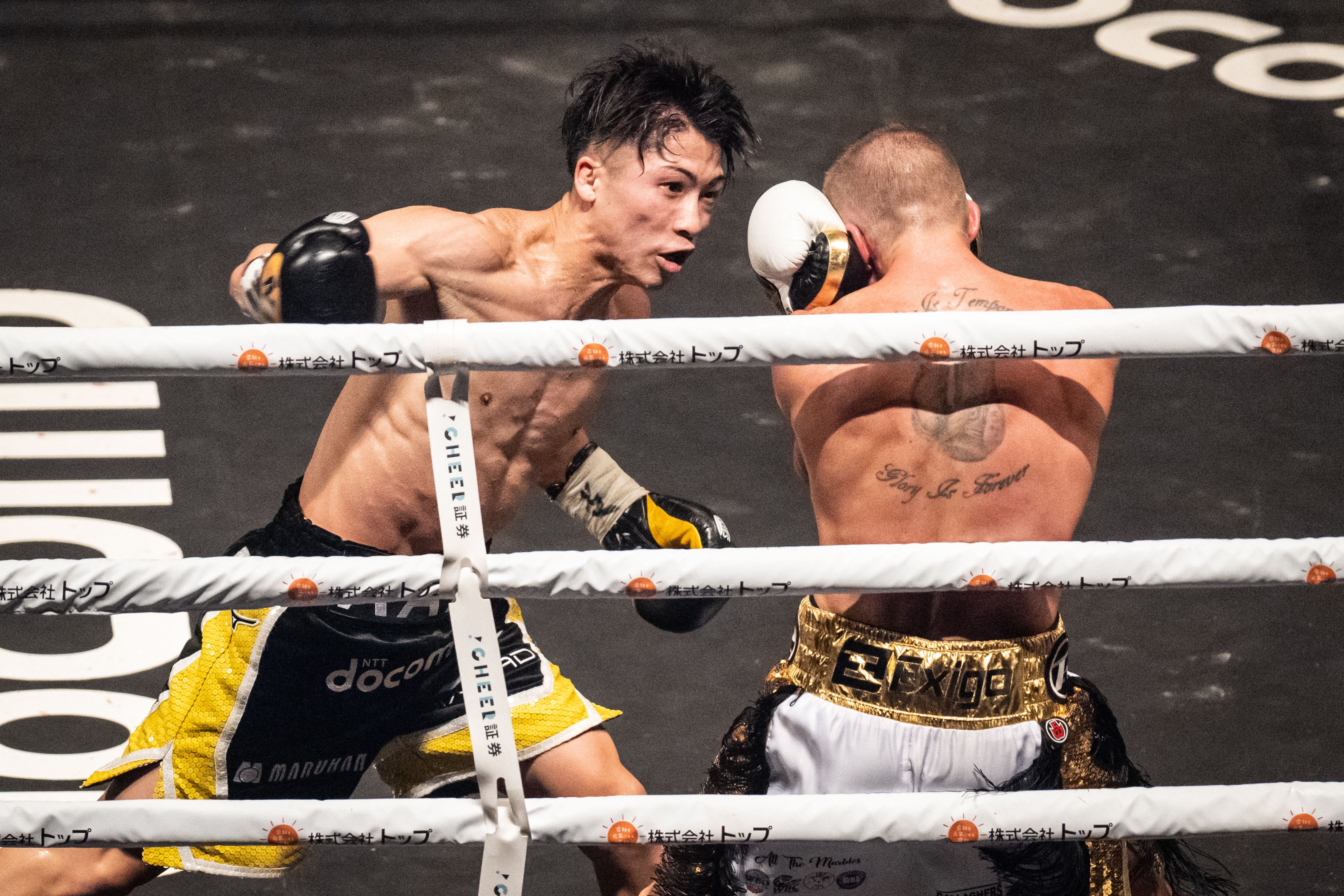
To hear Butler recall his time in Japan, one would be forgiven for thinking there was something manipulative or sinister about the way Inoue treated his guest that week. However, knowing what we know of champions, it is far more likely that Butler’s account is one shared by most who have challenged Inoue over the years — therefore nothing personal — and that he was merely the latest foreign opponent to be fed through a well-oiled machine.
Rather than personal or cruel, it is perhaps just a matter of control, as most things in boxing tend to be. Truth is, control is a byproduct of power, and few in the sport are as powerful as Naoya Inoue right now. Quite aside from the power he demonstrates in the ring — where he has ended 27 of his 32 wins by knockout — Inoue has, by winning world titles in four different weight classes, ensured that he wields a considerable amount of power at the negotiating table as well. What that means, in essence, is that he gets most things on his terms. He gets the opponents he wants when and where he wants them, and then, once they land on his plate, he gets to control them however he sees fit.
Most champions, if granted the same luxury, would act exactly the same way. They too would bring opponents to them rather than run the risk of exploring unfamiliar territories and cultures, and they too would make it patently clear to the visitor, when they arrive, that the away corner is called the away corner for a reason. In that corner you will stand. In that corner you will obey. In that corner you will fall, fade away.
Time and time again we have seen this happen to opponents of Inoue over the years, almost to the point that the faces and names become immaterial. To a man, they show up, say the same things, and go the same way. We know them only by their nationality and where they now stand, or sit, in the long unbeaten record of the diminutive champion who cut them down to size.
Machine-like, but never boring, the only concern with Inoue was that he would one day run out of opponents on whom to feast and that this could lead to desperation, then his downfall. In short, we questioned whether in the name of creating his legacy he might advance through too many weight classes and find that the inability to source severe enough challenges would result in him losing to an opponent who wasn’t better than him, no, but was instead just bigger.
“I’ve always said that the only thing that will beat Inoue is what beat [Vasiliy] Lomachenko in the end: Size,” said Butler. “I know Lomachenko got beat in his second fight [against Orlando Salido], but that was probably just inexperience — and arguably he won that fight as well. Eventually, though, it was size that got to him. He just went up the weights too much. That plays a big part. The opponent doesn’t really feel your power anymore; they can manhandle you up close.
“I think Inoue can do well at featherweight but I wouldn’t go any higher than that. He’s not daft, Inoue. That’s why he’s sitting at super bantamweight for now. He’s going to have a look around and see what opportunities are there for him.”
They really looked after us at first. They sorted out our hotels, our food, anything we wanted, and then on fight day — bang! Totally different. I was like, ‘Who are these people? We’ve been dealing with them all week and they were fine. What have they turned into?’Paul Butler on the experience of fighting Naoya Inoue in Japan
Inoue has been a super bantamweight for nearly three years now, ever since beating Stephen Fulton to take the WBC and WBO belts in mid-2023. In that time there has always been a feeling that he is, as Butler says, having a look around, biding his time, and seeing what opportunities are out there for him. That is fine to a point, and surely his right, yet there remains a feeling, a growing one, that the longer Inoue waits, the more chance there is that he perhaps overstays his welcome or discovers his motivation starting to wane when he needs it most. Of this we have already seen shreds of evidence, notably against Luis Nery and Ramon Cardenas, both of whom managed to drop Inoue. They still ultimately lost, of course, but those brief moments of success were so alien to us, as observers, that we wondered if Inoue, at age 33, has been in search of his defining fight for so long that he leaves himself now vulnerable to being defined by a shock upset when looking the other way.
Which is why, for Inoue, Saturday’s date with Junto Nakatani comes at precisely the right time. It comes off the back of a year in which Inoue boxed on four occasions and in three different locations — Japan, America and Saudi Arabia — and it possesses everything those four outings in 2025 lacked. Whereas fights with the likes of Ye Joon Kim, Ramon Cardenas, Murodjon Akhmadaliev and David Picasso were all lowkey and quite easy to ignore, there will be no escaping Inoue’s fight with Nakatani this weekend. For the people of Japan, it is the biggest fight they will have witnessed on home soil for decades, while for Inoue, the proximity of it, combined with the danger of it, means it has become the most significant fight of his 14-year professional career.
He won’t thank Nakatani for that yet, but in time he might. In time he might come to accept how beating foreigners at home is all well and good, as far as racking up numbers and building a reputation, but that nothing can compare to the feeling of having control of a country and its people. Beat Nakatani on Saturday and that is what Inoue will feel — in abundance. He will hear it in the gentle applause of the locals around the ring and he will hear it in the voice of his opponent, for once speaking a language Inoue can understand.

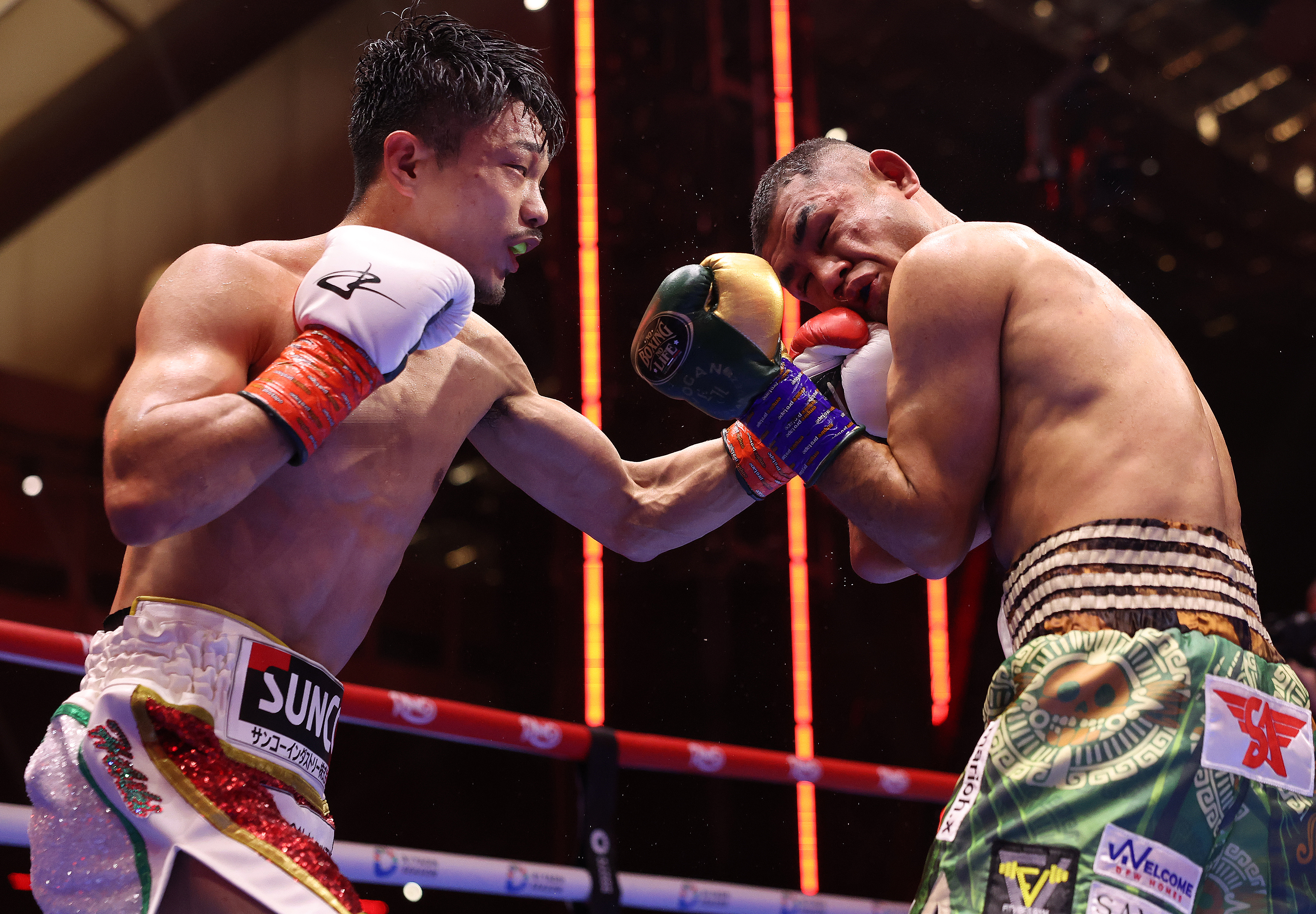
As for Nakatani, 32-0 (24 KOs), his motivation will be similar. Because impressive though it is to win world titles as a flyweight, super flyweight and bantamweight, which he has done, what Nakatani really needs at this point, having just turned 28, is a major, defining fight. That is why he has chosen to make the jump to super bantamweight, where Inoue currently resides, and why to get what he needs he has, in turn, given Inoue what he needs.
Some will suggest that Inoue has boxed clever in getting a rival to move in next door — on his street — and that Nakatani’s super bantamweight debut, a lackluster showing against Sebastian Hernandez in December, is tangible proof of this. Yet to think like that is to ignore the fact that Nakatani is, at 5-foot-8, three inches taller than Inoue and was therefore forever on borrowed time as a bantamweight. This move, regardless of what awaits him at super-bantamweight, was always on the cards for Nakatani given both his dimensions and dominance at the weight below.
Besides, all that Nakatani has decided to do is follow a path already paved by Inoue. He wants to be tested now, clearly, and he knows that to get the best out of himself he must be creative, embrace discomfort, and sacrifice a little to gain a lot. This is something not unfamiliar to Inoue, another former flyweight whose journey through the weights owes more to ambition and the scarcity of rivals than simple growing pains.
For that reason, one can’t help but believe they are meant to be together, these two. It may have taken a while to get there, but they got there and they found each other. Above all, they found just what they need; what they have both been looking for. Even if, on paper, they might appear dangerous and wrong for each other, it is precisely that — their incompatibility as “friends” — which, in a ring, makes Naoya Inoue and Junto Nakatani a match made in heaven.
Read the full article here


