





My All-Time Historical Chicago Bears team is full of players with accolades galore, but they are also built around a tough style of play that to me defines the history of the Chicago Bears. This in-your-face ethic is to me an essential part of the team’s legacy, and so I present the Bear Essentials.
-
By now, you all know the basic rules of our All-Bears Historical Fantasy Draft. We each picked a team consisting of 25 players. We got 11 picks on offense, 11 picks on defense, and three picks on special teams.
-
The offensive picks require a full offensive line, a quarterback, a running back, two wide receivers, and a tight end. The 11th pick on offense could go to any skill position of the team’s choosing.
-
Given the Bears’ historical preference for a 4-3 base defense over a 3-4, we required two defensive ends, two defensive tackles, two linebackers, two cornerbacks, and two safeties. The 11th pick could be used at any position of the team’s choosing, whether it be a nickel defender, a third linebacker, or an extra defensive lineman.
-
For the special teams picks, we were asked to take one kicker, one punter, and one miscellaneous contributor (returner, coverage defender, long snapper).
-
Each player’s skill level will be transported to the modern age. For example, a Hall of Fame offensive lineman from the 1940s, while smaller than the modern o-lineman, will still be a Hall of Famer.
-
We also only get the player’s ability as it was when he played in Chicago. For example, Jason Peters made 9 Pro Bowls from 2007-2016 while in Philly, and if he were drafted in this exercise, the drafter would only get his abilities in 2021 as a 39-year-old Bear.
THE OFFENSE
(QB) Johnny Lujack (Round 14) It’s been a long time since Chicago had a quarterback who led the league in completions, attempts, and passing yards–but that’s exactly what Lujack did in 1949. The only year he wasn’t above the league average passer rating was in 1950, which coincidentally was his first Pro Bowl year (of two) and the year he was a first-team All-Pro. It’s also the year he led the league in rushing touchdowns (11 over 12 starts). He spent two of his four seasons with one of the top five passer ratings in the league, and he was in the top ten of most passing categories for at least have of his career, if not more.
Advertisement
(LT) Ed Kolman (Round 11) The only member of my offensive line who was never a first-team All-Pro, Kolman nonetheless earned three Pro Bowls for Chicago while serving as the left tackle for three championship appearances and two wins, including the famed 73-0 defeat of Washington. He then had another 4 starts on the next championship team (1946), with his time with the Bears interrupted by his service during World War 2.
(LG) Dick Barwegen (Round 10) Barwegen served as Chicago’s left guard for three years, earning Pro Bowl honors every year and first-team All-Pro honors in every year but one.
(C) Larry Strickland (Round 12) Serving with the Bears for all six years of his career, Strickland made the Pro Bowl twice, first-team All-Pro once, and second-team All-Pro another time.
(RG) George Musso (Round 7) This Hall of Famer captained the Bears when he was serving on an offensive line with Clyde “Bulldog” Turner, and he made it to seven championship games with Chicago, winning four. The “Moose” was also able to play right tackle, but it was at right guard that he earned his first-team All Pro nod and his three Pro Bowls.
Advertisement
(RT) Lee Artoe (Round 13) Another player from the championship runs in the 40s, Artoe was three times a Pro Bowler, once a first-team All-Pro, once a second-team All-Pro, and one of the two Bears on my team who also served in World War 2 as part of the Navy’s Underwater Demolitions Team, the precursor to the modern-day Navy Seals.
(TE) Hampton Pool (Round 20) Pool played for Chicago for four years, and his position was then considered to be that of a hybrid between “Receiving End” and “Fullback”, but he played tight end in all but name. He was in the Top 10 in receiving yards, receiving touchdowns, and rushing touchdowns for the league during two of his four years with Chicago, and when he left the Windy City it was to become the second member of the Bears who became a member of the Underwater Demolitions Team.
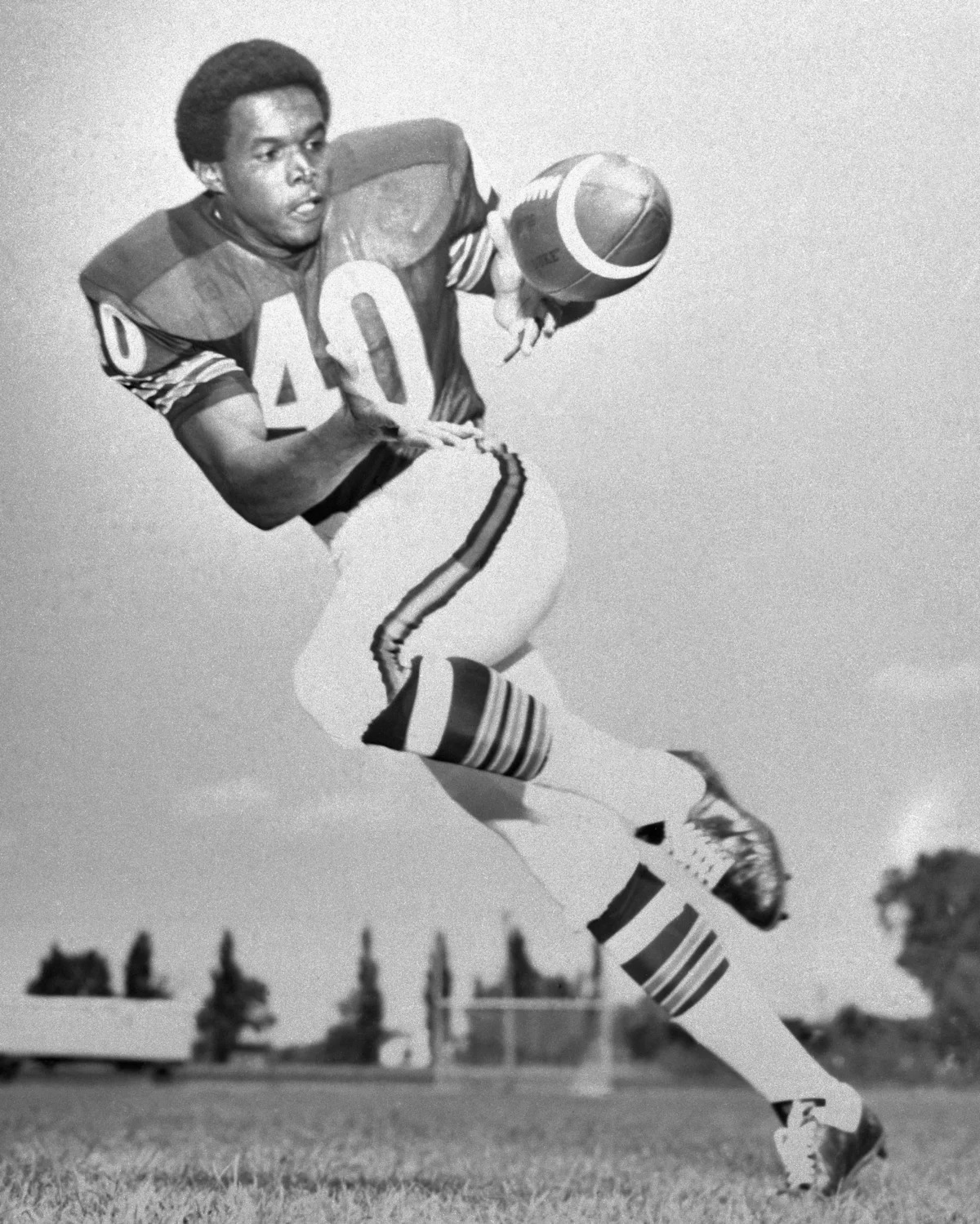
(RB) Gale Sayers (Round 1) Hall of Famer, five-time first-team All Pro, and generally the second-best running back in Bears history.
(WR) Bill Hewitt (Round 4) How dominant was Hewitt during his five years in Chicago? He was three times a first-team All-Pro and a second-team All-Pro another year. If it was a receiving stat, he was on the Top Ten leaderboard for the league at least two years during his time “out wide”, or at the End as the position was called in his era. He was Top Three even in receiving yards and receiving touchdowns twice in his career.
Advertisement
(WR) Luther Burden (Round 16) The only member of my starting offense with neither Pro Bowl nor first-team All-Pro credentials, the kid still has talent to spare, and I see potential in him.
(OFF UTIL) Bill Osmanski (Round 21) Osmanski will be comfortable playing with this offensive line, as many of them were with him for the majority of his four runs as a national champion, and while he actually led the league in rushing yards during his first-team All-Pro year, he was generally more of a fullback for his three Pro Bowl nods and four seasons in the top ten for rushing touchdowns.
Summary: Built around trench dominance, this offense is going to be able to move the ball. The offensive line is elite and the number of scoring options both on the ground and in the air are going to be overwhelming.
Advertisement
THE DEFENSE
(DE) Ed Sprinkle (Round 5) Sprinkle provides a golden jacket to anchor my defensive line, Sprinkle was a terror to quarterbacks, with Halas calling him the greatest pass-rusher he had ever seen. In his career with Chicago, “the Claw” earned rour Pro Bowls and three second-team All-Pros.
(DT) Link Lyman (Round 8) Another Hall of Famer on my defensive line, Lyman pioneered shifting on defense, aligning himself to cause the most disruption, and the 2-time first-team All Pro was known for how readily he diagnosed offensive plays–helping the Bears win four NFL championships.
(DT) Henry Melton (Round 19) Although he only earned a single Pro Bowl nod with Chicago, Melton was a steady enough presence to provide a stiff defense–especially with who is playing next to him on the interior of the line.
Advertisement
(DE) Austin Booker (Round 23) One of the few modern-era players I accepted on my team, Booker offers absolute speed off the edge and is flexible enough to drop back should I want a third linebacker.
(DEF UTIL) Corey Wootton (Round 22) Wootton belongs on a team of historical Bears, and if I need to explain why then I’m not sure I want you voting for my team anyway. However, with his presence I am obviously going five-wide on my base defense–this team is going to bring the heat at the line of scrimmage.
(LB) George Connor (Round 6) Halas said that they always set high expectations for Connor and that he still exceeded them, and the four-time first-team All Pro (with two second-teams thrown in) was a defensive tackle who stood up to provide greater leverage against the run game. This Hall of Famer paved the way for the man who will be playing next to him.
(LB) Bill George (Round 3) Of course, one reason I feel comfortable fielding a team with only two linebackers is that I have the man who invented the MLB position. Eight first-team All-Pros, more than any other Bear. Eight Pro Bowls. The Hall of Fame. And he’s playing behind Lyman and Sprinkle, as well as next to another Hall of Famer.
Advertisement
(SF) Richie Petitbon (Round 9) Petitbon was a certified ballhawk, with multiple years at the top of leaderboards for interceptions, interception return yards, and non-offensive touchdowns. All four of his Pro Bowls came in Chicago, as did each of his three years as either a 1st- or 2nd-team All-Pro.
(SF) Major Wright (Round 24) Wright is a functional safety who can get the job done with the rest of this defense in play.
(CB) Charles Tillman (Round 2) The man helped change the game of football, and his ability to generate turnovers via the Peanut Punch and interceptions was remarkable. He played against some of the best in the business and made them look pedestrian at times.
(CB) Don Kindt (Round 17) With 21 interceptions and ten forced fumbles in his career with the Bears, Kindt was an outspoken leader, willing to class with Halas and able to shut down plays.
Advertisement
Summary: Built to apply constant pressure of up front and to take away the ball in the secondary, the core of this defense is the grouping of Hall-of-Famers able to take away the middle of the field from any offense.
SPECIAL TEAMS
(PK) Robbie Gould (Round 15) My team has Chicago’s all-time leading scorer.
(PU) Pat O’Donnell (Round 25) Mega-Punt was able to hold the ball just fine, and his punting skills should be adequate for the team I’m putting together.
(ST) Sherrick McManis (Round 18) The special teams gunner was elite at coverage and he can serve as a nickel for the team if need be.
Summary: Multiple players on my roster can play the role of dynamic returner, so this is a special teams unit built around reliability.
Advertisement
You can check out our full draft here.
Once all eight teams are announced, we’ll hold a tournament and ask you, the WCG readers, to pick the winner.
Read the full article here