







Twenty-four hours before watching Moses Itauma suffer the first professional loss of his boxing career, I took a trip to the cinema to watch “Tony,” a biopic about the early years of chef Anthony Bourdain. The film and the fight have little in common, it’s true, but after the fight finished I suddenly remembered how the film had begun. It had begun with a quote from Bourdain’s 2000 memoir “Kitchen Confidential: Adventures in the Culinary Underbelly,” which goes: “I was — to be frank — a spoiled, miserable, narcissistic, self-destructive and thoughtless young lout, badly in need of a good ass-kicking.”
Twenty-four hours later, my mind recalled this quote not because Moses Itauma is a spoiled, miserable, narcissistic, self-destructive and thoughtless young lout, but simply because the idea of an ass-kicking being beneficial now had newfound context and relevance in light of Itauma’s first defeat. According to Bourdain, the act of having one’s ass kicked could have therapeutic, healing properties. It could change a man, or the course of their life, and it could set them on a different trajectory than the one they were previously heading down, rerouting them before it is too late.
Advertisement
In Bourdain’s case, his ass-kicking arrived early, around the age of 19, and he lived long enough to write about it and realize how he both learned and grew from it. He wouldn’t have known that at the time, of course, for in the moment an ass-kicking brings only pain, not enlightenment, but that was certainly how Bourdain came to interpret the ass-kicking in the years to follow.
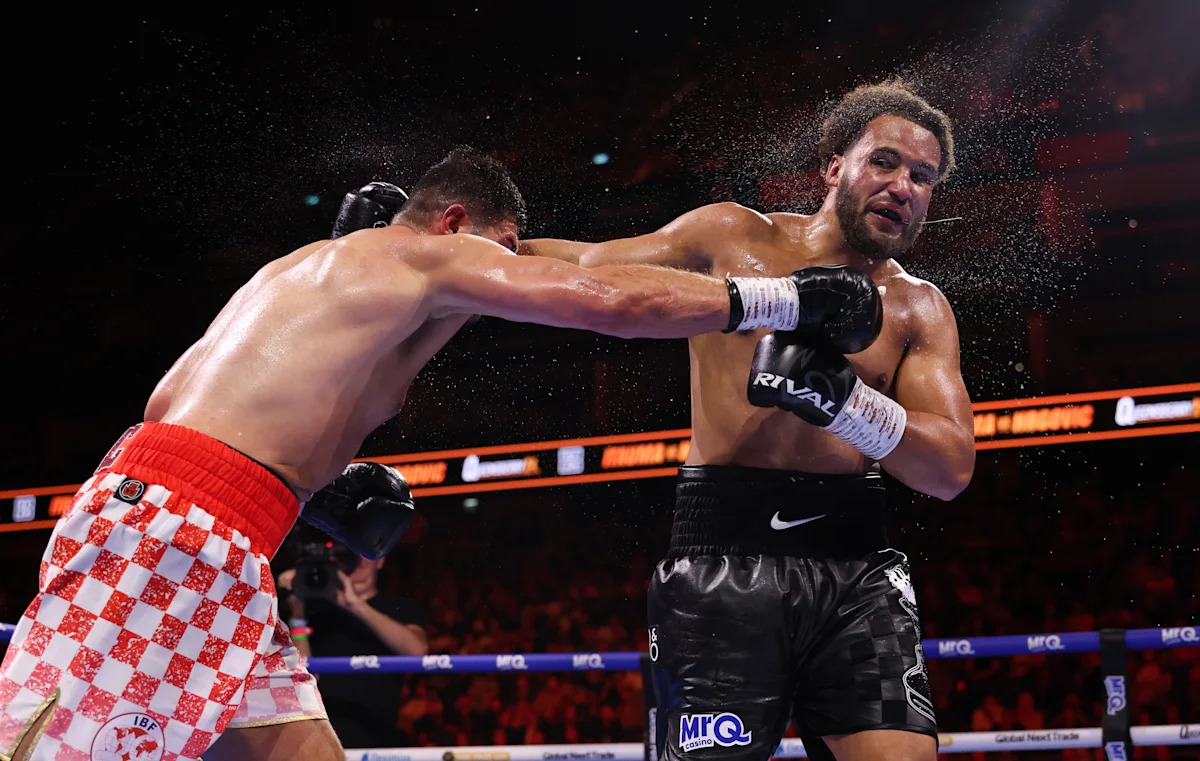
As for Itauma, one can only guess how long it will take a 21-year-old heavyweight — a fighter so full of testosterone, pride and promise — to get over what Filip Hrgovic did to him on Saturday night in London. All we know at this stage was that he suffered an ass-kicking, at least in the ninth round, and that all the things people were saying about him prior to Saturday night, they are no longer saying about him today. That doesn’t mean he is now half the fighter, or talent, only that our view of Moses Itauma, The Next Mike Tyson, has shifted on account of seeing him get a good ass-kicking and us not yet knowing how he will respond from it.
The path of Moses Itauma’s career was forever altered by Filip Hrgovic.
(Richard Pelham via Getty Images)
Should he respond the right way, as all great fighters do, there remains hope that Itauma’s impressive athleticism, speed and punch variety will be enough to one day secure him the heavyweight title most assumed would be his Saturday, when competing for the IBF belt.
Advertisement
If, however, Itauma struggles to see the ass-kicking for what it was — a lesson, a wake-up call — the future, both for Itauma and the heavyweight division, could look very different than how we all pictured it on Saturday morning. He might, for instance, return too soon and reemerge as gun-shy, inhibited, full of self-doubt. Or, if not that, perhaps his opponents, now armed with the blueprint, will entertain the prospect of fighting Itauma with a confidence they hitherto lacked, believing all they must do is soak up whatever he throws at them and then, like Hrgovic, return the favor once he exhausts himself.
Regardless, there is, from Itauma’s perspective, no need to panic. Not yet anyway. This, after all, is heavyweight boxing. These things happen. That they happen with such regularity ultimately says less about the fighter who succumbs to the shock upset and more about the inherent danger of the division in which they compete. Indeed, the speed with which Itauma’s defeat to Hrgovic was compared to similar upsets — often catalysts to later successes, by the way — shows how commonplace the unraveling of a blue-chip prospect tends to be in this cruel and unforgiving sport.
In the UK at least, one of the go-to examples of a prospect blowing up in the presence of a veteran happened 22 years ago, again in London. On this occasion the young fighter with the world at his feet was David Haye, a 23-year-old cruiserweight whose future, they said, would be bright, lucrative, and likely at heavyweight. All he had to do was keep winning. Specifically, all he had to do on the night of September 10, 2004 was beat Carl Thompson, a 40-year-old former WBO cruiserweight champion whose age, inactivity and wear and tear suggested he was ripe for the picking.
Such was Thompson’s wear and tear, in fact, most deemed the Haye fight a foregone conclusion, the very definition of a changing of the guard. That’s perhaps why Haye, 17 years Thompson’s junior, could afford to base his training camp for the fight in Bournemouth, an English seaside resort, and why the completion of half-hearted sparring sessions in the ballroom of the hotel in which he was staying led to nightly trips to For Your Eyes Only, the local strip club. It’s also why, on the night of the fight, I was handed a colored wristband by the boxer’s girlfriend for the after-fight party, despite my protestations and my belief that it was a bad omen. “But he hasn’t even won the fight yet,” I pointed out, either wise or naïve at just 18. “Anything could happen.”


That’s David Haye on the right. Yeah, you can see where this is going.
(Mark Lees – PA Images via Getty Images)
It’s easy to remember it like that now, of course, two decades on. Yet the truth is, I was, as a teenager, as guilty as the rest of believing that upsets, like addictions or illnesses, were things that happened to other people, never to you or people you knew. Besides, anyone who witnessed the first three rounds of Haye’s fight with Thompson that September night would have had every right to label me a killjoy for having questioned the planning of an after-fight party. Because it was in those opening nine minutes Thompson found himself repeatedly staggered and hurt and on the brink of collapse. It was in those opening nine minutes we all sensed it was a case of when, not if, Haye ended both the fight and Thompson’s career.
Advertisement
“He laid into me for the first two or three rounds,” recalled Thompson, now 62 years old. “The first two or three rounds he was the boss, wasn’t he? But unfortunately for him he didn’t look into how I fight and what kind of fights I had won. He didn’t know what kind of person I am. He didn’t know I could come from behind and win a fight. I don’t think they were banking on that because he tried taking me out early without thinking about what would happen if he didn’t take me out.
“I was always going to be dangerous later in the fight, though. I did it with Terry Dunstan, Sebastian Rothmann, Akim Tafer, Massimiliano Duran. In the majority of my fights, I would find myself behind but then come back and show I have the ability to still win.”
As much hamstrung as helped by his perfect 10-0 record, Haye wasn’t able to visualize a scenario in which Thompson, or indeed anyone, could stand up to his power, let alone retaliate. In fact, the Haye record wasn’t just a perfect 10-0, it also contained 10 straight knockouts. Is it any wonder, then, that most expected Thompson, a man whose face was often his first line of defense, to be merely an addition to a list?
“He caught me with some decent shots and they hurt, but I still had it in my mind: I’m going to win this fight,” said Thompson. “It didn’t matter that I was falling behind. My intention at the end of the day was to win the fight.
Advertisement
“I always believed I could beat David because he had never fought anyone like me. I thought he would get a rude awakening and soon realize how hard it was in there. And he did. He ran out of puff. I was, by some miracle, able to take his punches and that was his downfall. He just didn’t know what to do after that.”
By Round 4 the “puff” had clearly gone from Haye, that much is true. Now the colored wristband had started to slip down my wrist and, like Haye, came unstuck. Now I thought about the sticky floors of For Your Eyes Only, and those lazy jogs on the beach, and the ballroom spars against heavyweights reluctant to throw right hands, and the sight of Jodie Marsh, a Page 3 glamour girl, walking Haye to the ring, and the sound of “Happy People” by R. Kelly announcing their arriva. Now, and only now, did we realize that we — yes, we — had got it all wrong. Every last bit of it.
Advertisement
“You get those bogeymen and I could have been his,” said Thompson. “I didn’t shy away; I was never scared. Nothing’s going to put me off or stop me unless you can keep me down. I wasn’t a great or exceptional fighter, but one thing I know I had was heart and that I could punch. There was no way anybody was going to take that away from me.
“I hate getting outboxed so I feel that I need to use pressure to stop them outboxing me. Before they know it, they’re working so hard to get rid of me that their energy has been sapped. I’m just constantly in an opponent’s face and catching them. They’re then getting caught more often than they would like. For my tactics to work I have to be in their face. I can’t allow them to box me and keep in their own rhythm. Even when I get caught, that’s the key pattern. Stick with it. Sap their energy.”
In the end Haye was stopped in the fifth round by Thompson, more exhausted than hurt. He was, like Moses Itauma, eventually saved by a combination of referee and corner and was, at the time of the finish, lurching drunkenly but still extending his arms; a reflex action rather than a considered one; prods rather than punches.


The look of a man who never saw this coming.
(Mark Lees – PA Images via Getty Images)
After the fight, Haye excused himself from the post-fight press conference, having complained of headaches, and was then taken to the nearest Wembley hospital. Describing his pain, or at least the physical pain, he said, “It felt like somebody was attacking my skull with a sledgehammer.”
Advertisement
That pain, as with most things, would fade in time. Once it had, Haye booked a solo holiday to Gran Canaria, where he thought about what he was and what he wanted to be. Bored, he even wrote and sent me a poem about his complicated relationship with boxing. It went something like this:
Boxing is a sport,
Sports are played.
Playing should make us happy,
Happiness is a chemical reaction in the brain.
Boxing damages the brain.
He was, in his own way, becoming quite philosophical, perhaps even maturing. He had to, I suppose, if only because the alternative was denial, self-delusion and the repeating of old habits. Still, though the pain had now started to alleviate, pride always threatened to drag the wounded back to where he had just been; the lure of a rematch too great to ignore. Without one, Haye said, he would forever find it difficult to look at his record and see that defeat on it. It was hard enough trying to watch, or recall, the fight in those days.
Advertisement
“The first few rounds were terrible, even if I was winning them,” he explained at the time. “That’s when all the damage was done. I’d rather see myself get beaten up and stopped than watch me act like an idiot for the first three [rounds] and still win them. Those first three rounds were almost too easy. I got drunk on my own success.”
The fight, in that respect, was merely a microcosm of Haye’s career — or his attitude toward his career — up to that point. But still, that wasn’t to say he couldn’t now redeem himself, change his ways or become, in the context of getting drunk on his own success, a teetotaler. In fact, for Haye to become the fighter everybody predicted he would become, that is what he would need to do. He would need to accept the limitations exposed by Carl Thompson at Wembley Arena and he would have to alter certain habits. If unable to avenge it, he would have to simply make peace with his first defeat and humble himself.
“I still thought it could happen for him,” Thompson said of Haye, who later went on to win three world titles as a cruiserweight and one as a heavyweight. “He was only 23. He had all the time in the world. It was just a minor hiccup. He underestimated me and his team underestimated me. But at 23 you can’t just say someone’s career is over because he got beaten by one man. It’s only idiots who say that.”


Moses Itauma, 21, still has plenty of time to achieve greatness.
(Richard Pelham via Getty Images)
For Haye, the key to recovery was twofold: one, get back in the ring as soon as possible, which he did, blasting out journeyman Valery Semishkur inside a round just two months after losing to Thompson; and two, embracing, in 2006, the tedium of a long, drawn-out fight. It wasn’t his favorite thing in the world, no, but Haye, a fighter who loved nothing more than a knockout, knew the key to longevity and success in boxing was having a Plan B and being able to rely on Plan B when his punches had no visible effect on an opponent. It was for this reason his 2006 was awash with challengers like Lasse Johansen (stopped in eight rounds), Ismail Abdoul (outpointed over 12) and Giacobbe Fragomeni (stopped in nine), all of whom offered Haye, now the European champion, a resistance in the ring he had never before experienced as a pro and would later put to good use. His seventh-round stoppage of Jean-Marc Mormeck the following year, for example, was secured by Haye only once he had gotten off the canvas, stared down his anxiety, and patiently chipped away at the champion, no longer so fearful of exhaustion.
Advertisement
It was, without question, a fight Haye would have lost had he not slowed his pace and, more importantly, humbled himself in those previous European title fights. In short: that night in Paris, his first world title shot, was a fight he would have lost were it not for the pain of his first loss three years earlier.
Some, when comparing Itauma’s self-destruction on Saturday, will now advise him to do similar to Haye going forward. They will, in good faith, say that he should calm down, take a step back, and learn to manage rounds. They will refer to him saying, pre-fight, that he couldn’t remember having sparred 12 rounds as a major red flag and a sign of either complacency or incompetence. Then they will say the same about his too-honest claim, again pre-fight, that he had been in better mental and physical condition before previous bouts but that he would still have too much for a fighter like Filip Hrgovic.
Of course, only in the event of a shocking defeat do we, the shocked observers, possess this wealth of fresh insight, wisdom and knowledge. Only then do we see how fine the line actually is between genius and ignorance. Beforehand, on the subject of Itauma, we were all as bad as each other; each of us clambering over one another to pay the anointed one the highest compliment or unlock the most creative way to describe what makes him so special. Yet sometimes that kind of feedback quickly becomes a chorus, cultish in its power and its pervasiveness. It is often what makes upsets like Saturday so hard to fathom and so jarring to then witness. For the reality is, not a single person, not even those who watch him every day and therefore know his flaws, saw Moses Itauma’s first defeat coming.
“So, yesterday wasn’t my night,” Itauma (14-1, 12 KOs) said in a video posted to his social media on Sunday. “We attempted greatness and just fell short to the more experienced man.
Advertisement
“I want to say congratulations to Filip Hrgovic on his win, and although I never reached my desired outcome, I believe I gained experience that I’ll take to my future fights.”
In that case maybe Anthony Bourdain was right. Maybe, as painful as it is, we all need a good ass-kicking from time to time, and maybe the ones who need it the most — or will at least benefit from it the most — are those for whom the idea of their ass being kicked is inconceivable. After all, it is they, the glorified and unsuspecting, who are most vulnerable to panic, confusion and collapse when the unthinkable suddenly happens.
Read the full article here


