





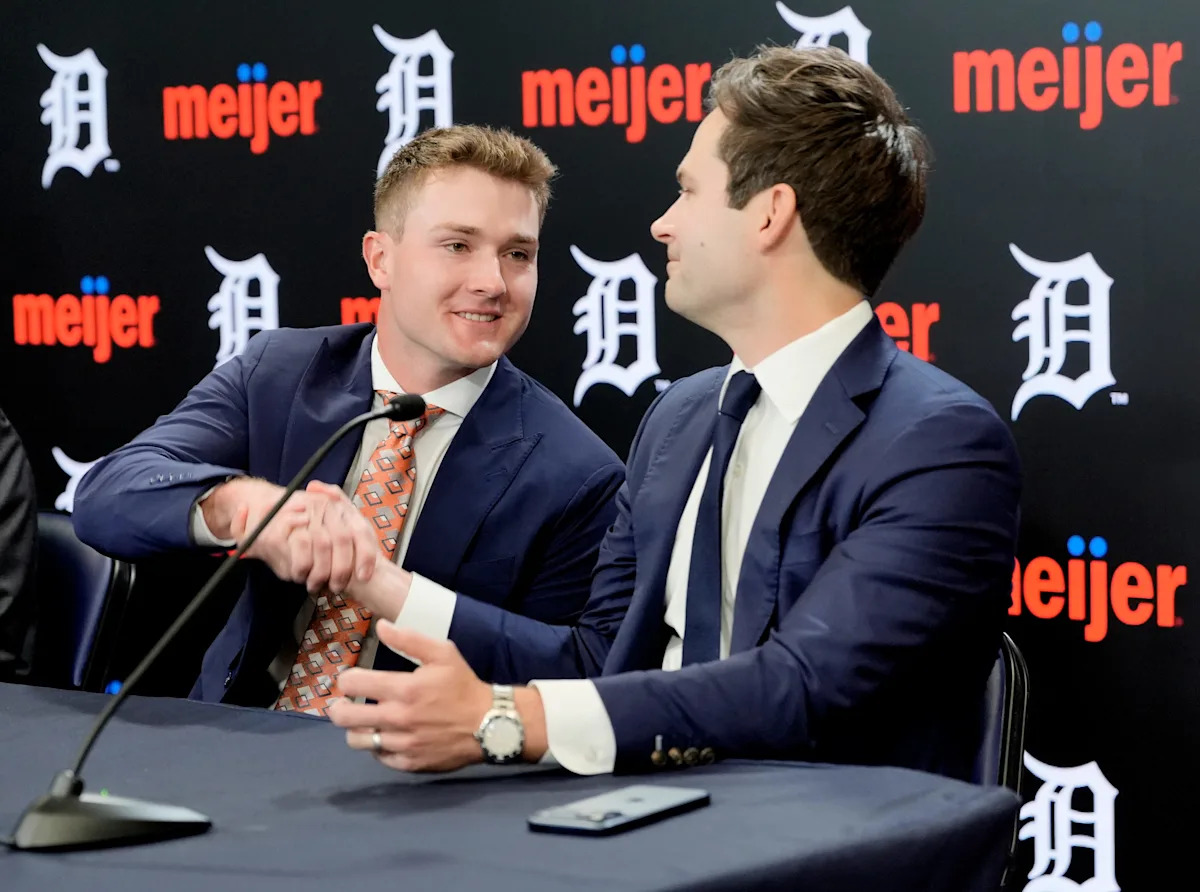
If you’re an elite young ballplayer looking for long-term financial security, you picked the right time to be alive. On April 15th, Kevin McGonigle of the Tigers inked an eight-year, $150 million contract extension which will keep him in Detroit until 2034. Eight days before that, Pirates phenom Konnor Griffin signed a nine-year, $140 million pact to stay in Pittsburgh for the foreseeable future. Good news for the Pirates and the Tigers; bad news for everyone else, particularly teams who were hoping to acquire their services via free agency.
Granted, because Griffin and McGonigle are so young, the length of their contracts does not completely preclude them from getting hefty free agent contracts once their current deals expire. However, they are signing away premium years; Griffin is now slated to enter free agency at age 28 rather than 25, McGonigle 29 rather than 27. For teams looking to court them in the 2034/35 offseason, that’s a big difference.
Advertisement
It’s not just those two who have signed long-term extensions with little to no big league service time. Earlier this year, Colt Emerson and Cooper Pratt each signed eight-year extensions without ever setting foot on a big league diamond. Last year, it was Samuel Basallo and Roman Anthony. And looking around the league, there’s no shortage of more established young stars signed to lengthy extensions with their current teams – Bobby Witt Jr., Julio Rodriguez, Fernando Tatis Jr.; the list goes on. Increasingly, elite young talent is being aggressively signed and secured while they are still under team control.
This is a worrying trend for teams who want to improve themselves via the free agent market. As the most attractive options are being increasingly signed away, it will only continue to become more difficult for teams to rely on shopping as a way to make substantive upgrades. Per FanGraphs’ Michael Baumann, out of the 141 players projected to accrue at least 7.0 WAR by the end of 2028, just 10 can become free agents after this season. That’s a pretty barren shelf.
Where does all this leave the Yankees? In pretty dangerous territory, if you ask me. Just this past offseason, the Yankees spent upwards of $180 million to secure two of their lineup mainstays in Cody Bellinger and Trent Grisham. Sure, they were both re-signings, but it doesn’t change the fact that they were free agents. In the 2024-25 offseason, they were pretty quiet on the position player front, but they were reportedly in on the Juan Soto sweepstakes until the very end. Granted, it’s been a while since the Yankees were perennial buyers at the top of the market à la the current Dodgers, but even recently they’ve filled their positional needs by signing solid free agents more often than not, and especially when none of their prospects were banging on the door.
That last part is key. I won’t say that the Yankees’ recent track record of developing position players is outright bad; Ben Rice is awesome, Austin Wells has been an above-average catcher, slow start to 2026 be damned, Jasson Domínguez continues to tantalize, and Anthony Volpe has at least impressed with the glove when healthy. But as of this moment, they have a dearth of big-league ready talent at positions of need. Two up-the-middle positions, center field and second base, will be vacated at year’s end, when Grisham and Jazz Chisholm, Jr. are set to become free agents. Do you really think Spencer Jones and George Lombard Jr. can immediately replace their production? I think that’s a pretty risky bet for a team with championship aspirations to make.
Advertisement
Sure, the Yankees can elect to re-sign both Grisham and Chisholm Jr. However, in a relatively weak free agent class they’ll be in high demand, so they won’t come cheap, especially not Jazz. And if they miss out, the other options don’t look to be all that appealing – we’re looking at names like Brandon Marsh, Cedric Mullins, or Mickey Moniak at center field, or Gleyber Torres, Mauricio Dubón, and Brandon Lowe for second base. They might be fine stopgaps, but they’re not much more.
Or, maybe the Yankees will be able to swing a deal for higher-quality players by offering one of their high-profile pitching prospects in Elmer Rodríguez and Carlos Lagrange. But the trade market is significantly harder to forecast, and there’s no guarantee that teams will be willing to ship out attractive targets. Plus, it’s not like the Yankees currently have a stacked farm; it’s pretty top-heavy and shallow, which is why both FanGraphs and MLB.com place it among the bottom handful in the league. That limits the possibilities of the deals they can make happen.
So, the Yankees will be faced with a pretty tough situation in the 2026-27 offseason. And if the current trend of young talent signing early extensions continue, subsequent offseasons are only going to become more difficult to navigate. The only true way that the Yankees can adapt to this new reality is by developing talent internally – however, that takes time, not to mention smarts, effort, and a truckload of luck. In the meantime, the Yankees will have to pray that their current core is good enough to win a ring, because at least when it comes to position players, neither the farm nor the free agent market look like they’ll provide much in the way of reinforcements.
Read the full article here