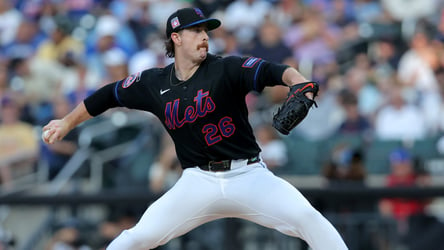



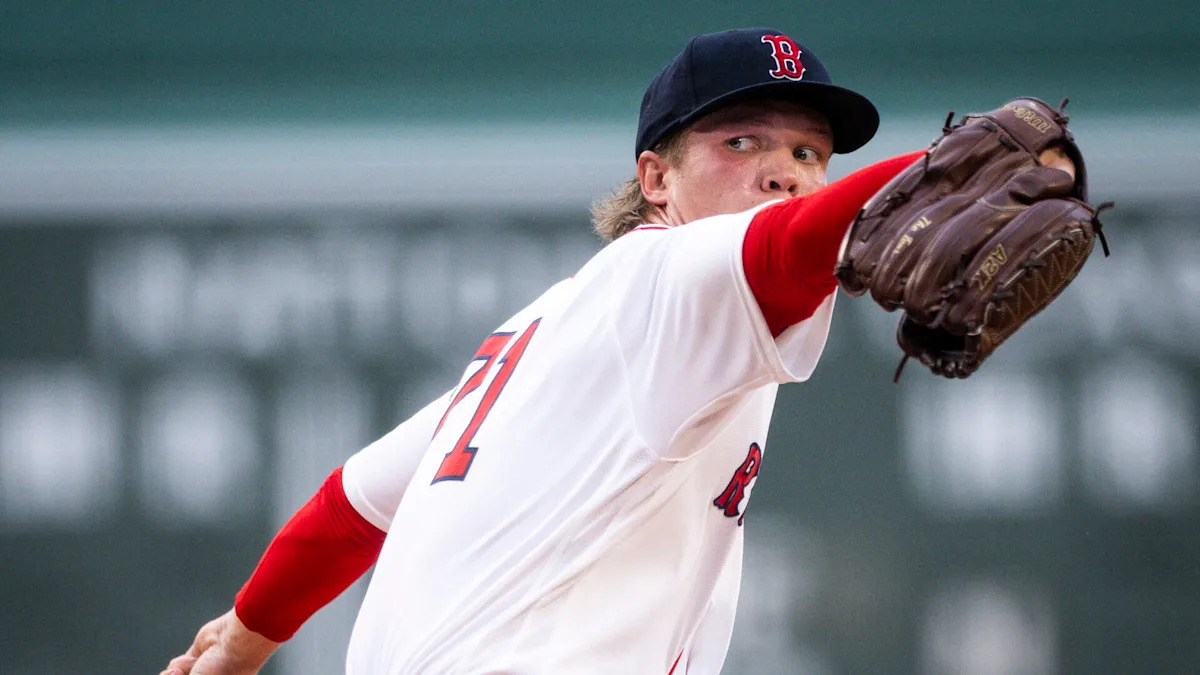
Well, the MLB Trade deadline has officially kicked off. Just before midnight on Saturday night, the Boston Red Sox and Nationals agreed on a deal for two young MLB regulars, with the Red Sox sending left-handed pitcher Connelly Early to the Nationals for infielder Curtis Mead.
While this trade surprised many people when it was initially reported last night, it’s worth digging into why each team would make this deal and whether or not the trade makes more sense once you look a little closer.
Advertisement
What are the Nationals getting with Connelly Early?
The consensus on social media is that the Red Sox made an awful trade. It can be easy to see why. Early flew up prospect boards in 2025 after having a fine 2024 season where he posted a 3.99 ERA, 1.19 WHIP, and 30.8% strikeout rate in 103.2 innings in High-A and Double-A. He started 2025 in Double-A and was electric over 71.2 innings, so he was promoted to Triple-A, where he made just six starts before the Red Sox called him up due to injuries in their MLB rotation. In four MLB starts, he posted a 2.33 ERA, 1.09 WHIP, and 36.7% strikeout rate, and even started a postseason game, and his legend began to take off.
The truth about Connelly Early is a bit less rosy, even without considering his current elbow injury.
This season, he has a 3.44 ERA, 1.25 WHIP, and 23.8% strikeout rate in 91.2 innings. His walk rate has gone back up to 8.7%, and his chase rate induced has fallen to 31.3%. Those aren’t alarming numbers by any means, but they’re more in line with the pitcher he was in the minor leagues and not the one we saw for five MLB starts last year, where he posted a 36.7% chase rate and just a 5.1% walk rate.
Advertisement
Early has a deep arsenal of pitches and the foundation to be a really strong MLB starting pitcher for many years. He can attack righties with a four-seamer, changeup, curve, and slider, while lefties get a sinker, four-seamer, and sweeper. The sweeper has the makings of an elite whiff pitch to lefties, but Early has struggled to find a true out pitch versus righties. Right now, his best swinging strike rate pitch to righties is his four-seamer. The curve and slider both have below league-average swinging strike rates to righties, and he rarely uses the slider in two-strike counts while the curve has a league-average PutAway Rate. The issue with relying so much on elevated four-seamers to swinging strikes against righties is that when Early misses his spots, as he has a few times this year, the pitch can be hit hard. Early has allowed a 23.8% HR/FB rate on the four-seamer against righties this year, which is well above the 19.9% league average.
Early’s approach is also geared towards chase, which makes sense when you have plus stuff. His first-pitch strike rate is just average, and his 43.4% zone rate is below the 45% league average for starting pitchers this season. That can work when hitters are consistently offering at your pitches outside of the zone, but hitters have adjusted to Early this season. He still has a solid 32.8% chase rate, but that’s only slightly above average, and his PutAway Rate is just 20.1%, which is still above the 19% league average but way down from the 30% mark he posted in a limited sample last season. All of that explains why Early is still producing whiffs but has struggled to make last year’s strikeout upside as hitters have adjusted to him.
Connelly Early zone
The Red Sox obviously felt they had the starting pitching depth with Jake Bennett emerging this season and prospect Anthony Eyanson tearing up Double-A in the same way Early did last season. That, plus Johan Oviedo starting to throw bullpens again after a flexor strain, and Brayan Bello starting to look stronger in bulk relief outings, made the Red Sox feel OK with dealing away a controllable left-handed pitcher. The Nationals will gladly take Early and pair him with Cade Cavalli at the top of their rotation for years to come. If they can also re-sign Foster Griffin in the offseason, they would have a solid three-man core that features young arms with plus stuff and a veteran who can pound the zone with a deep pitch mix and elicit weak contact. It’s a move that makes tons of sense for a Nationals organization that also has Brady House and Yohandy Morales at Triple-A, waiting to fill in that third base role.
Advertisement
What are the Red Sox getting with Curtis Mead?
For starters, we need to move away from the “Curtis Mead was designated for assignment” discourse. It’s true that it happened, but it doesn’t really have any bearing on him as a player or prospect.
After being signed by the Phillies out of Australia in 2018, Mead was later traded to the Rays for Cristopher Sanchez. Yes, that Cristopher Sanchez. Mead then spent five years in Tampa Bay’s organization, where he hit .298 in his minor league career and was the 33rd-overall prospect in baseball, according to MLB Pipeline, heading into the 2023 season. For many reasons, which we’ll get to, Mead was unable to consistently break into the Rays’ lineup and was traded to the White Sox for Adrian Houser at last year’s trade deadline. The White Sox gave Mead a few chances last season before designating him for assignment this offseason, where he was scooped up by the Nationals.
And now we’re in the present day. Mead is just 25 years old and has finally been given a regular starting job. He’s hitting .254/.352/.500 in 327 plate appearances with the Nationals, with 17 home runs and six steals. He has a 10.8% barrel rate and a 42.3% hard-hit rate, while showing an elite understanding of the strike zone, with an above-average chase rate and a nearly 12% walk rate. He also has tremendous contact ability, with just a 6.5% swinging strike rate to go along with a 92% zone contact rate. We can say it’s a “small sample size” of 87 games with the Nationals, but this was also the hitter that Mead was in the minors which made him a top prospect. The understanding of the strike zone and elite contact ability have always been there.
Advertisement
The power is the new development, and much of it feels real.
For starters, the Nationals changed his stance, narrowing his feet a little bit and opening up his stance. This is the same approach that the Brewers took with Brice Turang before he experienced a power surge. The narrower stance can allow hitters to load up on the back half a bit more when the stride, and the open stance can make it easier for hitters to clear their hips on the swing, both of which should lead to more power. The open stance also can lead to more pulled balls, which is what is happening with Mead. His pull rate has gone from 34.3% last year to 48.6% this year. His Pull Air% has also jumped from 15.7% to 22.5%.


Curtis Mead
That’s clearly something that caught Boston’s eye with the Green Monster looming as an inviting target in left field. Just this season, we’ve seen Willson Contreras raise his pull rate to a career-high 53.1%, which has helped fuel a career-best .941 OPS and .261 ISO. Contreras is also hitting .291, which would be his best batting average in a full season by about .015 points. The Red Sox clearly see a similar boost for Mead by playing in Fenway Park, and while there has been much discussion about Mead being a “short-side platoon,” that is really just tied back to how the Rays used him. Mead has an .817 OPS and .242 ISO against right-handed pitchers this season. There is no platoon here.
Advertisement
The biggest question is where does Mead play defensively? The Nationals have been using him at third base, and his -1 Defensive Runs Saved (DRS) isn’t terrible, but his -4 Outs Above Average (OAA) paints a different story. He has displayed poor range at third base and would be a major downgrade from Caleb Durbin, who has been tremendous at third base for Boston this year despite playing mostly second base as a prospect. However, it’s possible that the Red Sox can keep Durbin at third base. In 108.2 innings at second base with the Rays last season, Mead had an OAA of 2 and a DRS of 2. His range graded out slightly above average, and he had a Fielding Run Value of 1. That’s obviously a small sample size, but the Rays were able to get league-average defense out of Mead at second base last year, possibly due to positioning, which is something the Red Sox could duplicate. Of course, the Red Sox could also use him as their primary designated hitter for the remainder of the season as well.
Final Trade Takeaways
Despite the initial reaction that this was a gross overpay for the Red Sox, it actually looks like a pretty fair swap. Both teams get a young, controllable player in a position of need. Early undoubtedly has the higher upside and could be the ace of the Nationals staff in time, but the Red Sox need more offense right now, and they feel good about their pitching coming up behind Early in the ranks. Mead has legit offensive tools that could make him great at Fenway Park for the next four years, but the Nationals also have good, young third basemen behind him and another player in Luis Garcia who they also have no defensive home for.
This feels a bit like both teams got what they needed.
Read the full article here