





It was a tough night for the Mets batters in more ways than one.
Not only did the Mets bats go 2-for-11 with runners in scoring position and leave 11 men on base — the third straight game they left at least 10 on the basepaths — they failed on two early ABS challenges that could have benefited them later on in their eventual 5-3 loss on Tuesday night.
Advertisement
First, Francisco Alvarez tried to get a strike for Kodai Senga in the first inning. With Senga having walked the first batter of the game, JJ Bleday took ball three on a 2-1 cutter that he didn’t bite on. Trying to save his starter, the Mets backstop asked for a challenge. While Senga’s pitch missed by 0.7 inches, the reality is that Alvarez took an unnecessary risk.
“There was a runner on first there,” Alvarez explained through an interpreter after the game. “I thought in challenging that one instead of having a 3-1 count, it could be a 2-2 count and I think it makes a big difference there.”
Senga wound up walking Bleday, setting the Reds up for a four-run first inning, a deficit that the Mets could not overcome.
Marcus Semien was the second culprit, challenging a 1-2 pitch an inning later. There were two outs and no one on base when the veteran second baseman asked for a second look. The result was a called third strike from a Brady Singer sinker that clipped the outside corner.
Advertisement
“We were super aggressive today,” manager Carlos Mendoza of the challenges said after the game. “Essentially, you lose that first one right there early, a little too much there. We got to do a better job. That’s something we’ll continue to talk to the guys about it.”
Mendoza was asked why players were using challenges in low-leverage situations this deep into a season, and the Mets skipper acknowledged they have to be better.
“They’re competing there. They’re competing and there’s going to be times where they don’t agree with a call,” Mendoza said. “I thought Marcus was one that was super close there. But again, it’s something that we have to be mindful, especially early on, when you lose the first one like that.”
That lack of situational awareness cost the Mets a challenge for a more important moment in the game. And that moment came in the sixth inning. Mark Vientos had just cut the Reds’ lead to 5-3 with his two-run shot. Alvarez walked, allowing Carson Benge to come up as the potential tying run. The young outfielder struck out looking on four pitches, but many of the strikes called — especially the third strike — were noticeably low. Without a challenge, an opportunity was gone to extend the at-bat.
Advertisement
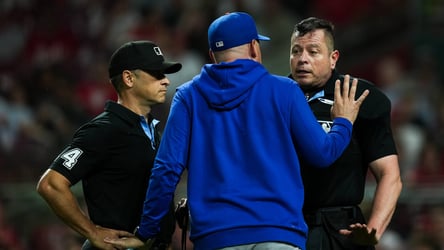
That moment would lead to Mendoza being ejected in the bottom of the seventh. After Bleday worked a one-out walk, home plate umpire Carlos Torres heard someone from the Mets dugout and ejected them. Mendoza came out to argue to find out what was going on, and was promptly ejected.
“It was a quick one there. Somebody said something from the dugout and Carlos just threw someone out. No one knew who it was and that’s when I jumped out of the dugout,” Mendoza explained. ” I wasn’t pleased with the strike zone, especially with the Benge at-bat there. Went back and looked at some of the pitches. I wasn’t happy about it. Again, I know it’s a tough job there, but that’s all to it.”
The Mets hope they can put that lack of situational awareness behind them as they look to salvage a win in the series on Wednesday afternoon.
Read the full article here