




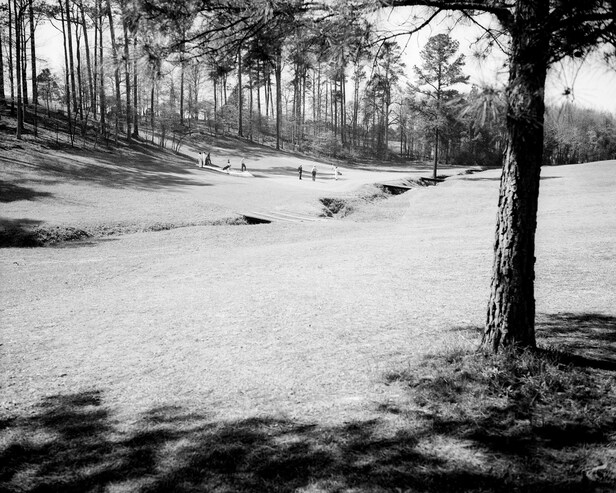
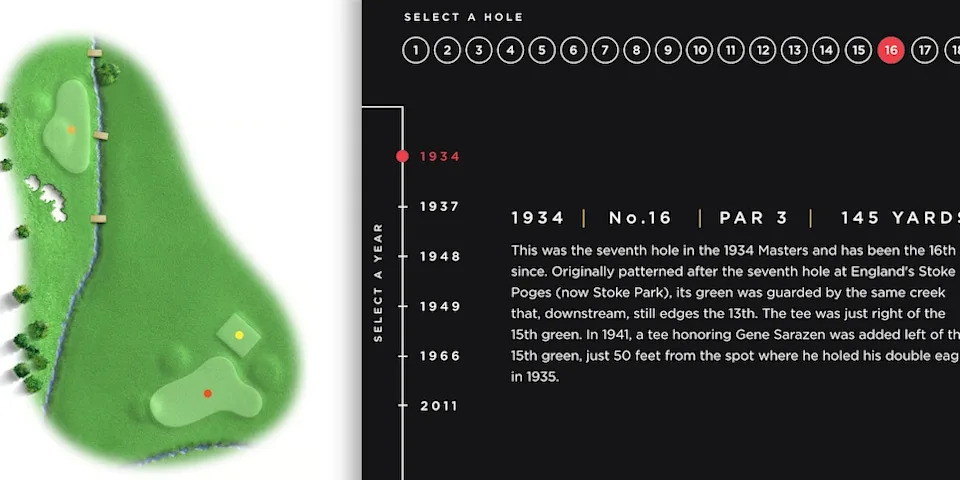
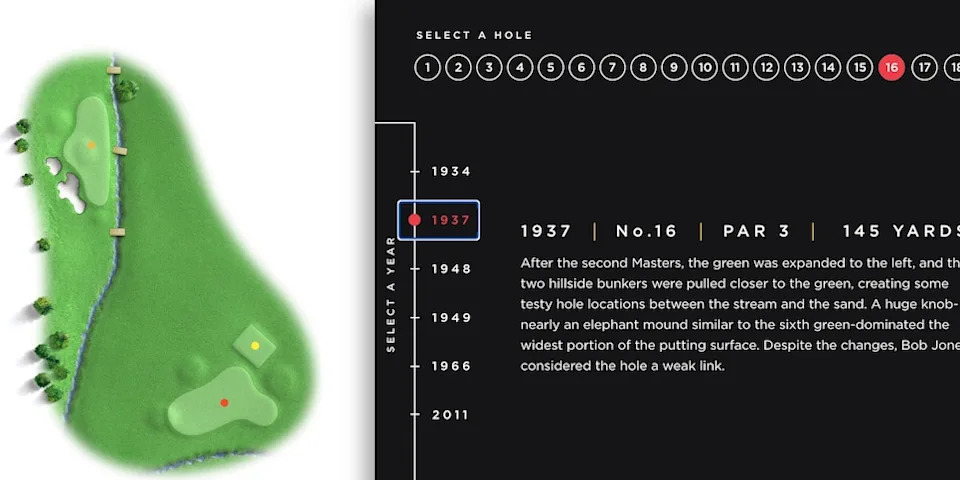
The only hole at Augusta National that was not designed by Alister MacKenzie and founder Bobby Jones, who created the course in 1932, is the par-3 16th. As we know it, the 16th is one of golf’s most recognizable holes, displayed vividly each year during the Masters in a colorful glade of pines across a beautiful reflection pond. However, this version wasn’t put into play until 1948, 14 years after the first Masters in 1934 and three years after the tournament resumed following a three-year hiatus during World War II. MacKenzie and Jones’ original 16th, also a par 3, was shorter, continuing in the same direction as the previous hole, the par-5 15th. The tee was to the right of the 15th green and the 145-yard shot was hit over a small creek (the same Rae’s Creek tributary that crosses in front of the 13th green) fronting a green banked against a hillside behind it and cocked significantly so that the left side was closer to the tee than the right side. Any shot that came up short, to any part of the green, would be in the creek.
THE ORIGINAL 16TH HOLE
Advertisement
Members who played the hole from about 120 yards enjoyed the 16th and thought it one of the most attractive on the course. Jones and Augusta National chairman Clifford Roberts, however, worried that it wasn’t sufficiently challenging for Masters competitors, and indeed the 16th surrendered the first holes-in-one, three of them in fact, in 1934 (Ross Somerville), 1935 (Willie Goggin) and 1940 (Ray Billows). Jones also thought it was too similar to the more respected par-3 12th. Both had similar-length shots over water to angled greens, with right-hand hole locations more challenging than those on the left or middle, with the 16th lacking the intimidation and infuriating winds of the former.
83121225
OLD POSITION: The first version of the 16th hole was built against the hillside to the left of the current green.
Augusta National
Advertisement
The club tried to give the 16th more teeth in 1937 by building a new Masters tee to the left of the 15th green, extending the hole to 170 yards. This altered its character by shifting the angle of attack, so golfers were hitting more into the deeper axis of the green and placing the creek hazard to the right than directionally in front. That tee was extended to 190 yards in the early 1940s—it would have been located somewhere close to the current concession stand off the 14th tee.
Augusta National, reviewed: Our course raters reveal their opinions on the Masters home
A JONES COLLABORATION
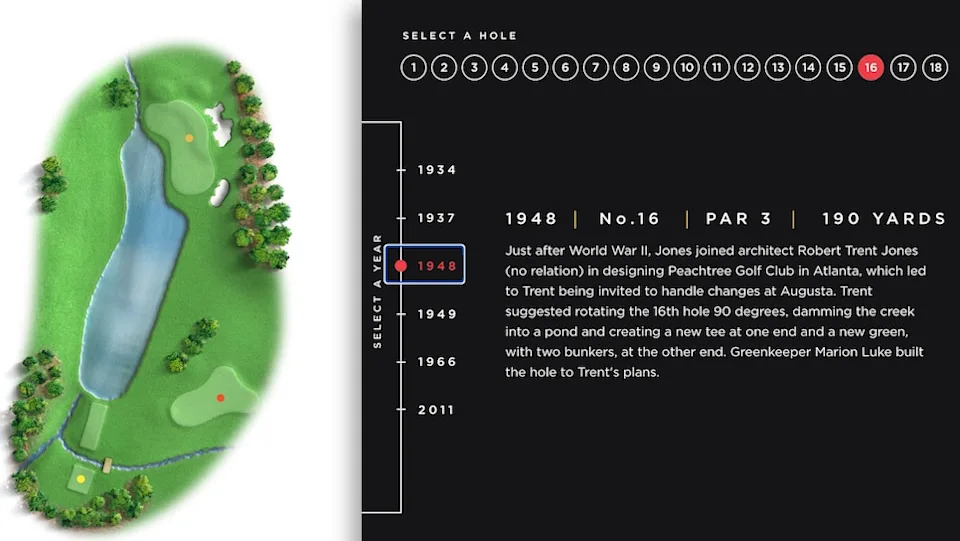
The wartime pause gave Jones and Roberts a chance to reassess the hole, and Jones brought in Robert Trent Jones to consult on a possible remodel. Trent Jones, incidentally, also went by Bob Jones at that time but began using his middle name when the two began working together out of deference and to avoid confusion. He had emerged from the Great Depression and war years as the commanding figure in American golf course design, and Bob Jones had recently hired him to design and build Peachtree Golf Club in Atlanta. Given the limitations of the 16th greensite between the creek and the hill, the two considered rotating the hole by relocating a new green to the right, or to the east, of the creek, and shifting the tees even farther to the left of the 15th green, at a distance of 190 yards.
Advertisement
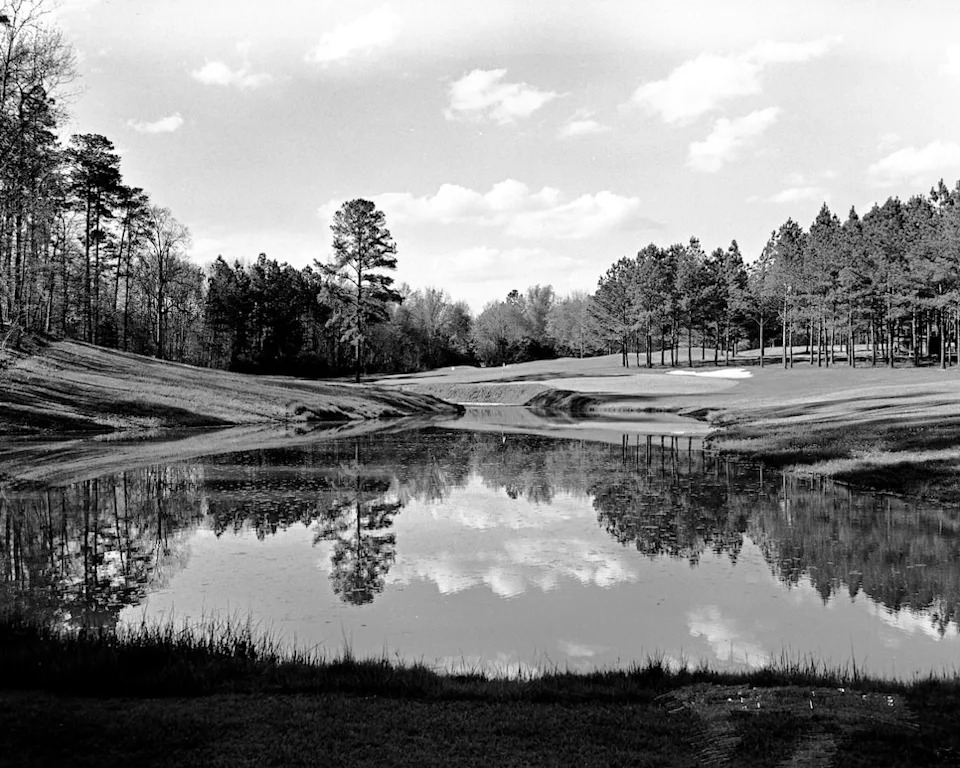
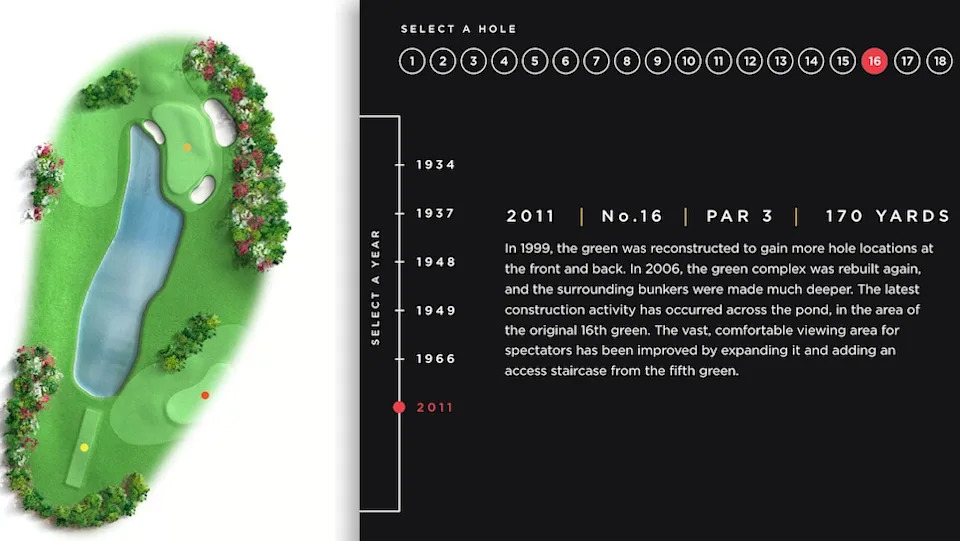
Construction crews excavated a large basin between the tee and the new green, then dammed the creek and filled the area with water, giving the hole a distinctive water fairway that ran up to the front of the green and around the left side. Prior to World War II, architects were happy to incorporate naturally occurring water hazards in their designs, but it wasn’t common practice to create artificial ponds and lakes. After the success of Peachtree and Augusta National, Trent Jones and every architect after him included this type of water feature in their arsenal of tools.
The green design at Augusta National’s 16th hole is nearly scientific in the way that it can control scoring.
The most important aspect of the new 16th was the green. The original green was wide and shallow; the modern green was deep, curving toward the back left with a distinct high back section and a lower front-left level creating diverse hole locations, protected on the left by water and the right by two bunkers.
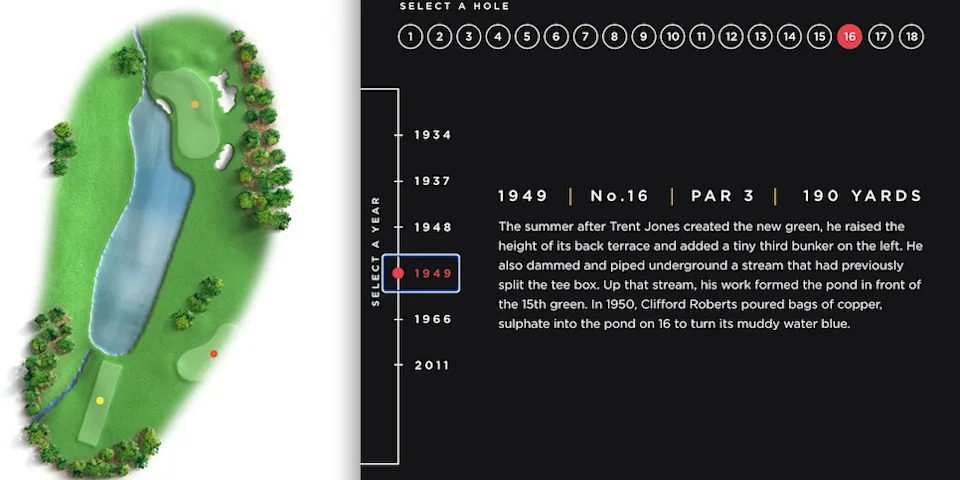
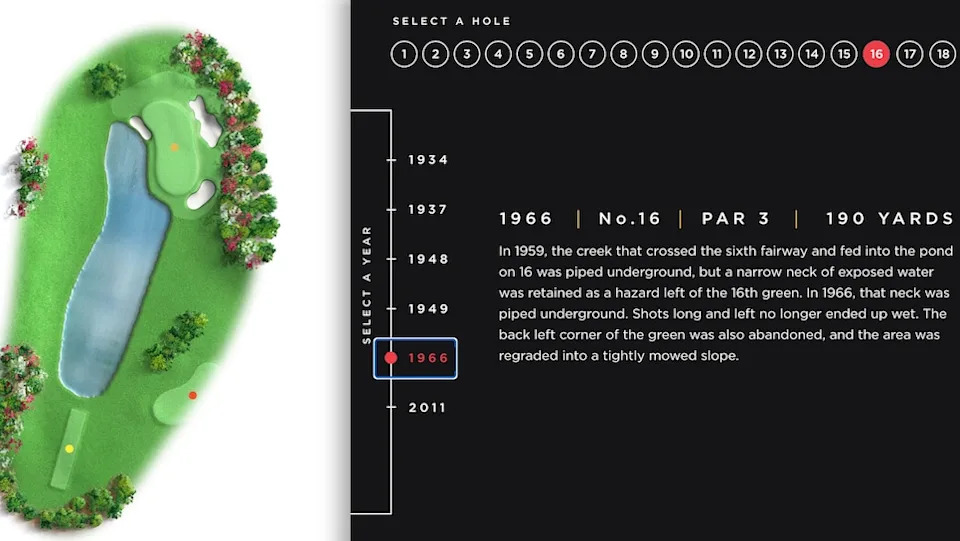
It was put into play for the 1948 Masters. The following year, Trent Jones rebuilt the green, accentuating the high/ low levels, and added a bunker in the crook between the putting surface and the water. Small modifications would continue through the years including extending the putting surface back left, deepening the bunkers and grading the area behind the green. Cliff Roberts began adding copper sulphate to the water in 1950 to turn it blue. But the fundamentals of the hole were set from the beginning.
More From Golf Digest


Golf Digest Logo Adam Scott, on the eve of his 25th Masters, reflects on nerves, swing envy and the big changes at Augusta


Golf Digest Logo The Last Stand of the Masters Gnomes

Editor’s Letter: What it really feels like to attend the Masters
Advertisement
THE NEW LOOK

82745443
TRANSFORMATIVE TIME: The new green had a major influence on course design.
Augusta National
Curiously, Roberts was reluctant to give any credit for the hole to Trent Jones. At the time he told reporters that the hole was entirely the vision of Bobby Jones, suggesting Trent Jones was merely a contractor. But everything about the 16th points to Trent Jones. The runway tees (the hole would later be shortened to 170 yards), the man-made water feature, the massive green, 45 yards front to back, one of the largest on the course, with the dividing tier and formulaic hole locations—these would all become RTJ design signatures in the coming decades. It wasn’t until shortly before his death in 1977 that Roberts finally acknowledged Trent Jones’ role.
Advertisement
The green design is nearly scientific in how it can control scoring. The ridge defining the upper-back section and lower front runs diagonally through the putting surface. There are four basic hole locations, two on the upper level (front right and back right) and two on the lower, and each is used during the Masters. Effectively, these comprise four internal greens with small pinnable areas that put acute pressure on players to execute line and distance control with their tee shots, pressure exacerbated by the hole’s position late in the round and late in the tournament.
Quite simply, when the hole is cut on the upper level, 16 can be a difficult hole. Shots that come up slightly short will catch the ridge and drift back down to the lower tier leaving 30- to 40-foot putts back up the slope. Missing right or over the green into one of the bunkers also leaves a delicate recovery that can easily drift down the slope.
Austere one day, flirtatious the next, the 16th is the last best chance to pick up a stroke en route to a green-jacket run.
When holes are placed on the lower level it’s an easier tee shot because the backing slope will redirect and contain balls. Basically, there’s more margin for error, even though these left-hand hole locations bring the water into play.
Since 2018, the scoring average for the two upper hole locations are 3.04 and 3.07. As expected, the lower hole locations are marginally easier, 2.96 for the back-left location and 2.97 for the front left. That might not seem like much of a difference, but those scoring averages don’t tell the whole story. In the same period going back to 2018, the two upper hole locations have given up just 152 birdies, or an average of 19 per tournament. The lower-tier hole locations have seen 279 birdies, almost twice as many.

/content/dam/images/golfdigest/fullset/2026/3/augusta-national-16th-hole-1934-illustration.jpg
/content/dam/images/golfdigest/fullset/2026/3/augusta-national-16th-hole-1937-illustration.jpg

/content/dam/images/golfdigest/fullset/2026/3/augusta-national-16th-hole-1948-illustration.jpg
/content/dam/images/golfdigest/fullset/2026/3/augusta-national-16th-hole-1949-illustration.jpg
/content/dam/images/golfdigest/fullset/2026/3/augusta-national-16th-hole-1966-illustration.jpg
/content/dam/images/golfdigest/fullset/2026/3/augusta-national-16th-hole-2011-illustration.jpg
On the other side of the coin, there have been a near identical number of bogeys on both the upper and lower tiers, 176 to 173. Bigger numbers come into play when the hole locations are down below, close to the edge of the water where they encourage players to go flag-hunting, knowing there are birdies to be made. There have been 38 double bogeys or worse carded to the lower pins during the past eight Masters, compared to just 18 when the holes are up high.
Advertisement
Of course, those lower hole locations have provided some of the Masters most memorable Sunday moments, especially the traditional back-left pin. Players know if they get the yardage right and get the ball to land on the slope just past hole high, the green will feed the ball to the hole leaving a short birdie putt, if not a tap-in. It might even go in.
Since the hole was created in 1948, there have been 21 holes-in-one on 16, by far the most of any of the other par 3s. There were multiple aces during the final rounds in 2004, 2010 and 2012. In 2016, Shane Lowry, Davis Love III and Louis Oosthuizen all sank their tee shots, banking the ball off the ridge. Justin Thomas and Bryson DeChambeau doubled up in 2019, and Tommy Fleetwood dialed the right number in 2021, though that was the last time anyone recorded an ace at 16.
Balls don’t even have to hit the green for the slope to be a factor. In 1999, two shots behind leader Jose Maria Olazabal, Love hit his tee shot over the green. He played his chip into the slope and then watched as it slowly trickled down to the hole and dropped. In 2005, leader Tiger Woods hit his tee shot just 10 feet right of where Love was. He bumped his ball into the bank where it began its slow, familiar path to the hole, dangling on the lip before falling, giving him a much needed two-shot cushion over Chris DiMarco. Though it may have come from a different vintage than the other holes at Augusta National, the 16th is similar in the way it can either give or take away. It is austere one day, flirtatious the next, and the last best chance to pick up a valuable stroke on a Sunday green-jacket run.
FOR AN UPCOMING “THE HOLE AT” VIDEO OF AUGUSTA NATIONAL’S 16TH HOLE, STAY TUNED TO OUR YOUTUBE CHANNEL: YOUTUBE.COM/@GOLFDIGEST.
Read the full article here


