





This spring training, there were two Mariners stories that stood out: Emerson Hancock, who showed up to camp with increased velocity and an expanded arsenal; and Cole Young, who showcased improvements on both sides of the ball. The question, as it always is in spring, was if those improvements would be sustainable.
Tonight, the calendar freshly turned to June, those two players—along with rookie Colt Emerson (who had his own spring training storyline) and not-rookies Josh Naylor and Randy Arozarena—combined to deliver the Mariners their seventh straight win, continuing to buoy the team above the .500 mark they’ve so miserably been circling most of this season, as the Mariners defeated the Mets 3-2.
Advertisement
It didn’t necessarily seem that this would be the case. After the Oakland series, the Mariners had lulled some people (not me) into a false sense of security in their ability to perform against left-handed pitching, something that’s been a bête noire for the team all season given the lefty-heavy nature of the roster, the injuries/ineffectiveness of their right-handed options, and the overall stop-and-start nature of an offense that was designed to do damage from top to bottom. That wasn’t the case today as the Mariners hitters struggled against Sean Manaea, making boatloads of quick, weak-contact outs. The only damage against Manaea was a left-on-left home run in the third (technically Manaea’s second inning, as the Mets used an opener because it’s apparently 2016 in the Bronx) by Colt Emerson, his second big-league barrel:
That is just…an objectively beautiful swing from Colt “the scouting reports love to lie about me” Emerson.
But one solo home run over six innings will, generally, Not Cut It, even when the person on the mound is Emerson Hancock, spinning another gem. Hancock was very good today, but not perfect, and that not-perfect caught up with him on two solo homers, both in three-ball counts: one game-tying in the fifth and one go-ahead in the sixth (and to Marcus Semien! Just his second of the year!)
But this feels like damning with faint praise for Hancock, who again was very good, showing off yet another wrinkle in his pitch mix by digging deep in his arsenal to add in his rarely-thrown curveball (he threw six today, after having thrown only 16 all year), dialing up his cutter usage against a lefty-heavy Mets lineup. The north-south movement of the curveball provides a solid counterpoint to Hancock’s more east-west arsenal, such as his cutter, which he was able to spot on both sides of the plate tonight and throw at varying velocities in seemingly any count.
Advertisement
“I think [the cutter] gives you an option early,” said Hancock postgame. “It gives you an option behind in the count, or even late. And I think with that pitch, all my pitches, I’m just trying to be as creative as possible, be able to have as many options as I can.”
But it looked like Hancock was on his way to being a tough-luck loser despite pitching so well – six innings, seven strikeouts, no walks and just the two homers – until the seven inning when the Mets, who have been using Manaea as a swingman, replaced him with Brooks Raley, who loves giving up home runs to Mariners like Josh Naylor loves shoes. Naylor immediately made them pay for that decision, skying a game-tying home run to right field.
The Mariners couldn’t add on after that despite a Cole Young single, so Dan Wilson went to Matt Brash in the eighth. Brash hit the first batter he faced, MJ Melendez, but Cole Young was able to bail him out on a nicely turned double play and then Matt helped himself out with a truly vicious strikeout of Marcus Semien. The only bummer about that inning was that Josh Naylor disappeared, replaced by Patrick Wisdom at first base; Dan Wilson later confirmed Naylor was removed with back spasms, felt on the home run swing, and he is day-to-day.
But back to that double play for a second: this was an inflection point in the game, with the Mets threatening against Brash, who was shaky in his last outing. Young’s heads-up play (I strenuously object to the official MLB video title for this clip which is “Mariners turn interesting double play”), where he successfully fields the ball, tags the runner, fires to first cleanly, and makes sure he doesn’t obstruct the runner, all in a matter of moments, is the kind of reflexive, instinctual play Young used to make in the minors all the time but disappeared at the big-league level in his rookie season as he struggled to get his bearings at second base. Not that this is a doubt by now but the improvements from spring training did make the trip north.
Advertisement
“That was a really heads-up play,” said Wilson. “I gotta believe he took a page out of Naylor’s book from the other day, too, very similar kind of play…that’s what we’ve seen at second base all year from Cole…we talk about his slow heartbeat, and that was another moment where he just did what he had to to get the double play. Huge for us.”
Young himself deflected when asked if he was indeed taking a page out of Naylor’s book, saying he wasn’t exactly sure what the rule was but he “figured it out.” How did he figure it out?
“I asked the umpire,” he said. “I honestly didn’t know, but good to know, now.”
Andrés Muñoz pitched the ninth for the Mariners, facing Luis Torrens and the top of the lineup, and it was nice to see Muñoz put together a clean 1-2-3 inning. It was less nice to see Julio go down hacking against Devin Williams in the bottom of the inning, followed by Victor Robles grounding out and Randy Arozarena also striking out hacking, sending the game to extras for the second day in a row.
Advertisement
Gabe Speier took the tenth to face the lefties stacked in the middle of New York’s lineup. Speier opened the inning by striking out Juan Soto in a full count, prompting the Mets to put in pinch-hitter Mark Vientos for lefty Jared Young, owner of one of the Mets’ two home runs that night. Speier struck him out. When this series is over Mets and Mariners fans might have some similar bellyaching to do about platoons. Speier followed that up by getting rookie A.J. Ewing to pop out, keeping the Mets’ Manfred Man standing at second. It was maybe the sharpest we’ve seen Speier all year, and if the upshot of the piggyback is it allows vintage Gabe Speier to re-emerge, I might have to reconsider my reservations.
The Mets called upon yet another lefty, A.J. Minter, to deal with the Mariners in the bottom of the tenth, curious given that Patrick Wisdom was leading off instead of the injured Naylor – but again, Wisdom couldn’t make the most of the platoon advantage, striking out. However, Randy Arozarena was the runner at second, and having drawn a couple of throws and generally made a pest of himself, he took off for third as Wisdom struck out, putting the winning run on base with just one out and making Cole Young’s job a little easier.
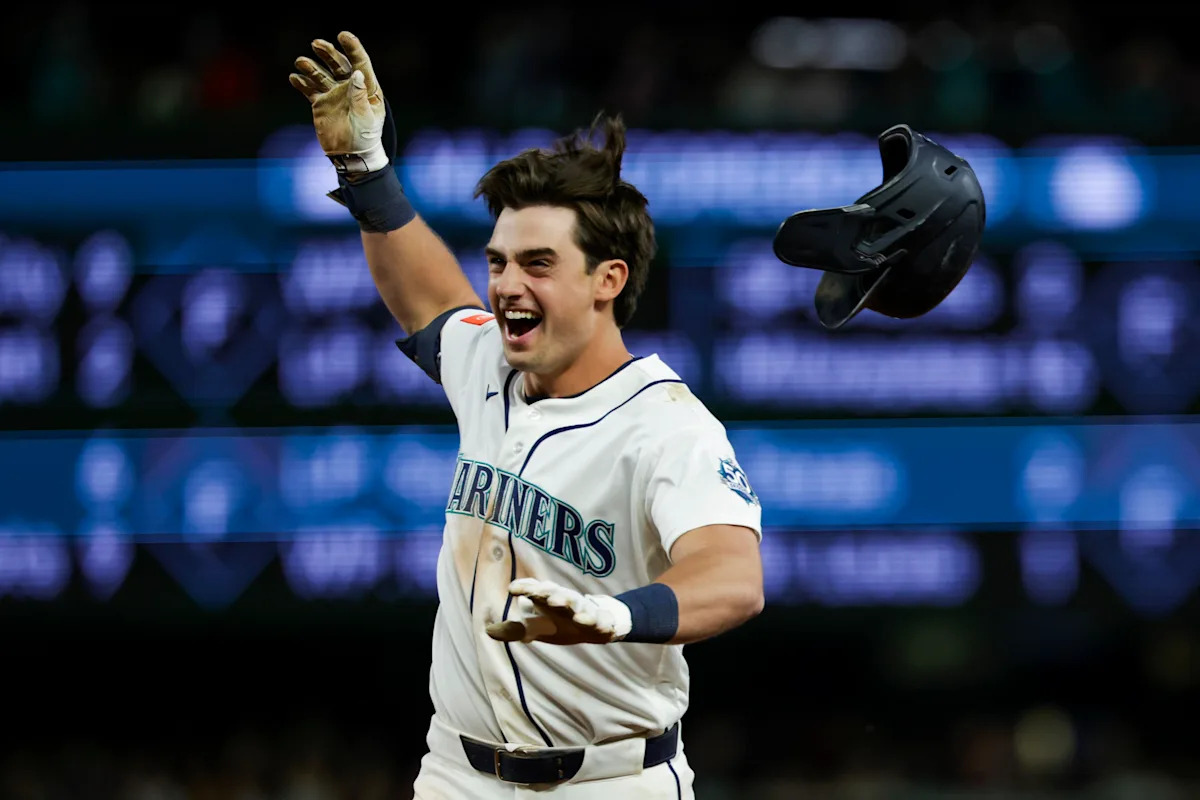
I have been sitting on these numbers for a while because the sample size is so small but we’ve gotten enough to where Young finally has over 50 plate appearances in high-leverage situations. In those situations, his slashline is .273/.396/.500. Dan Wilson has praised Young’s “slow heartbeat” multiple times this season, but it’s different when you see it in action. Young took a cutter off the plate away, and Minter went back to the same spot; he reached out and flicked a little hit into left field for the game-winner, exactly one year and one day after his debut walk-off (this one traveled just a bit further).
If the Mariners are going to keep control of the AL West while their starting catcher and biggest off-season acquisition are shelved, it’s going to need to come from contributions from players like these: a rookie sensation Emerson, a resurgent Hancock, a sophomore no-slump Young. So far, all three are proving their spring awakenings are here to stay.
Read the full article here