





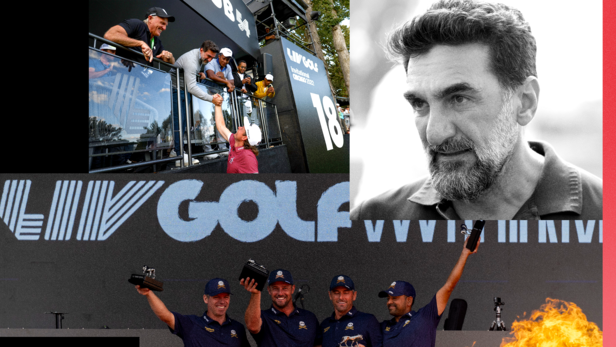
LIV Golf is on life support. The circuit that promised to disrupt the sport by liberating players and democratizing power is losing support from Saudi Arabia’s Public Investment Fund. Its architect, PIF governor Yasir Al-Rumayyan, has stepped down. A recent event was postponed, the league citing heat and a soccer scheduling conflict. LIV insists the project continues, scaled down from its Golf But Louder origins, with a restructured board of directors hoping to find new investment to keep it running come 2027. The rest of the evidence is harder to soften. No funding, no captain, no fanbase to absorb the financial and reputational weight the league is now dragging, its marquee star Bryson DeChambeau openly entertaining a return to the tour he sued.
Should LIV’s attempt at survival fail, it leaves behind a landscape permanently altered—Fissures that will take years to close, loyalties that calcified under pressure, and a generation of fans that watched the sport they love hold itself hostage. It is tempting to declare winners. This is understandable and mostly wrong. Let’s be precise about what happened, because there is a specific kind of silence that follows a standoff that neither side truly won, with the participants left wondering what, exactly, they were fighting for.
Advertisement
RELATED: LIV Golf members have reached out to PGA Tour about return
LIV Golf was not, at its core, a golf league. It was a geopolitical instrument. Saudi Arabia spent an estimated $5 million to $8 billion on the venture because soft-power exercises work. PIF understood, correctly, that associating the kingdom’s brand with the game was worth more than any conventional PR campaign could deliver. The players who signed were not naive about this. Some convinced themselves the cause was separable from the source. Others simply didn’t care. Both positions were defensible in their own way, and both were, ultimately, wrong.
The LIV product was mediocre, although that was besides the point. What made LIV genuinely, existentially dangerous was its bottomlessness, and the greed that bottomlessness unleashed. There is no conventional competitive response to an opponent who has decided that losses are acceptable. The PGA Tour spent a century building a system of merit. LIV walked in and wrote checks that made that system feel like a prank. When Dustin Johnson signed, when Brooks Koepka and Bryson DeChambeau and Jon Rahm signed, each name felt like another stone pulled from a wall that had seemed permanent.
The tour suspended the defectors, asked its remaining membership to fight for the league, then reversed course and announced a framework deal before the deal existed. It was the behavior of an institution that had never gamed out the scenario it was now living through. Jay Monahan was right to fight. He was wrong to pretend, for as long as he did, that the fight was about the integrity of the sport rather than the preservation of the tour. The PGA Tour outlasted its opponent in part because a foreign government decided to redirect its attention elsewhere. That is not the same as winning. The tour had strategy and endurance. It also had luck, and the difference between strategy and luck is the kind of thing institutions are tempted to revise in their own favor afterward.
Advertisement
The professional golf landscape after LIV looks like a neighborhood after a flood—structurally intact in most places, yet waterlines on the walls everywhere you look. The players who stayed, who watched colleagues leave, who made the calculation that their careers and their principles required them to remain, who played through the uncertainty of a tour that was simultaneously suing a competitor and negotiating with it, were never celebrated for staying. Loyalty tends not to be. You are left with the satisfaction of having made a decision you can live with, and you get to watch the tour eventually extend an olive branch to the men who burned it.
The players who stayed were not all the virtuous ones. Some cashed in. The LIV threat handed the tour’s biggest names a form of leverage they had never previously possessed. Stars had always been compensated well. Now they could be compensated transformatively. They knew it and used it. The result was the signature events structure, built specifically to guarantee that the game’s top players would show up and not defect. It was a defensible decision by the tour. It was also, in practice, a mechanism for concentrating wealth and status among a group of men who were already wealthy and already elevated. The structure has a shelf life. At this week’s signature event in Doral, five of the top 15 players are sitting out. The guarantee that the format was designed to deliver is already weakening, less than three years in.
LIV accelerated an inequity already there. It is now structural, and will harden further with the the PGA Tour’s upcoming announcements about a two-tiered tour. A player outside the top tier will not compete for the same money at the same events as a player inside it, and the path between the two is narrower than the tour’s public messaging suggests. The men who leveraged Saudi pressure into restructured compensation did not, precisely, do anything wrong. They acted in their own interest. But the claim that the tour emerged from the LIV era as a meritocracy is a story the tour tells about itself, and one its own membership has questioned. The players who benefited from that acceleration do not get to stand entirely on the right side of history just because they never got on a plane to Jeddah.
2228800436
Icon Sportswire
Advertisement
The most lasting damage may be the hardest to quantify, which is the goodwill of the audience. Golf as a participation sport was growing before LIV, lifted by a pandemic-era surge that had introduced millions of new players to the game and returned millions of lapsed ones to it. Rounds played hit a 40-year high. Equipment sales broke records. Junior participation climbed. The sport had momentum it had not felt in a generation, and the timing was rare, a confluence of cultural availability and demographic interest that the industry had spent decades trying to manufacture. It then spent the next five years asking that audience to care about a labor dispute between multi-millionaires and a sovereign wealth fund.
The casual fan, always the most important and most fragile constituency in any sport, is not an idealist. That fan understands athletics are not synonymous with saints. However, that fan requires the sport to be primarily about sport. LIV made that impossible. Every tournament existed inside a larger conversation about money and loyalty and the kingdom’s human-rights record, a conversation most fans had neither the appetite nor the obligation to follow. The hardcore audience stayed. The hardcore audience always stays. But the viewer who had started watching after 2020, who was learning the rhythms of the season, who had not yet decided whether this was a sport that belonged in the rotation alongside the NFL and the NBA—that viewer was handed an exit ramp, week after week, for five years. Some took it. The industry will be measuring the cost of that for a long time.
The damage was particularly harmful because it was cumulative, a slow tax on attention paid in storylines nobody asked for. Golf exhausted its fans quietly. That is, in certain ways, harder to recover from. The current effort to frame Yasir’s departure, PIF’s pullout, and the postponement of the New Orleans event as “strategic decisions” is part of the same pattern. What this moment does offer is clarity. For five years, golf operated under an atmospheric pressure of uncertainty. Would the deal happen, would more players leave, would the framework collapse, would the Saudis walk away? That pressure is lifting. The air is cleaner. You can see farther.
The work LIV interrupted is still the work. The schedule is bloated. The co-sanctioning relationship with the DP World Tour needs genuine investment to become structural rather than ceremonial. The younger generation of players deserves answers about what a career on tour is worth and what it will cost them. The players returning from LIV deserve something, too. Not forgiveness, which implies a moral accounting that will never settle, but the functional reintegration the sport requires. Some will earn their way back through performance. Others through time. Many will never quite shake it. That is probably how it should work.
Advertisement
There is a version of this story that ends on the triumphalist note. Golf survived! The sport is resilient! That version is incomplete. What LIV revealed, underneath the politics and the money and the posturing, was a question the sport had long avoided asking itself directly: What is professional golf actually for? Is it a meritocracy or only in name? Is it a global sport, or a primarily American entity with global marketing? Are its players independent contractors or franchise assets? Does the history of the game belong to the tour that administers it, or to the game itself? These are not new questions. LIV pulled them into the light and refused to let anyone look away.
The soul of golf has never belonged to a tour or a sovereign wealth fund or a television contract. It belongs to the men and women who play the game, watch it, argue about it. Who make any of this matter in the first place. They were sidelined, asked to spectate a fight they did not start. The game has outlasted wars and scandals and its own periodic conviction that it was dying. Not gracefully, not cleanly, but through a stubborn refusal to be finished. For five years the sport lived that refusal out loud, without much dignity. Survival means little without an accounting of what it cost.
Read the full article here