





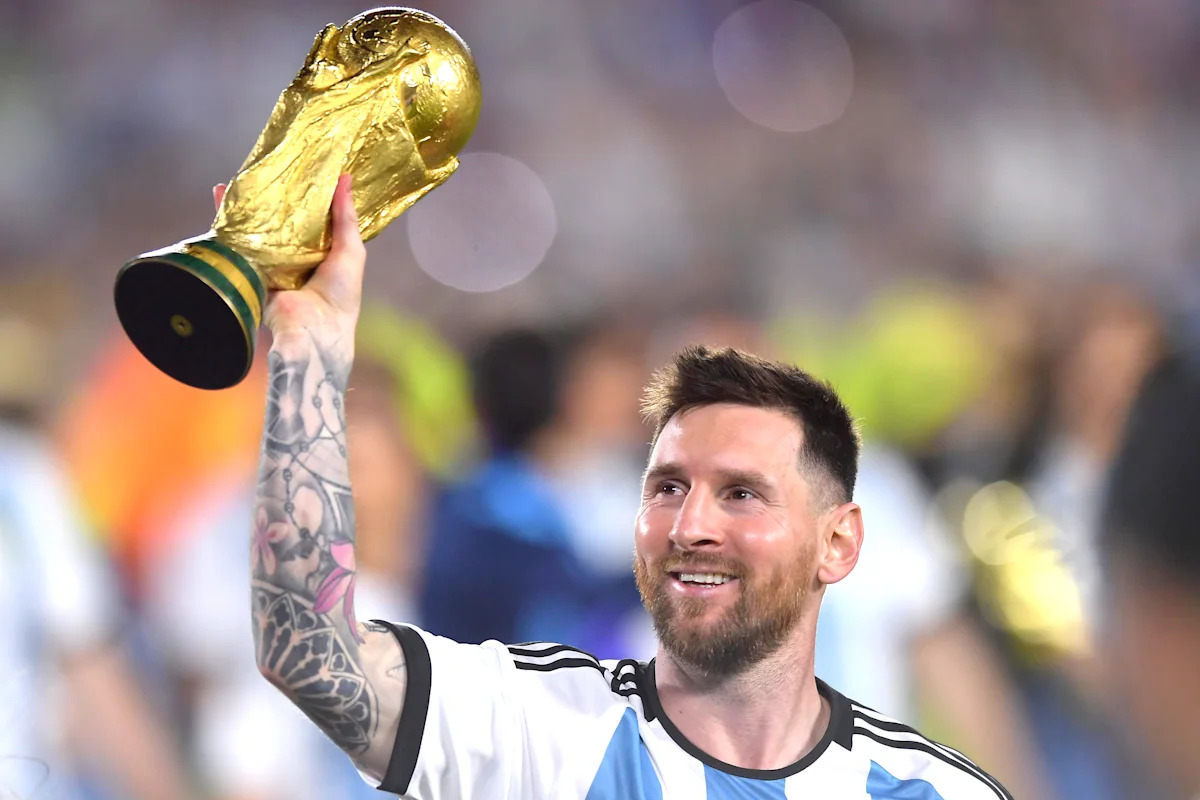
After more than two decades, Lionel Messi is bringing his highly decorated international career to an end. The Argentina captain announced Monday that he has retired from international play, calling it an “incredible experience” to play for La Albiceleste.
Messi’s 21-year international career is the stuff of legends. The forward ends with a World Cup title, two Copa América trophies, two World Cup Golden Balls and the second-most World Cup goals (21) in the tournament’s history, among many other honors. Messi constantly denied father time, putting up some of his best soccer in the later years of his career and continuing to import a high standard of play on a surging Argentina team.
With a long-spanning career and too many accolades to name, it’s difficult to pare Messi’s career down to just a few moments, but here are a few of the most important.
2006: Messi makes his World Cup debut
One year after earning his first senior team call-up, Messi traveled to his first World Cup in 2006. Even as a long-haired teenager, Messi was already a phenomenon.
Advertisement
The then-18-year-old made his debut in the group stage against Serbia, and scored 13 minutes after subbing in.
Though that goal ended up being Messi’s sole contribution across his three World Cup games that year, it was the start of something for the young forward.
2008: Messi leads Argentina to an Olympic gold medal
Messi’s first major international title came at the 2008 Beijing Olympics, when the forward joined the Argentina U-23s and helped them claim back-to-back Olympic gold medals.
But Messi wasn’t even supposed to be there in the first place. Barcelona had initially refused to release the 21-year-old from club duty, but Pep Guardiola, then the brand-new manager of the club, eventually allowed him to go.
Advertisement
With Messi’s help, Argentina went undefeated throughout the run and won all six games played. Messi played in five of those games, scored two goals and got his first major piece of hardware.
Lionel Messi earned an Olympic gold medal just three years into his international career.
(JEWEL SAMAD via Getty Images)
2014: Messi earns his first Golden Ball at the World Cup
After Argentina rolled to another quarterfinal finish at the 2010 World Cup, La Albiceleste was hoping to turn the tide as they traveled to Brazil in 2014. And turn they did, winning five straight games on the way to a strong overall finish.
Messi dominated the group stage, cutting through defenses to score four goals in three matches. Though he went quieter in the knockout round, Argentina’s overall efforts were enough to lead the team to the final — its best finish in 24 years.
Advertisement
Argentina went on to lose 1-0 to Germany, falling just short of that long-awaited trophy. Messi was given the Golden Ball for the best overall player in the tournament, though the close result left him within tangible reach of the trophy he really wanted.


Lionel Messi holds the Golden Ball trophy next to Germany’s Manuel Neuer after the 2014 World Cup final in Brazil.
(Clive Rose via Getty Images)
2022: Messi finally wins it all
After decades of falling short, Argentina finally got a chance to lift the World Cup trophy in 2022. Messi and Co. defeated France in a dramatic penalty shootout to win Argentina’s third World Cup trophy, and its first in 36 years.
Despite talk that the longtime captain was past his prime, and an embarrassing loss to Saudi Arabia to kick off the group stage, Messi truly met the moment in 2022. The forward pitched in seven goals, three assists and indispensable leadership as Argentina made it all the way back to the final.
Advertisement
French forward Kylian Mbappé nearly ruined Argentina’s run to the title more than once in that game, eventually forcing both extra time and the shootout. But Messi and his teammates delivered, and the captain finally got a chance to lift the trophy that had continued to elude him.

2026: Messi leaves it all on the line
After Argentina won the trophy in 2022, there were questions about whether it would be Messi’s last time at the global tournament. But Messi returned to lead La Albiceleste through a wild World Cup for what would end up being the final time.
Messi, who turned 39 during the World Cup, pushed himself hard in the historic tournament. When the forward reached 18 goals, briefly taking the all-time World Cup lead before Mbappé took it back, he said he was too “tired” to remember his favorite. Part of that may have been that he scored a lot of goals during this World Cup, starting things off with a historic hat trick and racking up eight goals across the tournament.
As Argentina continued a series of wild narrow escapes during the knockout round, Messi got a chance to play hero more than once. Probably most crucial was his late equalizer against Egypt, before Argentina managed to snatch a win in stoppage time.
The close calls led Argentina back to the final, though they would eventually lose to Spain. Messi was emotional after the loss, signaling the possibility that it would be his last time on the field in Argentina’s sky blue. In a heartfelt message a day later, Messi said that it would “take time for this wound to heal.”
Advertisement
That wound, along with the death of his father earlier this month, gave Messi much to think about in terms of his international career. But what will never be in doubt is his greatness, and the legacy he brought to the sport.
Read the full article here


