







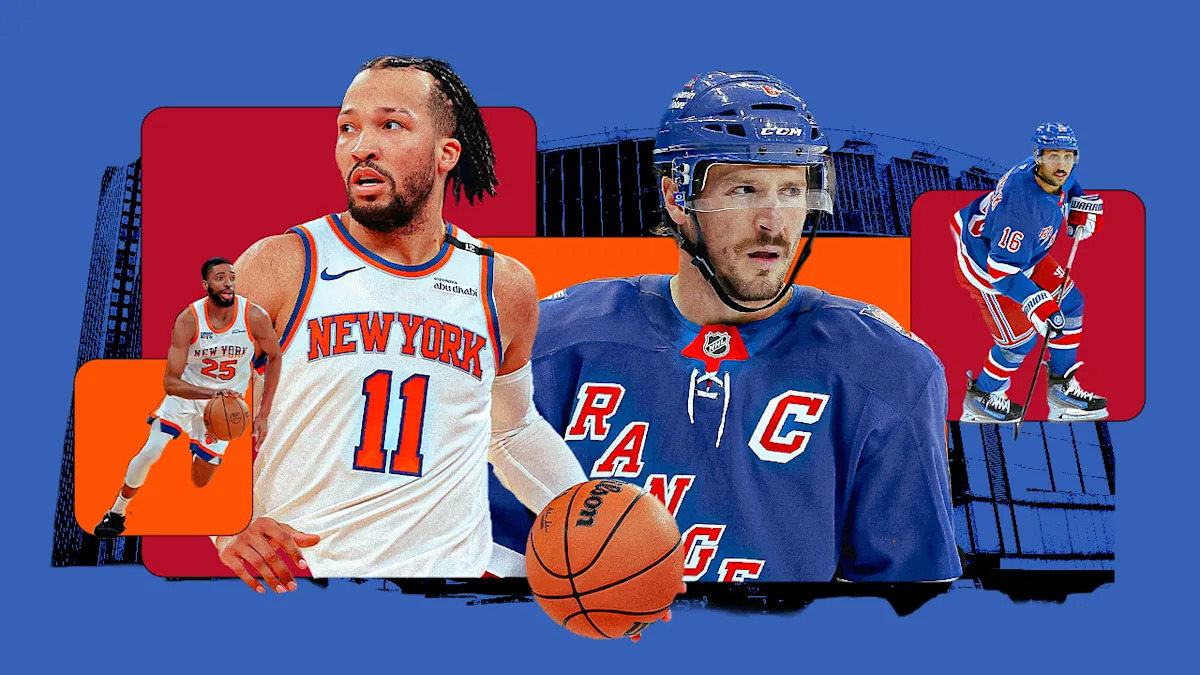
The New York Knicks continued their torrid run through the playoffs Monday night with a 130-93 demolition of the Cleveland Cavaliers in Game 4 of the Eastern Conference Finals. It wrapped up a 4-0 sweep and punched the team’s ticket to the NBA Finals for the first time since 1999.
While the Knicks stayed hot on the court, the club is amid a plan to unlock its full potential off the court by splitting the Knicks and New York Rangers into separate publicly traded companies—both are currently part of Madison Square Garden Sports.
Advertisement
More from Sportico.com
Here is a look at the who, what, when and why behind this potential transaction, which is still subject to league approvals and other conditions.
What is MSG Sports doing with the Knicks and the Rangers?
In February, the MSGS board approved a plan to explore a split. “We believe this proposed transaction would provide each company with enhanced strategic flexibility, its own defined business focus and clear characteristics for investors,” MSGS CEO James Dolan said when announcing the news.
The firm took the next step last week when it filed a Form 10 Registration Statement with the SEC for the proposed spin-off. It continued a long history of the Dolan family splicing up their business empire in the hopes of creating more value, i.e. a higher stock price.
Advertisement
Dolan family patriarch Charles built the family’s first fortune on the back of cable television by founding HBO and building Cablevision into a behemoth that was sold to Altice in 2016 for $18 billion. Dolan died in 2024 at 98; by that point, his son, James, had been running the family’s businesses for nearly three decades.
Cablevision acquired 50% of the Knicks, Rangers and related businesses in 1994 and the rest of the MSG properties three years later. In 2010, Madison Square Garden was spun off from Cablevision into its own publicly traded company.
“This enables MSG to freely pursue its business plan while providing shareholders with the benefit of being able to more clearly evaluate the company’s assets and future potential,” James Dolan said in announcing that split.
The MSG spinoff was the first domino in what is now three unique companies. In 2015, Dolan split MSG in two with the sports teams and venues (Madison Square Garden, Beacon Theater, Radio City Music Hall and Chicago Theater) in one and Madison Square Garden Network (MSGN) in the other.
Advertisement
The next machination was to split the teams and venues in 2020 under MSGS and Madison Square Garden Entertainment. This transaction forced the Knicks and Rangers to sign leases with their new landlords, MGSE. Meanwhile, Dolan launched his Sphere business at MSGN and renamed the company Sphere Entertainment in 2023.
Why is MSG Sports splitting the Knicks and the Rangers?
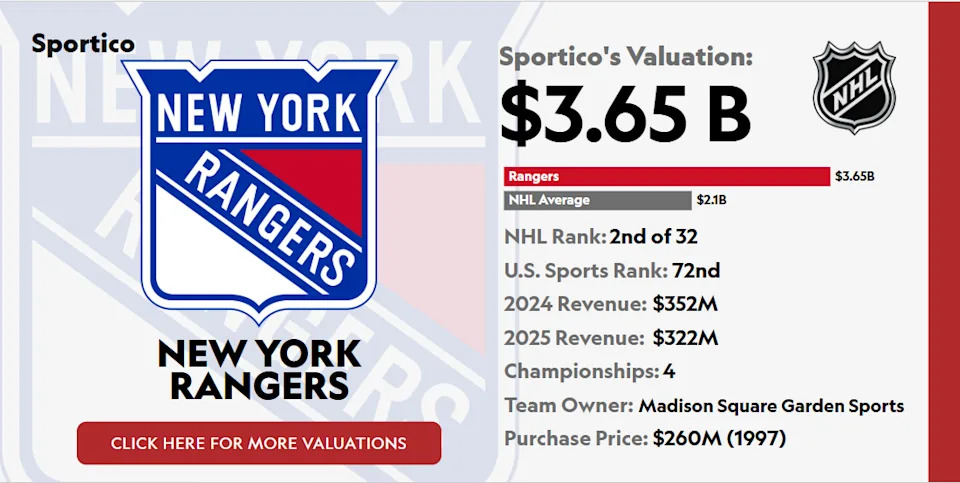
MSGS has long been pegged as having a “Dolan discount” for the stock trading at a steep discount to its enterprise value. MSGS’ current EV is $9.6 billion, a 29% discount to the $13.5 billion combined total from Sportico’s most recent valuations of the Knicks at $9.85 billion and the Rangers at $3.65 billion.
The reality is that sports teams have historically traded at a discount to what they might fetch in a private transaction. The Boston Celtics and Cleveland Indians—now Guardians—both traded at steep discounts before they went private.
Advertisement
Manchester United shares languished at $13 and below its 2012 IPO price but more than doubled on hopes of a sale when the Glazers hired Raine Group to explore their options in late 2022. Jim Ratcliffe ultimately bought 25% of the common stock at $33 per share in early 2024, implying a valuation of more than $6 billion. The stock sank back to $14 after the transaction closed, although it recently rebounded to a two-year high of $20.
There are a couple of strikes working against publicly traded sports teams. Soaring valuations are partly driven by scarcity value, and there is no scarcity value as a publicly traded stock. There are 8,000 securities traded on U.S. stock exchanges, including exchange traded funds, yet just 124 teams in the four biggest U.S. sports leagues, which have added only two new franchises during the past 20 years.
The other issue is sports teams are not great businesses by themselves. Team ownership opens doors for other investment opportunities and are a great tax break when you buy them, but there is reason that investment bankers started valuing teams on revenue multiples—still the standard today—instead of earnings ones, like most companies with a price-to-earnings ratio. Sports teams historically lost money, and while today’s collective bargaining agreements are more owner-friendly and TV deals have soared, teams still have low profit margins or can lose money, with the exception of the NFL.
Advertisement
The Knicks and Rangers lost a combined $22 million after taxes and interest during the 2024-25 fiscal year, per Madison Square Garden Sports’ financial filings, despite the Knicks’ run to Eastern Conference finals.
MSG Sports’ plan to potentially split the teams sent shares up 16% the day it was announced in February. MSGS shares are up 89% during the past year, bringing the public and private valuations more in line.
Why is MSG Sports splitting the Knicks and Rangers now?
A transaction 3,000 miles away last year helped heat up spinoff talks when Mark Walter agreed to buy the Los Angeles Lakers at a $10 billion valuation, months after the sale of the Boston Celtics for $6.1 billion. Before the rise of the Golden State Warriors, the Knicks and Lakers were the NBA’s financial titans in a league of their own.
Advertisement
“The spin enhances the possibility of raising capital, and [it] makes minority stake sales easier, as there are two distinct teams’ business models, which makes for a clearer investment vehicle,” Seaport Research Partners analyst David Joyce wrote in an April research note.
Sportico recently spoke with multiple investors who think Dolan could move beyond just an LP stake deal and sell one of the teams outright. Someone familiar with the spinoff details pushed back on the premise of a control sale of either team.
A spokesperson for MSGS declined to comment on the possibility of a control sale of one of the teams.

Dolan has long prioritized his sports teams, but the 71-year-old has increasingly spent time on the Sphere, a project that was his creation and described as his “baby” by those close to him. Dolan envisions a global network of Spheres, using the same IP, with the next two iterations already in the works for a mini-Sphere outside Washington, D.C. and a full-size version in Abu Dhabi.
Advertisement
What potential issues could arise in the Knicks-Rangers split?
The spin-off is expected to be structured as tax-free for shareholders, but there are other tax consequences to this deal.
A new federal tax law expands a 2017 tax provision that limited the compensation public companies could deduct for tax purposes. The 2017 provision capped the deduction at $1 million each for the CEO, CFO and the next three highest-paid officers. The new law expands the number of employees to also include the next five highest-compensated ones starting with the 2027 tax year.
An independently traded Knicks team would pay its top five executives and top five players $195 million—nearly 90% of that to players—triggering $55.4 million in taxes, per Joyce, after excluding the $1 million per employee in maximum compensation. The Rangers would incur a post-spinoff incremental tax of $19.8 million on $76 million in salaries.
Advertisement
Best of Sportico.com
Sign up for Sportico’s Newsletter. For the latest news, follow us on Facebook, Twitter, and Instagram.
Read the full article here


