




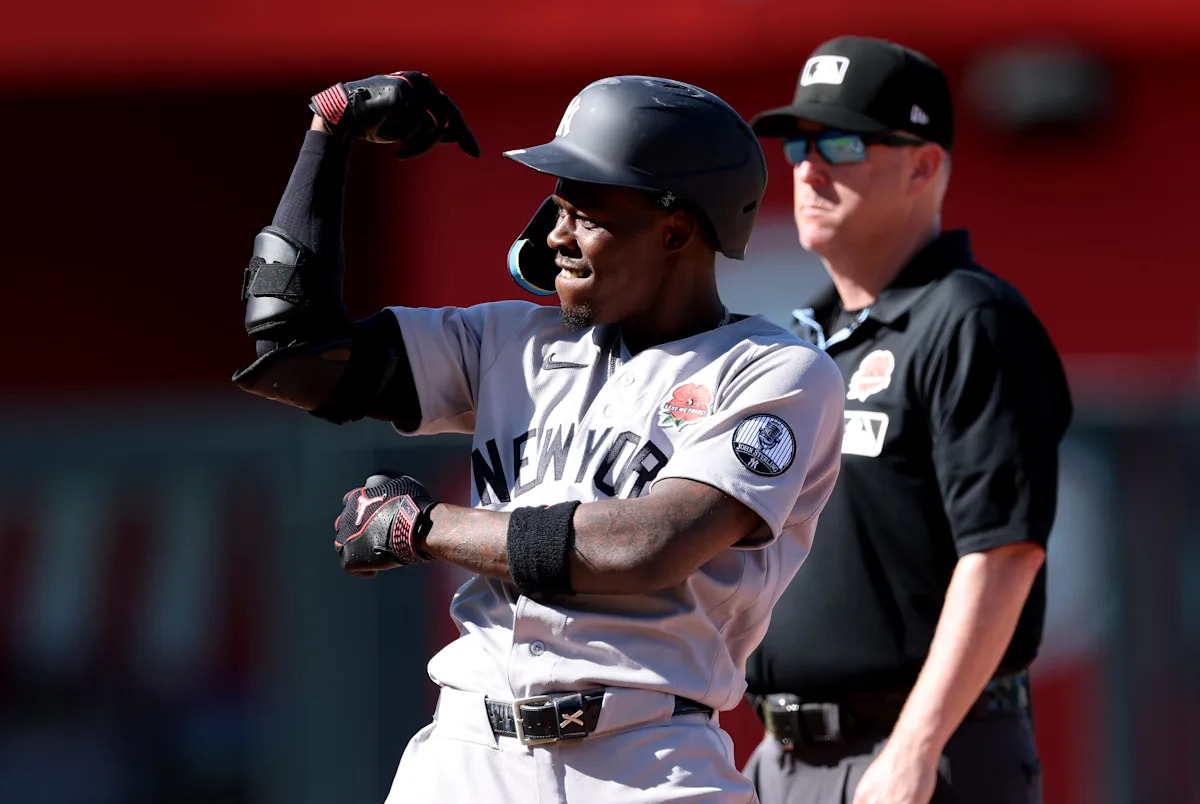
Coming into the 2026 season, it felt like this was the year that Jazz Chisholm Jr. would leap into superstardom. After a tantalizing 2024 that saw him post 2.3 WAR with the Yankees in just 46 games, he posted a 30-30 season to go with a 126 wRC+ in 2025, solidifying his status as one of the best second basemen in the game. With better health and a bit more consistency, it really felt like Chisholm would challenge Ketel Marte for the title of the best 2B in MLB.
So far, that hasn’t happened. Through Monday’s action, Jazz’s seasonal batting line sits at .247/.324/.389, good for a 104 wRC+. That’s far from disastrous – see Wells, Austin and McMahon, Ryan if you want a really bad time – but it’s a clear step down from last year. The defensive metrics like him enough to prop his WAR up to 1.3, but it feels like he’s had more than his fair share of foibles in the field too. I mean, who could forget this game-costing play from April against the Rays?
Advertisement
View Link
Given the high expectations and underwhelming results to date, it’s hard not to feel frustrated with Chisholm. However, I would advise fans to not lose sight of the bigger picture with him. Even the current version of Jazz is a solid player and a worthy regular. He doesn’t need to be a superstar to be a perfectly useful piece for the Yankees.
First, about Chisholm’s performance to date. There’s no denying that his bat has been underwhelming so far, but it’s important to keep in mind that despite his struggles he’s managed to maintain a league-average line. The lack of power and hard contact is concerning, yes, but Chisholm draws just enough walks to keep his bat from completely cratering even when the homers aren’t coming.
Will the homers ever come, though? Given that Chisholm hit 55 homers over his past two seasons, it seems easy to say yes, but his lackluster contact quality metrics for this year – a paltry .276 xwOBA and (excluding 2020) a career-low 28.5% hard hit rate – do give me pause. But Statcast tells us he still has above average bat speed, and his swing path has actually followed the ideal attack angle more often than in previous years. All of this suggests to me that Chisholm’s power shortage has more to do with timing and swing decision issues rather than erosion of his core skills. While the latter is irreversible, the former issues are definitely fixable through coaching, although it might take time. I fully expect that Chisholm will be able to regain his power eventually.
Advertisement
On the other side of the ball, Chisholm’s defense is certainly a polarizing topic, with proponents pointing to his stellar metrics, and detractors pointing to his mistakes and misplays. This is to be expected; there’s less certainty with defensive metrics as with offensive stats, leading to the eye test occupying an outsized role in conversations. And while the eye test, especially when the scouting is done by an experienced professional, can be invaluable, it is also easily sullied by cognitive biases, chief among them our tendency to latch on to negative experiences rather than positive ones. This complicates things, especially when evaluating a player like Chisholm, who is capable of both sparkling web gems and boneheaded miscues.
I’m not here to definitively declare whether Jazz is defensively Good or Bad. What I will try to do is provide some perspective. If you’re of the opinion that Chisholm is a liability in the field, maybe you’re only remembering the bad stuff. But for every lowlight, there is a highlight.
Here’s an example of Chisholm’s nice lateral range:
View Link
Advertisement
An example of both his spatial and situational awareness:
View Link
And finally, some good old-fashioned gamesmanship:
View Link
Again, my point isn’t that Chisholm is good just because of these three plays. It’s that Chisholm has demonstrated the capacity to be great defensively as shown by these plays, and that these should factor into the discussion just as much as his mistakes. You have to take the good with the bad, and in my humble opinion, Jazz provides enough in the first category to live with the times when he delivers something in the second one.
All things considered, even the current, underwhelming version of Jazz provides league average offense with a high defensive ceiling. That’s a valuable player to have on your ballclub! And when you zoom out further, he becomes even more attractive – since joining the Yankees in July 27, 2024, only Nico Hoerner and Ketel Marte have posted more WAR as a 2B. If he can just get his bat back to where it was last year, the title of best second baseman in MLB is still well within Jazz’s reach.
Read the full article here


