





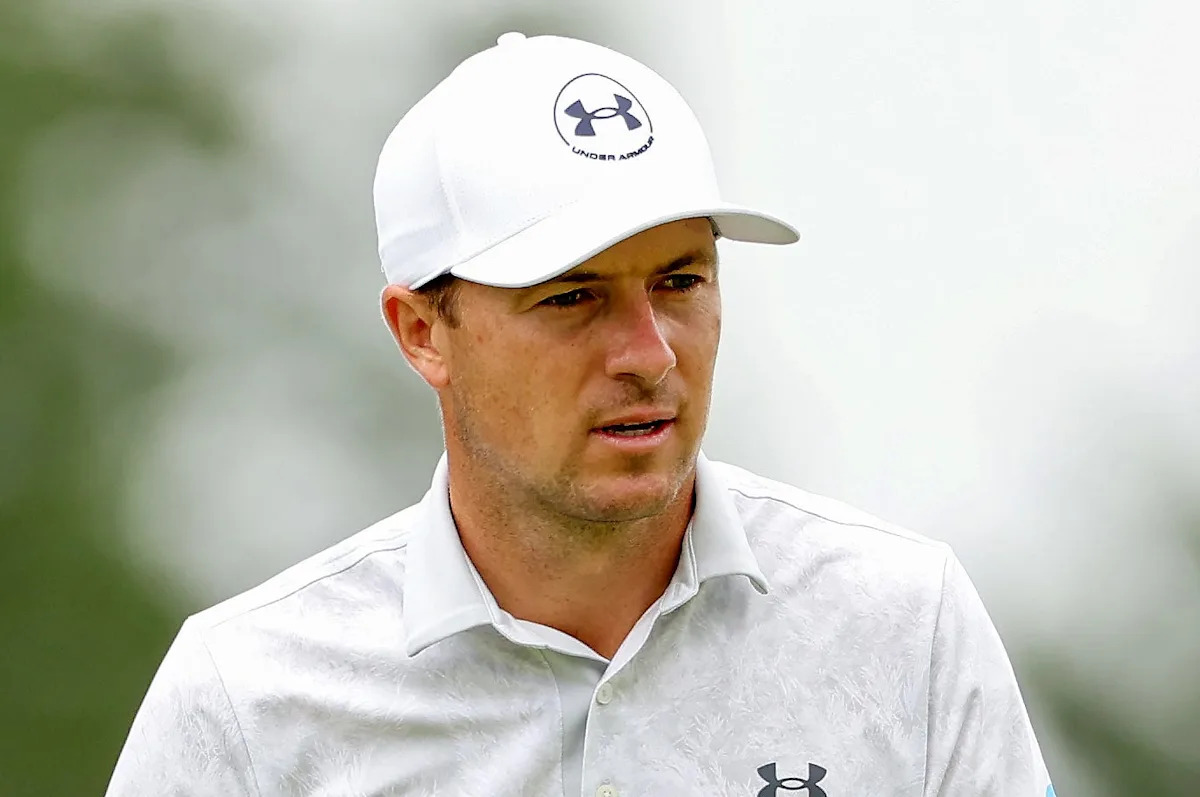
For over half a decade, we’ve been asking the wrong questions about Jordan Spieth: Can he get back to the form of 2015 when he won the Masters and U.S. Open before turning 22? Can he become the player who climbed to No. 1 in the world and looked capable of dominating the game for years? Can Jordan Spieth, who made impossible par saves seem routine and rolled in enough momentum-changing putts, become that guy again?
They’re understandable questions, but Spieth himself may have quietly moved beyond them to concentrate on other things.
Advertisement
During his press conference Tuesday at the John Deere Classic, Spieth was asked to compare the golfer he is today with the one who burst onto the scene a decade ago. Most people point to 2015 as the high-water mark of his career — when he was that guy — but Spieth doesn’t.
“Everyone looks at how many wins, and they think that’s when you were the best,” he said. “It’s not.”
Instead, he pointed to 2017.
More: Jordan Spieth believes sports betting might play a factor in how crowds treat golfers
Jordan Spieth, and his caddie Michael Greller, react after holing out of the sand for a birdie during the first playoff hole at the 2017 Travelers Championship to defeat Daniel Berger.
Jordan Spieth says 2017 was his best year
He won only three times that season, but he believes it was the best golf he has ever played. If a few more putts had fallen, he said, he might have won seven tournaments instead of three. The trophies in Spieth’s house tell one story, which is the one most fans understand, but the Texan tells another.
Advertisement
The question shouldn’t be whether today’s Spieth resembles the player who won three majors before his 24th birthday. Instead, can he resemble the golfer he thinks he once was?
Over the past week, I’ve spent far too much time digging through Jordan Spieth’s career numbers. I studied his putting statistics from 2015 through today, revisited his strokes gained numbers, looked at how his Official World Golf Ranking has changed and talked with Brad Faxon, who is universally acknowledged as one of the finest putters ever on the PGA Tour, about what happens when elite players see a dip in the skill that once defined them.
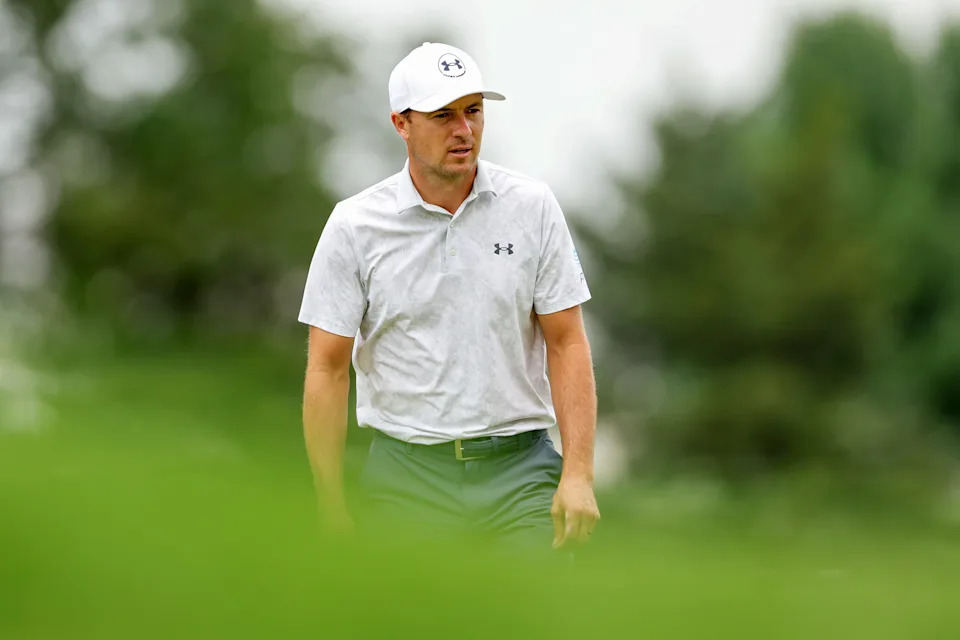
Jordan Spieth during the second green during the second round of the 2026 Travelers Championship.
Spieth’s game has evolved with age
The picture that emerged isn’t nearly as simple as saying Spieth isn’t as good as he used to be. He’s different, just like all of us are different after a decade.
Advertisement
Some parts of his game have slipped while others have quietly become stronger. Taken together, they help explain why a player who once seemed destined to spend a decade among the world’s top five has instead spent much of the last several years trying to reinvent himself.
During Spieth’s apex, from 2015 through 2017, he won differently than almost everyone around him. Rory McIlroy overwhelmed golf courses with speed. Dustin Johnson overpowered them. Jason Day had length combined with a putter that seemed incapable of missing.
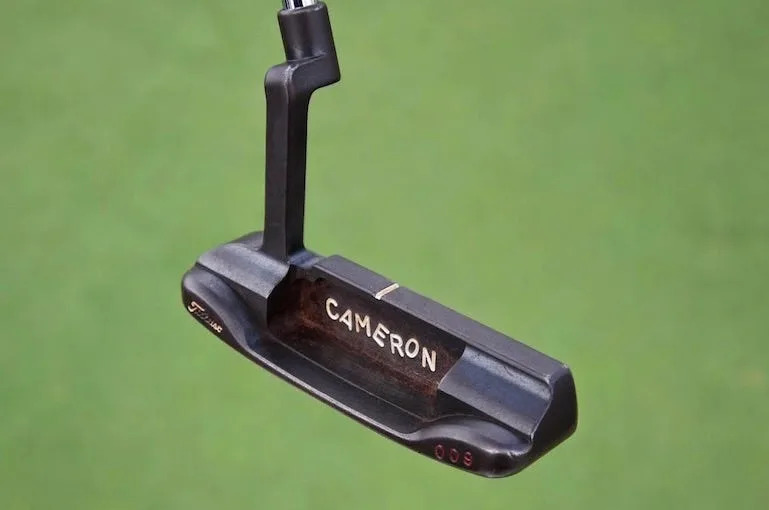
Jordan Spieth used this Scotty Cameron 009 putter in college and throughout much of his professional career until early 2025.
Spieth’s formula was based more on precision. He paired elite iron play with elite putting, and that combination was devastating. His approach shots created opportunities, and then he converted the kinds of putts that typically determine who wins PGA Tour events. Not the occasional 40-footer that makes the evening highlight shows, but the 10-footers for birdie, the slippery 8-footers to save par and the eyebrow-raising 15-footers that suddenly put pressure on everyone else in the field.
Advertisement
Those were the strokes that separated him from almost everybody else. Today, the statistics tell a more nuanced story than many people realize. As the chart below reveals, Spieth is actually longer off the tee than he was during those peak years. About 18 yards longer this season than he was in 2015.
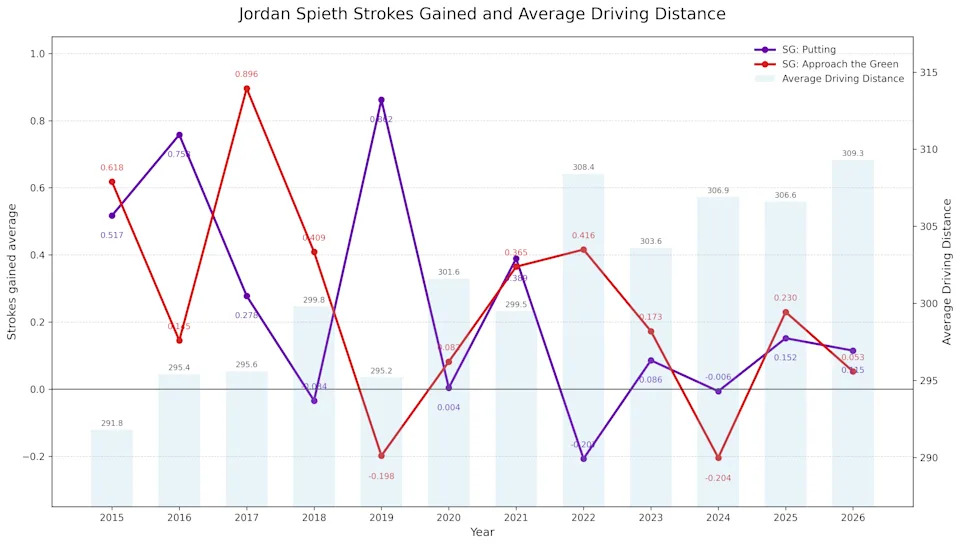
Jordan Spieth’s career Strokes Gained: Putting and Strokes Gained: Approach the Green averages, and Average Driving Distance.
His iron play (red), which dipped significantly after 2017, bounced back through 2022, but it has been inconsistent over the last few seasons. On Tuesday at the John Deere, he said he believes his mechanics are the best they’ve been in years.
“I feel like my game is in a really good state,” Spieth said. “I’m more consistent and an all-around better player than I’ve been in a long time.”
Advertisement
At first glance, that sounds difficult to reconcile with a player who has spent years outside the game’s elite and who slid from No. 49 on the Official World Golf Ranking last week to No. 53 when he arrived at the John Deere Classic .
Mid-range putts have changed Spieth’s trajectory
Then you look deeper. The biggest statistical difference between the Jordan Spieth of 2015 through 2017 and the Jordan Spieth of today isn’t that he’s forgotten how to make long putts. In many ways, he’s still one of the Tour’s better lag putters. He can still produce the occasional 30-footer that leaves galleries shaking their heads. The biggest change has come from roughly 10 to 20 feet.
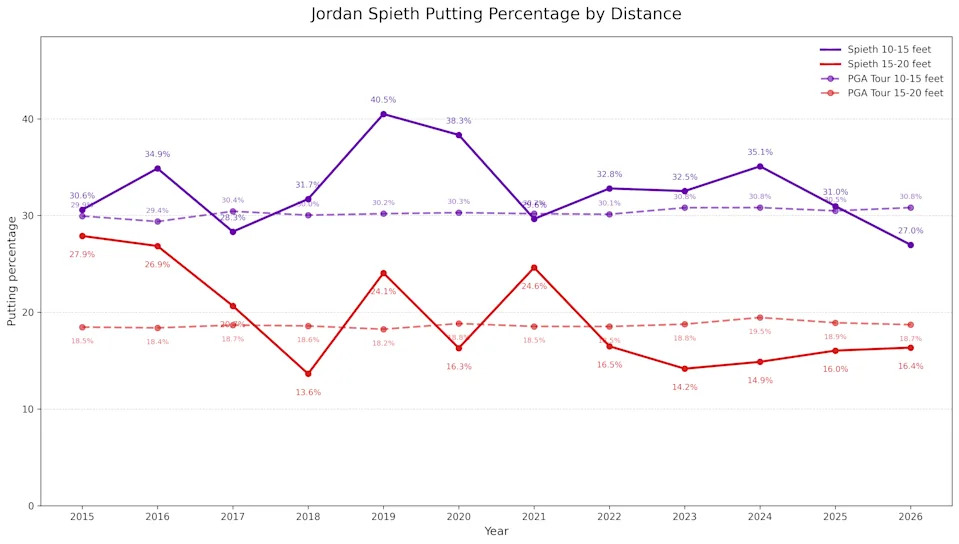
Jordan Spieth’s putting from 10-15 feet and 15-20 feet compared to the PGA Tour average from those distances.
As you can see in the chart above, in 2015 and 2016, Spieth holed an insanely high percentage of putts from 15 to 20 feet (red), and then was outstanding from that range in 2019 and 2021, but since 2022, he has performed below the PGA Tour average from that range.
Advertisement
In 2016, 2019 and 2020, he also made a ton of 10- to 15-foot putts (purple), and he stayed above Tour average for several seasons until he dipped lower last season. So far in 2026, he’s below Tour average from 10 to 15 feet.
At the same time, his short game, while still very good, isn’t quite producing as many kick-in pars and tap-in birdies as it once did.
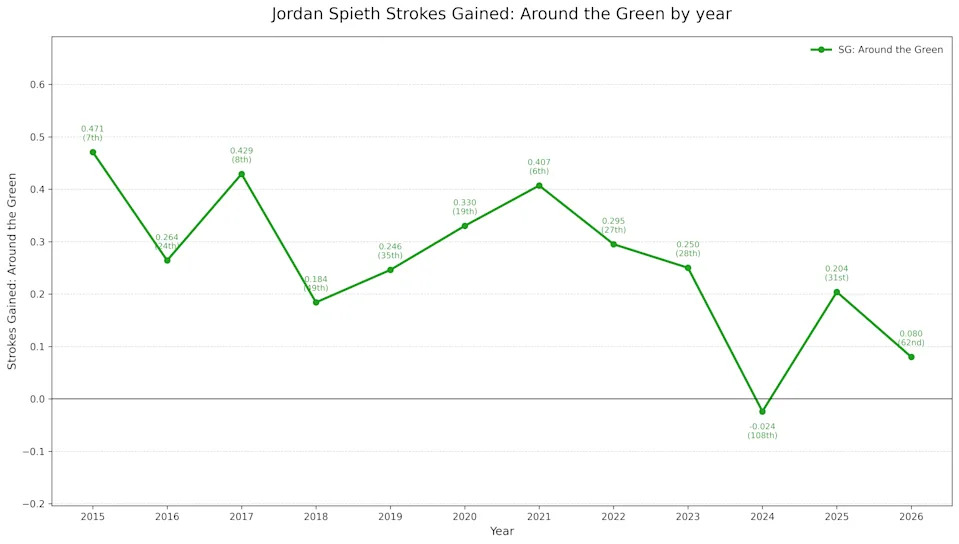
Jordan Spieth’s Strokes Gained: Around the Green average.
Those aren’t independent trends. They feed each other.
When your chips, pitches and bunker shots around the green finish a little farther from the hole than they did a decade ago, you naturally face fewer 3- to 5-foot putts and more putts from a longer range, and if you’re making fewer of those putts, your scrambling percentage declines and your scoring average creeps. The change isn’t dramatic enough for most fans to notice on any given Thursday afternoon, but over the course of an entire season it becomes the difference between winning tournaments and raking up a bunch of top 30s.
Advertisement
Injuries, other reasons for Spieth’s slight dip
Several things in recent years have likely played a meaningful role in Spieth’s struggles.
He was candid about a wrist injury that eventually required surgery in August, 2024. Last year, he withdrew from the Travelers Championship because of neck and upper back pain. In addition to that, he and his wife Annie became parents to three children. Life got more complicated than it was when he was a 22-year-old, so much of his world revolved almost entirely around golf.
Those aren’t excuses. They’re explanations and context. Faxon brought them up.
“I heard he was experimenting with mallets,” Faxon said Saturday at the Travlers Championship before going into the NBC Sports booth and working as an analyst during the broadcast. “He’s probably not happy with his game altogether. And, you know, what comes first? You lose your confidence or do you lose mechanics? Do they go together? And, you know, life in truth, right? He’s a father of three kids now. He’s got a lot going on. He worked through a ton of injuries. Stuff like that. The hand injury. I can’t imagine it being harder to get over as a golfer than that, but I’m a huge Jordan Spieth fan.”
Advertisement
Spieth seemed to acknowledge as much Tuesday, but what stood out wasn’t his discussion of injuries. It was the way he described the work. Asked if he was always a grinder or if he developed into a grinder as he has worked over the last few seasons to get his game back, Spieth reflected before answering.
More: Photos: The many emotions of Jordan Spieth through the years
“I would say that the way I’ve played golf was always a little less, you know, ‘pretty,’ even at my best. You know, it looked very pretty sometimes, but I felt like my ability to get out of trouble or hit certain shots that other guys didn’t want to try or something like that has always been something that has been a strength of my game.”
Then he got introspective and added, “You know, between my own struggles with what was going on, just mental struggles to physical injuries to whatever, you know, it took me a little while to get back on the right path. I felt like I got back on the right path back in ’21. Then I ran into where I had to have surgery a couple of years ago. As I mentioned a few minutes ago, I feel like right now, I feel like I’m the best I’ve been in 10 years or seven, eight years, whatever it is. It’s not quite showing in results. And I’m certainly still making some mistakes and don’t quite have all the tools, but I know what I need to do, how to do it.”
Advertisement
Finally, he said the part that every golfer who has ever been frustrated by the game can relate to.
“Getting rewarded on the other side would be nice. I’m human. I’d really like the reward. I’d like the results,” Spieth said. “But if I know that I’m working in the right direction and I’m gaining freedom from that, and I’m enjoying going out and doing what I’m doing — there was a time where that wasn’t the case — and all I hoped for was to be in that position again, whether I won another tournament or not. So I’m very pleased to be there. Now I’m just frustrated at the lack of results for what I feel like I should be getting out of it based on how I feel my game is.”
That isn’t the voice of someone wandering through the wilderness. It’s the voice of someone who believes he’s finally found the trail. Whether it leads back to major championships is another question entirely.
Spieth’s longevity is impressive
Compare the Official World Golf Ranking from the first week of July 2016 with this week’s rankings. Spieth was No. 3 in the world back then. Today, he is No. 49. Only 10 players who were inside the top 50 a decade ago are still there today.
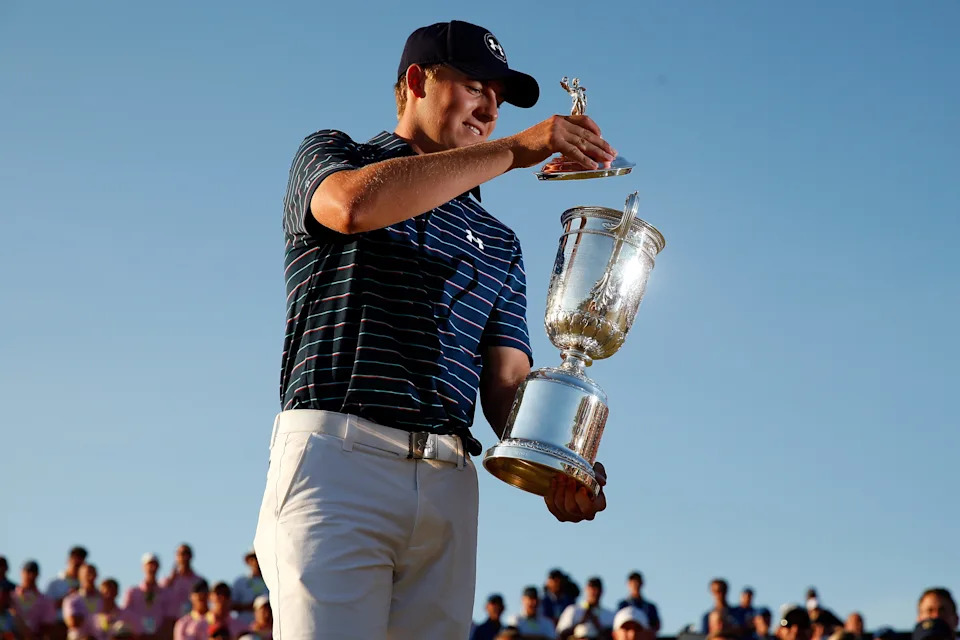
Jordan Spieth of the United States poses with the trophy for photographers after winning the 115th U.S. Open Championship at Chambers Bay on June 21, 2015 in University Place, Washington.
When I mentioned that statistic to Faxon, he didn’t talk about putting. He talked about greatness.
Advertisement
“When you’re measuring greatness,” he said, “you measure longevity.”
The Jordan Spieth who walked off the 18th green at Royal Birkdale with the Claret Jug in 2017 isn’t coming back. Very few athletes, in any sport, ever recreate the very best version of themselves a decade later. Injuries happen. Life changes. Competitors improve. Time has a way of demanding evolution from even the most gifted players.
Listening to Spieth on Tuesday, I couldn’t help wondering if we’ve been asking him to chase a version of himself that no longer exists.
Perhaps that should no longer be his goal.
Maybe the challenge isn’t becoming the Jordan Spieth of 2015 or even 2017. It’s becoming the best version of the golfer he is today, a player with a healthier wrist, a more complete golf swing, a deeper appreciation for the work and enough perspective to understand that careers aren’t defined by how quickly they begin, but by how well they endure.
Advertisement
Two weeks from now, Spieth will return to Royal Birkdale, the site of his last major championship victory. He’ll arrive older, healthier than he has been in years and convinced that his game is moving in the right direction, even if the results haven’t fully reflected it yet.
That doesn’t mean he will play a big role on Sunday at the season’s final major and it doesn’t promise a return to No. 1 in the world.
But after spending a week looking backward, I came away believing the most interesting part of Jordan Spieth’s career may no longer be the extraordinary player he once was. It may be the quest he’s on to be the player he might still become.
David Dusek is a senior writer at Golfweek.
Advertisement
This article originally appeared on Golfweek: Jordan Spieth data deep dive: Are we asking the wrong questions?
Read the full article here