





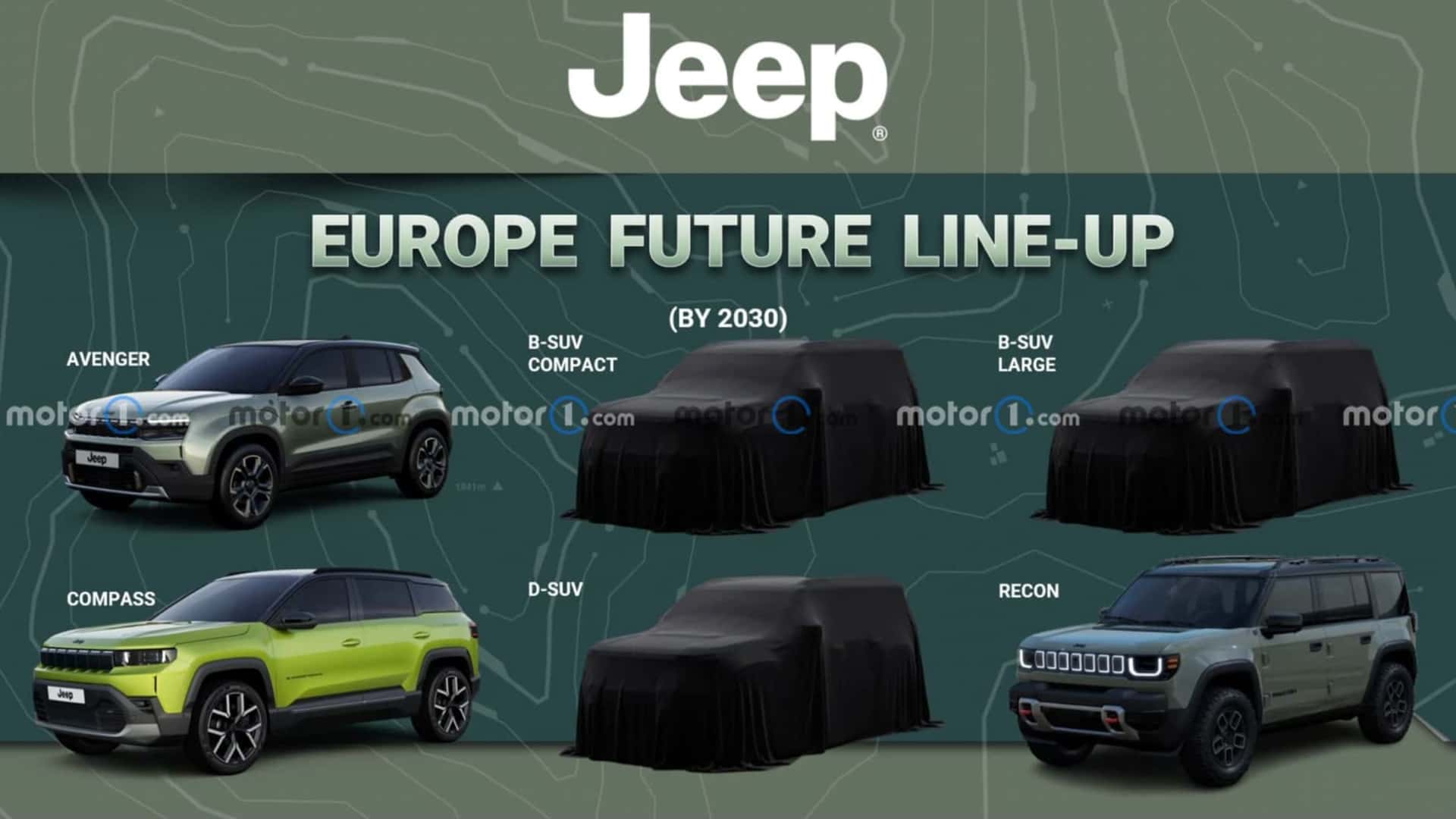
- Jeep’s European lineup is set to expand with three additional models spanning the B and D segments.
- Two new B-segment SUVs are planned to sit alongside the Avenger.
- A mid-size D-segment SUV developed with Dongfeng will join the range, part of Jeep’s broader global strategy.
During Stellantis’ presentation of its new global plan, one slide in particular left many people—including us—scratching their heads. The section covering upcoming Jeep models showed just one new vehicle: the Wrangler Scrambler, a smaller pickup positioned below the Gladiator. For such a key brand for Stellantis, the brief mention felt surprisingly limited.
As it turns out, that slide was only a small preview of what Jeep has planned between now and 2030. In a separate online briefing, the brand’s leadership hinted—without offering specifics—at three new models destined for Europe. Here’s what we know so far.
2027 Jeep Avenger (Euro spec)
Photo by: Jeep
Jeep’s Current European Lineup
At present, Jeep’s European lineup consists of just two models: the Avenger and the Compass. The upcoming Recon—an electric off-roader revealed some time ago—is expected to arrive in early 2027. It will effectively replace the Wrangler, which is set to exit the European market by the end of 2026.
The company has confirmed the Wrangler’s withdrawal, noting that bringing it back to Europe would be difficult under current safety and emissions regulations. Its distinctive shape limits flexibility in meeting crash-test requirements. Jeep says it is still working on potential solutions, but for now, it remains off the official European product roadmap.
The Recon will complete a trio that is expected to expand further in the coming years, although Jeep has not yet shared a detailed timeline or reveal schedule for its future models.

Photo by: Jeep
Jeep’s Next Models
Looking ahead, Jeep’s European lineup will grow with two additional small SUVs (B-segment) that will sit alongside the Avenger. With the Avenger measuring 161.4 inches (4.10 meters) in length, these new models are expected to be slightly larger, around 165.4 inches (4.2 meters).
Internally, Jeep refers to them simply as a “B-SUV Compact” and “B-SUV Large.” Based on current indications, the company is not concerned about overlap within the segment. An early glimpse of one of these models may have been shown during Stellantis’ original presentation.
While details remain limited, the two SUVs are expected to differ in both styling and positioning. Official names have not been confirmed, but one possibility is the return of the Renegade nameplate, which was discontinued at the end of 2025.
Both models will be underpinned by Stellantis’ new STLA platform architecture, designed for multi-energy use. This will support internal combustion engines, full hybrids, and fully electric powertrains, including Stellantis’ new hybrid system likely based around the 1.2-liter turbocharged engine.
The third new Jeep will be a mid-size (D-segment) SUV developed in collaboration with Dongfeng, as recently announced. Jeep has previously confirmed that new models will be developed and manufactured in China for both domestic and global markets, and this project further reinforces that strategy.
Despite the shared platform, Jeep has emphasized that this will be a true Jeep product, with in-house design and engineering. It will not be a rebadged model, but a fully developed SUV built on a platform currently being co-developed with Dongfeng. Like the smaller models, it will also be multi-energy, with electrified and fully electric versions planned.
All three upcoming models are expected to retain core Jeep traits, including available all-wheel drive and the brand’s familiar design and off-road character.
Where Will The New Jeeps Be Built?
For now, the only confirmed production location relates to the mid-size SUV, which will be manufactured in China. For the two smaller models, Jeep has only said it has “a very clear plan” but is not yet ready to provide details, while also referencing the proposed Industrial Acceleration Act—a potential European policy aimed at encouraging more automotive production within Europe to reduce reliance on overseas manufacturing.
Motor1’s Take: Jeep is clearly trying to build a scalable European footprint around the B-segment while using global partnerships to fill out the upper end of the range. The reliance on multi-energy STLA platforms also shows where Stellantis is heading overall—flexibility over specialization. The bigger question isn’t whether Jeep will have enough models, but whether it can maintain a distinct identity across such a wide mix of platforms, sizes, and development regions.
Read the full article here