





DUBLIN, Ohio — David Graham sat in his living room at his Dallas home watching Golf Channel around 6 o’clock on a Wednesday night late last May when the name Jack Nicklaus flashed on his caller ID.
Graham turned to his wife and said, “This could be a nice phone call.”
Advertisement
Indeed, it was. Nicklaus phoned from the same room where, at a dinner gathering of The Captain’s Club, a group of roughly two dozen members — including the likes of Tom Watson, Paul Azinger and Judy Rankin — voted to make Graham the 2026 Memorial Honoree.
“I’m honored and I appreciate it and I look forward to it. Thank you, sir,” said Graham, a two-time major winner, the 1980 Memorial champion and one of just five players to claim titles on six continents. Replied Nicklaus: “We’re glad it’s going to be you.”
Nicklaus chuckled in a later phone conversation as he recalled hearing Graham sobbing and noted how one of the crustiest of curmudgeonly golfers had become a big softie in his later years. “David will have tears streaming down his face sometimes if you just say hello,” he cracked.
More: Jack Nicklaus’ warning: New PGA Tour schedule is a problem
Advertisement
Indeed, Graham’s become the type in need of a box of tissues when attending a bank opening. Nearly a year after hearing the good news from Nicklaus, Graham, who turned 80 on May 23, becomes emotional simply recounting that momentous call, and for good reason. His bond with Nicklaus goes far beyond respect between competitors. Their friendship has spanned six decades, and Graham has never forgotten all that Nicklaus and his wife Barbara have done for him and his family. That’s why Graham is quick to say that while being admitted to the World Golf Hall of Fame may be considered golf’s highest honor and one that was bestowed upon the Australian in 2015, the Memorial Honoree stands alongside it in his book.
“He said that?” Nicklaus asked when told how much Graham revered the award, which will be bestowed upon him during a ceremony on Wednesday on the eve of the 2026 Memorial. “I feel very proud to be his friend.”
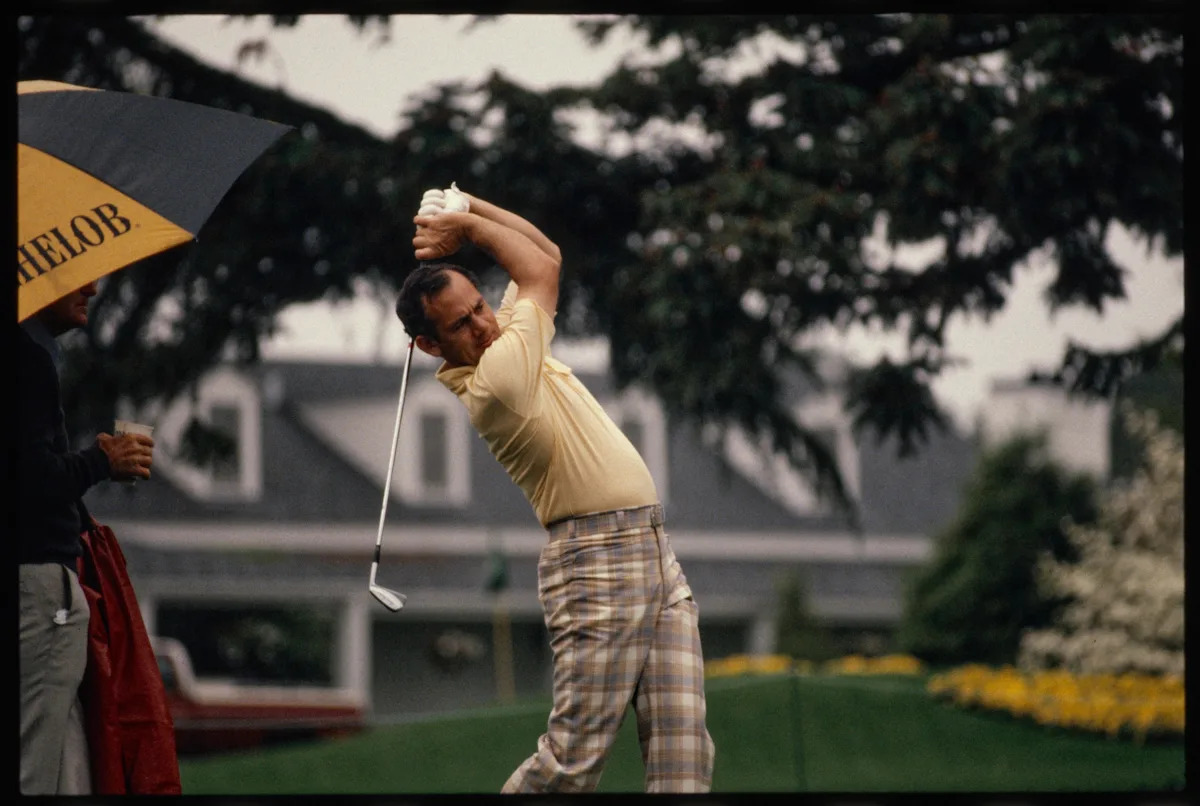
4/9/1981; Augusta, Georgia, USA; David Graham during the 1981 Masters Tournament at Augusta National GC. Mandatory Credit: File Photo -The Augusta Chronicle via USA TODAY NETWORK
‘How do you beat someone like that?’
David Graham still remembers the first time he met Jack Nicklaus as if it were yesterday. He was changing his shoes in the locker room at Royal Hobart Golf Club in Tasmania when Nicklaus arrived on a Wednesday afternoon for the 1971 Australian Open, one of six times he would win Graham’s national open. Nicklaus opened his bag and four or five pairs of shoes fell out. He asked Graham if he wanted to join him and they went out to play the back nine. The par-4, 12th was a short, severe dogleg to the right, a 2-iron and wedge but not for Nicklaus.
Advertisement
He said, “If I go over the trees, can I knock it on the green?” Graham didn’t think it was a good idea, but Nicklaus decided to give it a try. He ripped one to 15 feet. Then he rifled a 1-iron into the teeth of a howling wind that reached the green in two at the par-5 18th and Graham thought, “How do you beat someone like that?”
Afterwards, they returned to the practice area and he sat on the end of his golf bag and watched Nicklaus stripe golf balls. “I remember distinctly getting a phone call from him later that day asking me to get dinner with him and that was the start of a beautiful friendship,” Graham said.
Nicklaus said he always has admired how Graham came out of a little pro shop in Melbourne, Australia, moved to a faraway land and established a new life.
At age 13, Graham took up the game at Wattle Park Golf Club, a nine-hole course in Melbourne, where the pro, John Green, recognized a spark of interest in the game and offered him a job in the shop after school and on the weekends. Before long, he won the junior club championship and the small cup rests on his mantle at his home alongside the U.S. Open trophy.
Advertisement
Graham initially picked up a left-handed club and mimicked his cricket swing, where he tried to keep the bat elevated and tilted down so that he didn’t hit pop flies. He wanted the strong hand on top of the bat to pull the handle forward and keep the bat at an angle, and to look at the bowler, or the pitcher, with his dominant eye.
Two years later, Graham began working as a second assistant at Riversdale Golf Club in Melbourne, where the legendary Peter Thomson, a five-time British Open winner, also served his apprenticeship under head professional George Naismith.
One night, just before darkness, Naismith, who had won the 1939 Australian Open, parked his car and got out to watch Graham hit a couple of his patented fades with his 2-wood at the range. Naismith had seen enough. He insisted that Graham’s strong hand should be on the bottom of the club and listed the reasons why, concluding that if he ever wanted to be good at the game he must play right-handed. Graham switched the next day. “He told me that’s what I should do and I said, ‘Yes, sir.’ It wasn’t even open for discussion,” Graham said.
For two years, he avoided competition and built a reliable swing. Graham turned pro at the age of 16, but to him it was an easy decision. Golf was his opportunity in life and he tried to take full advantage of it. “I worked my ass off and I was determined,” he said. “I didn’t like the option of not being a golfer.”
Advertisement
David Graham’s early career in golf
Graham spent three years in the northwest part of Tasmania as head professional at Seabrook Golf Club until playing nine holes one day with Eric Cremin, the 1949 Australian Open winner, who realized his potential and told him, “David, you’re going to die in this place if you don’t get out.”
Graham got his first taste of playing in the U.S. in 1969 at the Alcan Open, a limited-field tournament for the top men of the world golf tours. Another big break occurred when he represented Australia alongside Bruce Devlin at the 1970 World Cup in Buenos Aires, and they won the team title. Graham became a full member of the PGA Tour when he made it through the 1971 Q-School, and Devlin helped him find an apartment in Delray Beach, Florida, not far from where Nicklaus was raising his family.
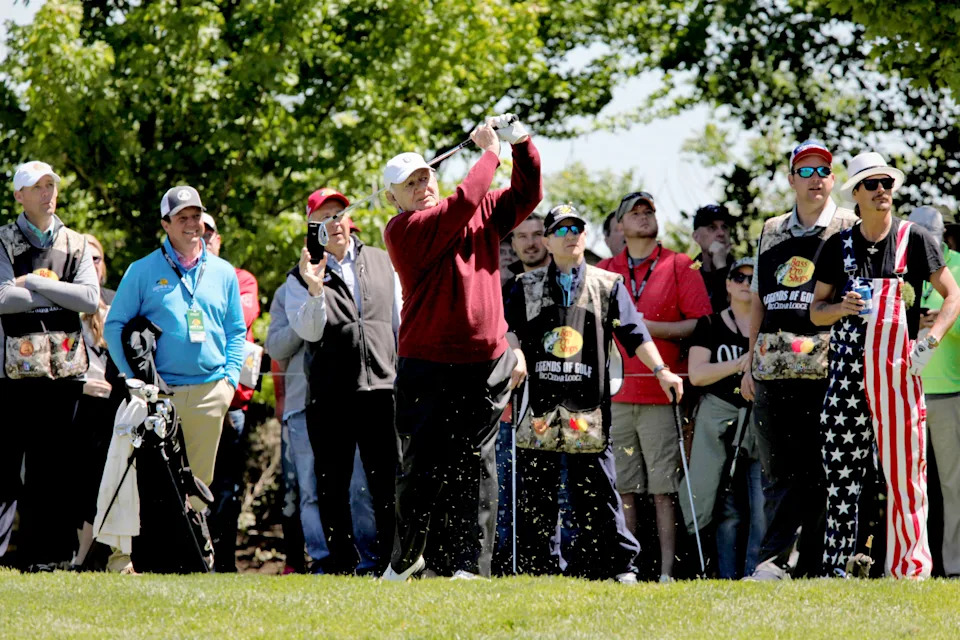
David Graham watches his shot during Bass Pros Legends of Golf Sunday, April 28, 2019. Mg 0008
Graham had developed into a serviceable pro, but he had grander ambitions, and he wasn’t afraid of hard work. After missing the cut at the Colonial Invitational in Fort Worth, Texas, he asked Devlin what he needed to do to become a better player. Devlin asked if he wanted the Cliff Notes version or the whole book? When Graham told Devlin to throw the whole book at him, he ticked off an assortment of fixes Graham needed to make: his clubs were too flat, he stood too far away from the ball and should stand more upright, his grip was too strong, his swing had too much radius, his ball flight was too low. “Otherwise, you’re a hell of a golfer,” Devlin concluded.
Advertisement
Practicing with Jack Nicklaus
Graham made a habit of studying the game of the best players on Tour. Early in his career, he’d sit on his bag and watch Gary Player hit bunker shots for hours when he’d come over to Australia. Later, he enjoyed practicing with Nicklaus. Graham still fondly recalls the time a round of the Bing Crosby National Pro-Am was rained out at Pebble Beach and he was lounging around his hotel room when Nicklaus called. He said the Bayonet and Black Horse military courses at nearby Fort Ord were closed too, but he talked the pro into letting them on. “I’ll pick you up in 10 minutes,” Nicklaus said.
“It was just us and our caddies and made for a really amazing day,” Graham remembered.
In the mid-80’s, he and Nicklaus would fly to Augusta the week before the Masters and play for several days. Graham said he learned the most practicing alongside Nicklaus at Lone Tree Golf Club, where Nicklaus set up shop when at home.
Advertisement
“Jack would hit these majestic 1-irons that would easily clear a practice tree. I asked him how he did it, and he said, ‘Just hit it over the tree.’ I had to make some improvements to hit my 1-iron that high, and the exercise led to long irons becoming the strength of my game. Which changed me into a player who could win majors.”
He claimed his first at the 1979 PGA Championship at Oakland Hills Country Club outside of Detroit despite a double bogey at the last, forcing three extra holes to defeat Ben Crenshaw. As gratifying as it was to become a major championship winner, Graham said the perk of a 10-year exemption on Tour was the life changer.
“That allowed me to look into the future and buy a house and raise my kids here and make a commitment to play on the U.S. tour,” he recalled.
Nicklaus took care of the rest. He owned a share in The Hamlet, a golf course facility in Delray Beach, and he persuaded the owner to build a house for the Grahams in exchange for representing the club as its touring pro. The Nicklauses also arranged for Graham’s children to be registered at The Benjamin School, a private preparatory school in nearby Jupiter where all the Nicklaus kids (and later the kids of Tiger Woods) were enrolled.
Advertisement
“They bent over backwards for us,” Graham said. “That’s the type of friend he’s always been to me.”
Memorable Memorial
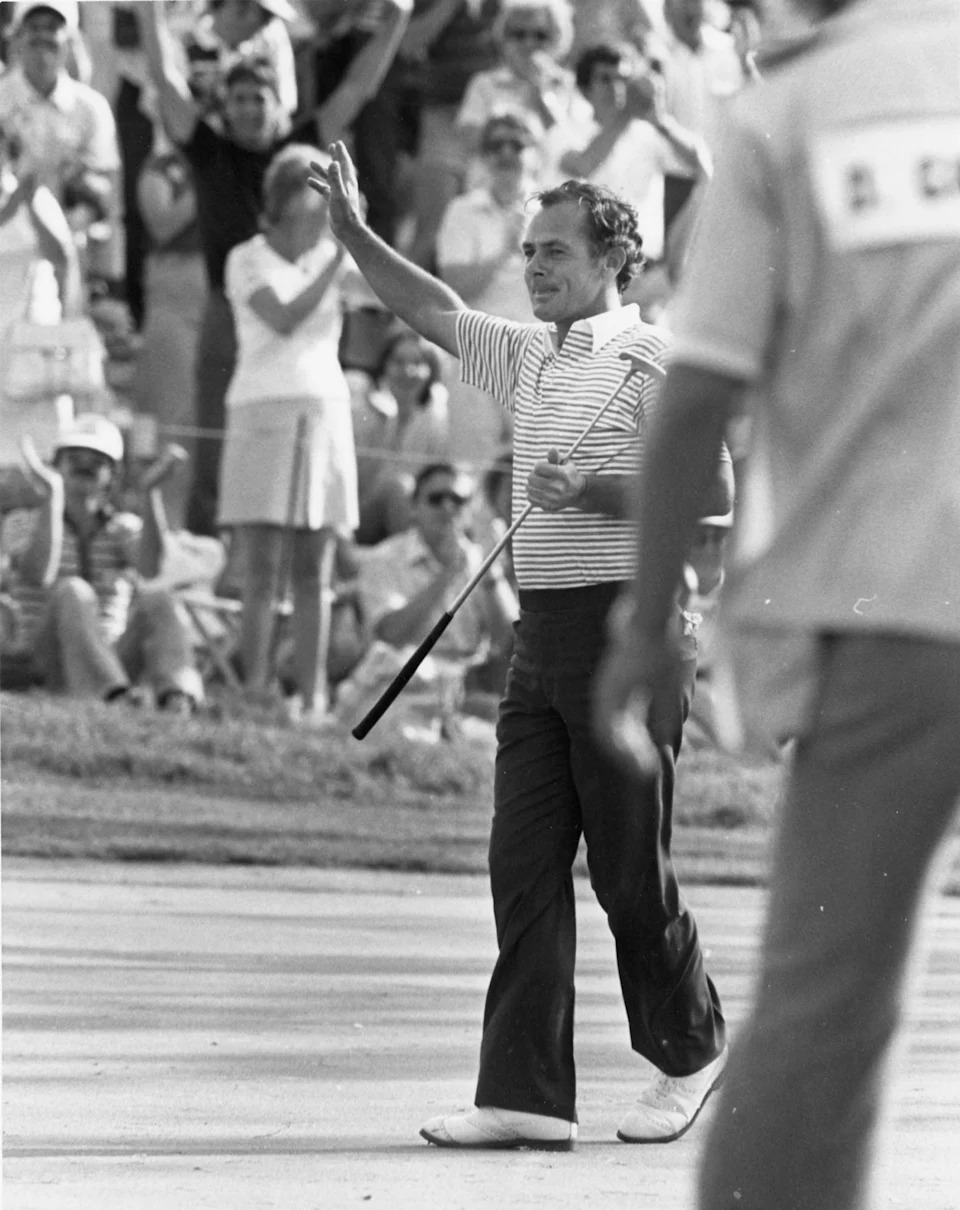
b&w — golf — 1980 Memorial Tournament winner David Graham, who credited his putting for delivering a victory. Tom Sines / Dispatch
Two years after his first major, Graham produced one of the most memorable final rounds at a U.S. Open, hitting all 18 greens in regulation, to win at Merion Golf Club in 1981. But in Nicklaus’s book, Graham will always be a three-time major winner for his victory at the 1980 Memorial. “Excuse me,” Nicklaus said when a reporter corrected the major tally as two. “I count the Memorial as one of my majors.”
What Graham achieved at Muirfield Village in 1980 ranks among his finest performances. Graham trailed Bob Gilder by a stroke entering the final round, but Gilder skied to 82 and was a non-factor. John Fought also blew a two-stroke lead on the back nine with a bogey at No. 13 and a quadruple-bogey 8 at 14. That set the stage for a dramatic duel down the stretch in the second-to-last pairing. Two days past his 34th birthday, for which Memorial officials had presented him a cake, Graham supplied the icing. He drained a 30-foot downhill putt for birdie at No. 18 and won by one stroke over Tom Watson, the defending champion, after Watson missed a 25-footer on almost the same line as Graham’s.
Advertisement
“I played the last hole about as perfect as you could play it with wooden clubs in those days,” Graham said.
Along the way, Graham saved par out of the bunker five times in his first 14 holes. When Graham smoked a 1-iron to 20 feet and eagled the par-5 15th, he moved within one stroke of Watson, who three-putted No. 17 for bogey and they were all tied with one to play. Graham carded 70 and signed for 8-under 280, breaking by one stroke the previous record for 72 holes by Nicklaus in 1977. [Nicklaus matched Graham’s 280 total when he won a second Memorial title in 1984.]
“Winning at a course that Nicklaus designed, that he conceived – from the dream to finding the financing and now it’s the 50th year – is really special,” Graham said.
Graham, the equipment junkie
There’s one more special chapter in the Graham-Nicklaus friendship, and it is the one that is most often overlooked. When Nicklaus became an owner of MacGregor Golf, he hired Graham as his chief club designer, following Tommy Armour and Toney Penna in the company’s tradition of “player-craftsman.” Graham learned how to build and repair clubs as an apprentice – how to grind, how to adjust swing weights and how to fit a player. Before chasing his touring pro dreams, he experienced another introduction to the ins-and-outs of equipment during a stint at Precision Golf Forgings, an Australian golf club manufacturer that was popular in Asia, when he left his job as a pro in Tasmania and moved to Sydney. “I got to be a good enough player that I could feel the difference between different clubs,” he said. “I became obsessed with trying to find the perfect club, which you never find but it’s a fun pursuit.”
Advertisement
With a sense of awe undiminished with passing years, Tom Weiskopf, before his passing in 2022, maintained he never met a pro who knew more about club design than Graham.
“He could bend your clubs in a doorjamb,” Weiskopf said.
Bending clubs in a doorjamb
Indeed, the side of the frame that holds the hinges and bears the weight of the door often doubled as a vice. Graham and Devlin traveled together on the road regularly and would ask for adjoining rooms at a motel. In the days before equipment trucks traveled the tour, Graham said their first stop leaving the airport wasn’t the golf course but rather the hardware store for lighter fluid and other supplies, and they routinely changed grips and shafts.
Advertisement
“One of us would hold the club in the doorjamb, the other one would hold the door and then we’d put a little bit of heat on it and pull the shaft out and put another one in,” Devlin explained on an episode in 2024 of “Fore the Good of the Game,” the podcast he co-hosts. “We never did set off any fire alarms. But I pity the poor people that came into that room the day after we checked out with putting grips on with lighter fluid and burning epoxy and all that kind of crazy stuff.”
If Graham’s success as a player is overlooked, his abilities as a club designer largely have been forgotten. Neither Graham nor Nicklaus could remember the exact setting, but during a round played together on Tour in 1978, Graham observed that Nicklaus was taking big divots with his wedges. When Nicklaus wondered why he did that, Graham explained there was no bounce on the sole of his club.
That sparked Nicklaus to bring Graham on board and together they co-designed the VIP irons, which Graham used in winning the 1979 PGA Championship. The tandem also created the Jack Nicklaus Limited Edition irons, which Graham used in his 1981 U.S. Open victory. (Nicklaus won the 1980 U.S. Open and PGA with prototypes of the Limited Edition as well as the finished product at the 1986 Masters.)
To this day, Graham still fools around with re-gripping and re-shafting his clubs, starting with the longest club and lining them up in descending order, “like toy soldiers.”
Advertisement
“I’ve spent half my life in my workshop. It’s my quiet space,” he said. “Some people like to paint, some like to play chess, I like to tinker with golf clubs.”
Nicklaus could only think of one golfer who tinkered more — Arnold Palmer. “He’d hit a bad shot and the grip was coming off the club,” Nicklaus joked.
Graham would argue that his pal Lee Trevino is right there with them. Graham and Trevino talk every day and often hit balls together and then dine at Preston Trail Golf Club in Dallas. Not long ago, Graham called him and Trevino raved that he couldn’t wait until the morning to hit a set he’d just assembled with a new shaft that Callaway had sent him. Graham chuckled and said, “You’re twice as bad as I am.” Trevino shot back: “No, no, no, you’re way worse than me.” And Graham conceded he might be right — just that morning he had driven around to four different stores in search of a can of lighter fluid.
But Graham won’t be found tinkering at his workshop or at Preston Trail testing a new shaft with Trevino or sitting in front of his television this Wednesday. He’ll be at Jack’s Place, where he was an original member, for the crowning achievement of a career that included 34 victories around the world. In addition to wife Maureen, their two sons and grandchildren, he has invited a crew of 52 to the ceremony or as Nicklaus put it, “a full deck of cards.” Graham said he had drafted more than 40 versions of his acceptance speech — a tinkerer through and through — and had memorized most of it.
Advertisement
Cue the tears, which have an over/under of the first minute. But Nicklaus will be prepared with an extra hankie because that’s what friends are for.
Adam Schupak is a senior writer for Golfweek, covering the PGA Tour.
This article originally appeared on Golfweek: Jack Nicklaus names David Graham Memorial Honoree
Read the full article here