





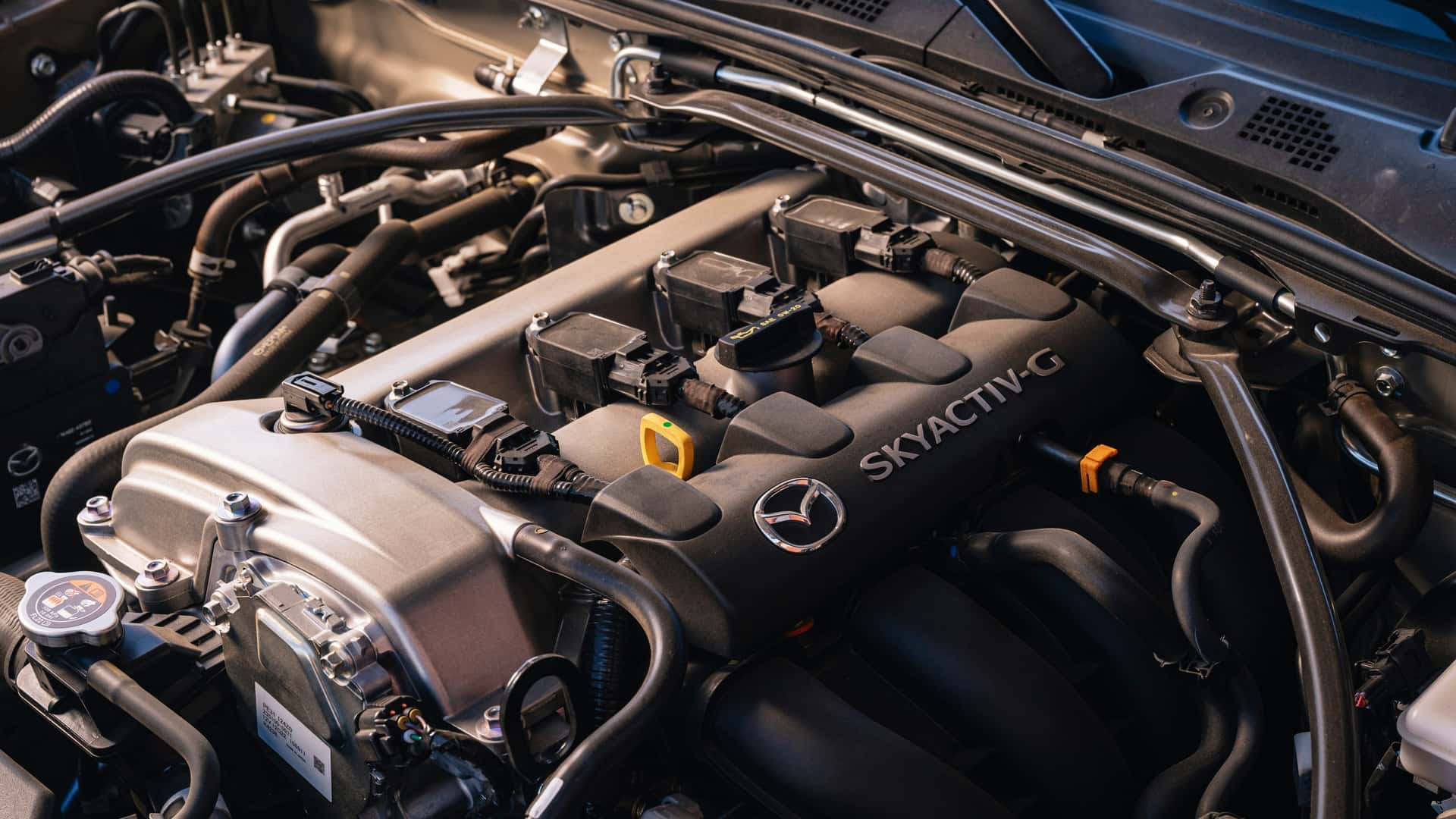
- As in the European Union markets, the Miata is now sold in the UK exclusively with the 1.5-liter engine.
- The smaller engine gets a minor power bump, but it doesn’t make up for the loss of the 2.0-liter.
- The next-generation Miata could get a larger engine when it arrives in a few years.
Miata aficionados know Mazda developed the ND generation primarily with the 1.5-liter engine in mind. It wasn’t until the company realized Americans would want more power that it changed its plans, engineering the roadster to accommodate the 2.0-liter unit as well. Having previously owned an ND2 RF with the larger engine, I can comfortably say the Japanese automaker made the right call.
However, the engine has been dying a slow death in Europe. Mazda had no choice but to retire the 2.0-liter unit from EU markets in 2024 because the powertrain no longer met emissions standards. Since the United Kingdom hasn’t been part of the EU since the start of the decade, it didn’t have to abide by the same legislation. However, local regulations have since caught up, prompting Mazda UK to call time on the more powerful engine.
The silver lining? Mazda’s British arm estimates it has enough stock to last until around January 2027. After that, the Miata will be sold exclusively with the 1.5-liter engine, which gets a minuscule power bump of 4 hp and 3 lb-ft (4 Nm) for the new model year. However, at just 134 hp and 114 lb-ft (155 Nm), it’s a far cry from the larger engine’s 181 hp and 151 lb-ft (205 Nm), which continues to be offered in most markets outside Europe.
Mazda Miata ND with 2.0-liter engine
Photo by: DW Burnett / Motor1
Mazda UK Managing Director Jeremy Thomson is just as disappointed as we enthusiasts are, but he prefers to see the glass half full:
‘While it’s a shame that changing legislation means we can no longer sell the 2.0-litre in the UK, the 1.5-litre engine remains at the heart of the MX-5. The current-generation MX-5 was originally developed around this engine, with its lightweight, responsive and accessible performance perfectly reflecting Jinba Ittai.
The 1.5-litre ensures customers can continue to enjoy the lightweight, engaging and fun-to-drive experience that has defined the Mazda MX-5 for more than 35 years and continues to win awards as one of the best driving cars on the road today.’
Looking ahead, it’s unreasonable to expect the next-generation Miata to have a non-electrified, naturally aspirated powertrain in Europe. Well, unless the engineers can find a miracle technical solution that allows the upcoming Skyactiv-Z to skip a hybrid setup while still passing ever-stricter emissions regulations.
But with the engine’s displacement possibly growing to 2.5 liters, we can’t see how it would have a chance in Europe without some form of hybrid assistance. It’s especially true since the EU’s CO2 targets will get even stricter in the next decade. By 2035, fleet emissions across EU countries will have to drop by 90 percent compared to 2021 levels, leaving little room for non-hybrid performance cars. At least the next Miata will still have an engine, though it may be the last generation with an ICE under the hood.

74
Source: Chris Rosales / Motor1
Motor1’s Take: I’ve always been vocal about how emissions regulations are nonsensical because they don’t look at the whole picture. Sure, the Miata’s aging 2.0-liter engine may emit more CO2 than newer four-cylinder engines. Still, legislation should factor in emissions throughout a vehicle’s life cycle, not just those coming from the tailpipe.
You can’t convince me that a large, heavy SUV that consumes far more resources during the production process is less harmful to the environment than a super-light Miata. Just because the SUV’s measured CO2 emissions fall below the maximum threshold doesn’t necessarily make it greener overall.
Legislation should account for the pollution generated during production, too. I know that’s much harder to quantify than what comes out of the exhaust pipe, but there must be a way to better account for a vehicle’s total environmental impact and level the playing field.
Read the full article here