






In his first 7 games of the season, Slade Cecconi got off to one of the worst starts to a season a starting pitcher could possibly have. He had a 6.56 ERA, a 5.79 FIP, and was giving up 2.02 HRs per 9 innings pitched. In the 9 starts since, his ERA has gone down to 2.96, his FIP to 3.47, and the HR/9 rate is down to 0.74. So, has Slade turned things around? Let’s break it down.
Before getting into some of the changes he’s made, it’s important to look at the information we already have a bit more closely. There’s a natural ebb and flow in a baseball season, as both hitters and pitchers will experience changing conditions in the field. Batted ball distribution, luck, and defensive performance behind a pitcher can fluctuate, and because of that, surface level results can often be cloudy. For example, on the surface, a pitcher putting up an ERA 3.50 runs lower than they had been and a FIP drop of almost 2.50 sound amazing, but if we look at his xERA and xFIP numbers, they tell a slightly different story. For example, look at the following table:
We can see that in those first starts, Slade was actually getting significantly higher than expected results, and in the more recent set of starts we see the opposite. (Granted, the more recent difference is not as extreme.) This leads us to conclude that baseball variance has amplified both ends of this equation. The good news is that even though the degree of the new performance is a little bit overexaggerated by the under and then overperformance relative to expected metrics, we can see there still appears to be a definite improvement that’s happened, even if it’s less of one than we originally might have thought. In order to get to an answer, we’re going to take a look deeper at his more specific quality of contact numbers and see if we can find any differences that would explain this extreme change in results. Let’s start with the following data:
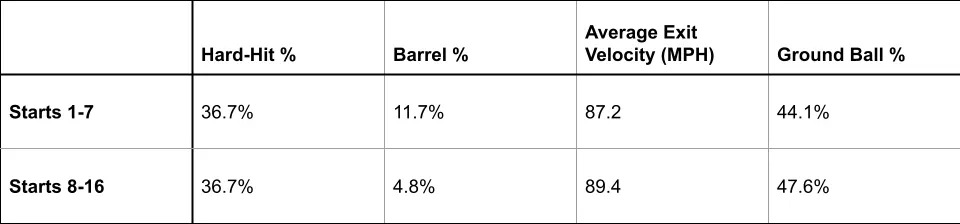
Looking at this, I think we may have a bit of conundrum. Hard-Hit % has stayed the same, but the Average Exit Velocity has gone up, and the Barrel % has plummeted. We also have a modest, but important, uptick in Ground Ball %, and here we can draw a few conclusions. Even though Slade appears to be getting hit slightly harder on average than before, we can see from the Barrel % and the Ground Ball % that the hard-hit contact is not translating into barrel-level damage nearly as much as before. The Barrel % drop is so significant it’s the clearest signal of improved damaging contact prevention. Another consideration with increases in ground ball outs comes the chance for increases in double plays turned. When we look at that data, we can see there were 3 GIDPs in Slade’s first 7 starts, and 6 in the most recent 9 starts. This could be normal variance, but it is worth mentioning to see if the pattern holds. This modest rise in Ground Ball % may have contributed to reducing the severity of the contact outcomes on Slade’s pitches, but the largest driver of improvement appears to be the overall suppression in barrel conversion of the hard contact and not a broad reduction in overall hard contact. These factors combined do show some real meaningful improvements beyond potentially noisy surface level results. Next, let’s break down Slade’s pitch mix and see if we can learn anything from that. Here’s some data to take a look at:
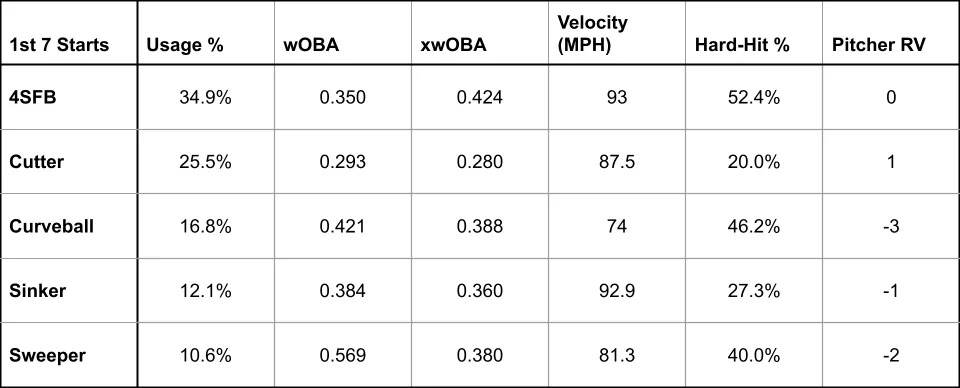
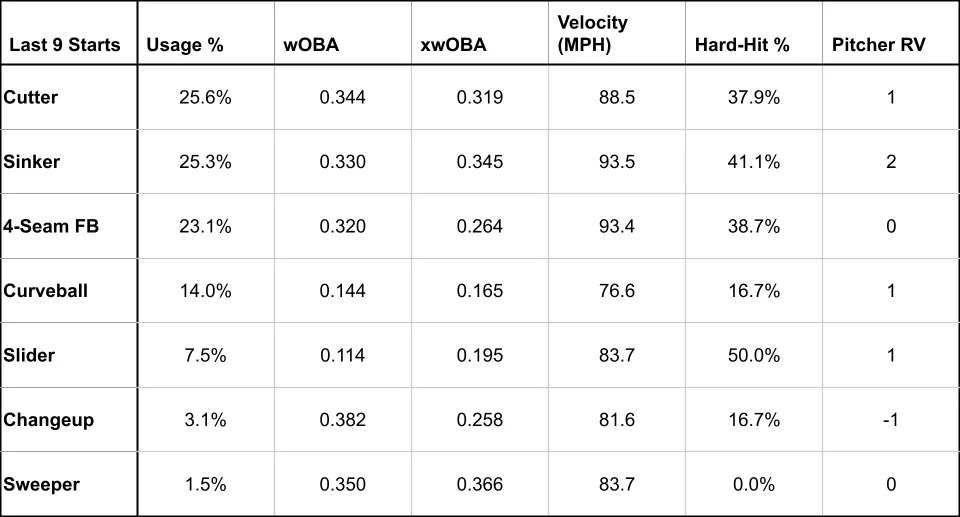
There’s a lot to unpack here, but the general trend we can see has been increased usage of the fastball and fastball variant pitches (the 4SFB, the cutter, and the sinker), the addition of the slider and changeup, and the near total removal of the sweeper. We see that the mix before was very 4SFB heavy, with moderate cutter and low sinker usage. Now, we can see the pitches are thrown in a much more balanced distribution.
Advertisement
We can also see the curveball is being used at about the same rate, but the contact quality on it is significantly better. Having multiple different fastball movement profiles may be making his pitches less predictable, and combining that with slider and changeup usage may be what’s opening up the curveball to be weaponized more. We can also see the velocity differences of the pitches give him a few different speed options to potentially help keep hitters off balance, and the slider and the changeup coming in at similar speeds but moving in different ways can make the pitch location harder to discern for the hitter.
The increase in options in the different velocities may be improving deception and timing disruption and ultimately contributing to the ability to miss barrels and get less damaging contact. The increased sinker usage also helps explain the increase in the Ground Ball % we spoke of earlier.
Now that we’ve identified some changes to the pitch mix and how they may have affected Slade’s results, let’s take a look at his command and see if there’s been any changes there.
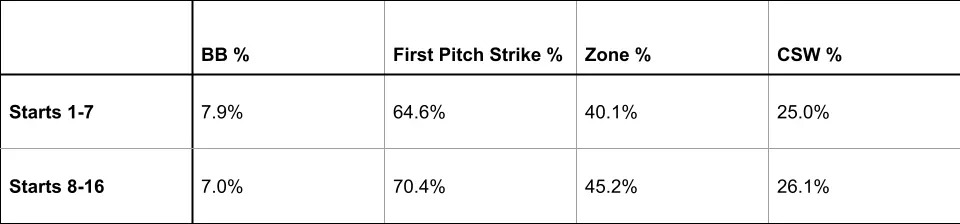
Initially there’s a lot of good here. Lower walk rate, more first pitch strikes, and more pitches in the ABS strike zone as well (Zone %). The final number in the table (CSW%) stands for “Called Strikes plus Whiffs”, and the idea behind this stat is to show how often the pitcher “wins” the pitch outright either by throwing something in the strike zone that the hitter does not swing at, or by getting the hitter to swing and miss. We can see this number has improved as well. This is a very modest improvement, but still worth mentioning because of the nature of the statistic.
Advertisement
We’ve seen evidence of the pitches getting more favorable contact quality before, and now we can also see Slade is throwing more strikes, and the higher CSW % shows that the increase isn’t just in easy to hit pitches either.
So we put that all together and what do we see? Honestly, these improvements appear to be very real and tangible. Although the magnitude of the improvements does appear to be magnified by normal baseball variance. We saw that his initial bad start looked worse than it was, and this good stretch looks a bit better than what the surface numbers suggest it is, but it’s still significantly better.
We should probably expect some regression from the recent starts, but overall it seems like Slade has made legitimate adjustments and gotten back on track, and it couldn’t have come at a better time for the Guards.
Read the full article here