







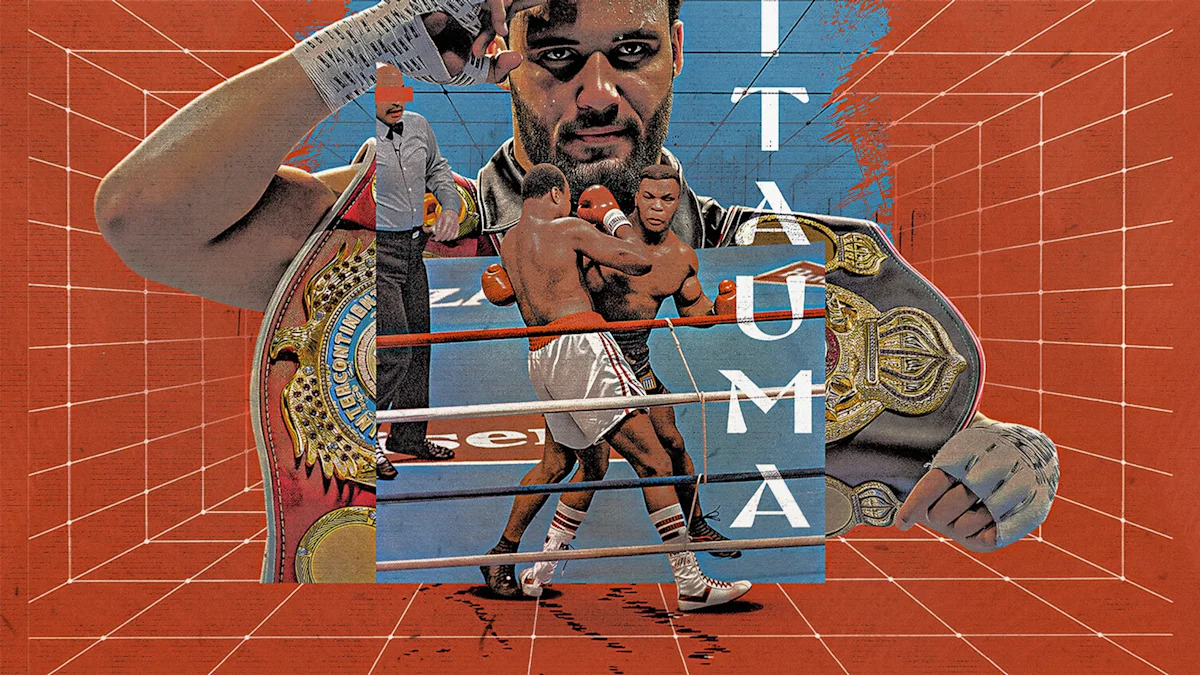
Call him Moses. It’s easier that way. Easier to say, easier to remember, easier to promote. Call him Moses on the fight poster, the billboard and the on-screen graphics and call him Moses when trying to attract either sponsors or the eyes of the public. Simplify him, in other words. Make him a brand, a product. Think of him as one of those superstars whose power is so great they need only their first name. Think Beyoncé. Think Prince. Think Shaq. Think of all the Brazilian soccer players who achieved international fame with just their first name on the back of their shirt, like Romário, Rivaldo, Ronaldo and Neymar. If it can work for them, it can work for you too, Enriko Moses Itauma.
That is the view of Itauma’s team at least. They, with good reason, sensed they had a superstar on their hands the day Itauma hatched and have started to now nudge him toward the light ahead of his IBF heavyweight title fight against Filip Hrgovic on Saturday. To get him the attention his talent deserves, they have made a conscious effort to simplify Itauma for a mainstream audience. That’s why his next fight was billed as “Moses X Hrgovic” on the DAZN ad I saw on the big red bus that passed while I began to write this piece. It’s also why, on that same bus, we were greeted with the tagline “Britain’s youngest ever world heavyweight champion awaits,” and why Mike Tyson, the world’s youngest, is someone to whom Itauma, just 21 years of age, is often compared.
Advertisement
In fact, ever since he turned professional at 18, Itauma has been compared to Tyson. At first, it was purely an age thing — Itauma, they said, wanted to win a world heavyweight title quicker than Tyson did when bouncing Trevor Berbick, the WBC champion, up and down in 1986 (at the age of 20). Yet the more we got to know Itauma as a pro, the more we noticed other connective tissue as well. Beyond a fondness for the color black, he shared with Tyson an intensity and a ferociousness and a hunger to leave work early. They also both had trouble finding opponents capable of remaining upright in their presence.
Twelve months ago, I wrote something about Itauma’s future; specifically, his search for heavyweight names, led by a belief that he would struggle to find the right ones to aid his development. Since then, he has fought just twice — a first-round stoppage of Dillian Whyte last August, and a fifth-round stoppage of Jermaine Franklin in March — but was so impressive in those two fights that no longer are we seeking on his behalf the right opponents to help him both build and bide his time. Instead, owing to not only his talent but a changing of the guard at heavyweight, Itauma now finds himself already on the brink of becoming the second-youngest heavyweight champion in boxing history. Suddenly, because of the decision of Oleksandr Usyk to vacate his heavyweight titles, Itauma’s route to the throne is clearer, his move expedited. Beat Hrgovic on Saturday in London and the IBF heavyweight belt, previously owned by Usyk, will then be Itauma’s to take home. Then it’s all about defending what he has and solidifying his status as one of the best heavyweights in the world. Then it becomes less about adding well-known names to his record and more about adding other heavyweight titles to his collection.
Itauma will become boxing’s youngest heavyweight world champion since Tyson if he beats Hrgovic on Saturday.
(Richard Pelham via Getty Images)
In light of this, the search now is not so much for opponents but rather attention, recognition, fans. It’s all well and good saying that Itauma is the most talked-about young fighter in the world, yet to what extent is that lip service, or hyperbole, and to what extent is it actually true? Moreover, who exactly is talking about Moses Itauma, The Next Big Thing, in 2026? Is it the few people who already know of his immense talent and his rapid rise up the heavyweight division, or is it the many more who, when asked to name a boxer, would struggle to think beyond Muhammad Ali and Mike Tyson?
Advertisement
Because it’s something else now, popularity. It can be achieved quickly, yes, but it is also often experienced only in a vacuum, a bubble, an echo chamber. If one happens to frequent that echo chamber on a semi-regular basis, the idea of popularity can in time become distorted, giving a false impression of a person’s value. In fact, it is only when one elects to step outside it — to touch grass, as the kids say — that one starts to realize that popularity in one realm does not always equate to popularity elsewhere.
For Itauma, this shift to mainstream prominence will be much harder to achieve than it was for his predecessors. Any comparison with Tyson, for example, seems unfair given the difference in eras. Whereas in the ’80s and ’90s a fighter like Tyson was everywhere, bigger than the sport and watched by everyone, Itauma, the Tyson of today, is at risk of falling victim to his sport’s burning desire to make itself even more niche. Now, in the year of 2026, Itauma doesn’t just have to break down opponents, he also has to overcome the existential threat of paywalls, attention spans, restless fingers, and all the alternative options available to the perennially indulged and indecisive. He is indeed a thoroughly modern fighter: one whose name is discussed more on social media than in real-life social situations where eye-contact still counts.
Last year, when asked about his fighter’s commercial potential, Itauma’s manager, Francis Warren, understandably saw no limit to it. “I know what he’s capable of,” Warren told me. “He is a [Lionel] Messi, he is a LeBron [James], he is a [Michael] Phelps, he is a Tiger Woods. He is a once-in-a-generation talent who will be a cultural sporting icon, worldwide. There’s no doubt in my mind.”


Itauma (L) and Filip Hrgovic (R) face off ahead of their IBF heavyweight title clash.
(James Fearn via Getty Images)
Even if he should fall short of that projection — and he likely will — the point still stands: Itauma is considered by most to be a generational talent with the ability to at least dream. Whether widely, or only within the narrowing, sparsely populated corridors of boxing, Moses Itauma is a name being spoken about and a boxer of whom big things are expected. He is the superstar both the heavyweight division and the sport itself crave, particularly at a time when superstars are few and far between. He is also, at age 21, already a pay-per-view headliner.
Advertisement
Which is why, when preparing this piece, I was shocked by the difficulty I had getting people to talk about Itauma, this heavyweight everyone is supposedly talking about. Neither his promoter, nor his manager, nor any member of his coaching team had any inclination to comment on Itauma’s ascent, his next fight, those Tyson comparisons, or, ironically, the battle to secure mainstream attention in the age of paywalls.
Perhaps their reluctance to do so suggests a weariness, or is merely a reflection of how often these people are asked about Moses Itauma in 2026. Perhaps they are, to a man, now just tired of talking about him, or have by this stage run out of superlatives to use to describe him. Or perhaps, like the fighter himself, the close-knit team surrounding Itauma can see the upside of maintaining an air of mystery, operating in the shadows and the silence, so to speak. If so, fine, fair enough. As well as it being their right, it is hard not to respect the decision to stay quiet at a time when everybody else is aroused by the sound of their own voice and won’t stop selling.


Itauma (left) knocks down Jermaine Franklin during their March bout in Manchester.
(Nick Potts – PA Images via Getty Images)
To compensate for the silence from Moses Itauma’s inner circle, I tried to think of other voices. The first that came to mind was my father’s. He had asked “What’s his name?” while driving a car the morning after Itauma had stopped Franklin so impressively in March. When I then repeated Itauma’s name to him, my father — an on-off boxing fan more off than on these days — said, “Isn’t that the guy who beat Joseph Parker?” To which I said, “No, that was Fabio Wardley.” He then, having butchered Itauma’s surname a second time, asked me to slowly spell it out for him. So, I did. “I-T-A-U-M-A.”
Advertisement
That same day there was another voice of note. This one was heard inside the locker room of a Sunday-league soccer team, often the perfect barometer of how popular someone or something is in the real world. In this room Itauma’s name was mentioned only by the center forward, a semi-serious boxing fan, who asked his teammates pre-match, “Did anyone watch that Itauma last night?” Following that … nothing. Just the sound of studs on the ground and Deep Heat sprayed on tight muscles. All except me, the center midfielder, either shrugged or asked, “Who is that?” or “Where is he from?”
When informed that Itauma was British, the right back in particular looked somewhat perplexed. “Doesn’t sound British,” he mumbled, which resulted in me having to explain to him that Enriko Moses Itauma was in fact born in Kežmarok, Slovakia to a Nigerian father and a Slovakian mother. He then spent four years in Slovakia before moving to Kent, England. That is where he learned to box and where, on the advice of his promoter and his brother, he later changed his name with a view to becoming a famous professional boxer. “Oh,” said the right back, clearly no longer interested. “Anyone got any tape?”
Three days later, my father’s voice, heard this time inside a coffee shop, said, “I can see what you meant about that Moses …” and abruptly paused, still unsure how to properly pronounce the surname. I then did it for him — “Itauma” — and my father said, “Yeah, that’s right. Itauma. A bit good, isn’t he? I watched that fight you were talking about. What an uppercut.” It was at that point I smiled, pleased to know I had done my part. My part of promotion. My part for the sport. “I knew he must be good,” my father added, “because you don’t get excited so easily about boxers these days.”
He was right. I had not waxed so effusively about a boxer for a number of years, that voice almost lost, and the only thing that reduced the significance of my championing Itauma was the fact that everybody else was — and is now — doing the same; singing the same tune. Some of those serenades belong to experts whose appreciation for Itauma goes back years. Lawrence Okolie, for instance, first met Itauma when the young phenom was just 15 years old and turning up to boxing gyms in his school uniform. He even shared a ring with him at that age.
Advertisement
“He’s someone I always thought would be amazing from [a] young [age],” said Okolie, 33, the former WBO cruiserweight champion and now a world-ranked heavyweight in his own right. “When I first saw him, I thought, ‘Wow, I haven’t had someone give me this type of work in years.’ I was thinking, ‘If he can do this now, what’s he going to be like in the future?’ Well, we’re starting to find out now, aren’t we?”
Asked to then pinpoint what made a teenage Itauma so special, Okolie hesitated, “It’s hard to say,” not because there was a scarcity of things, but rather because there were so many. By all accounts Itauma was not just excellent at 15, he was also ineffable. “He was very powerful for a young man and very smart in the ring. He was also hard to hit. I remember thinking, ‘Oh, this is something different.’
“Also, if I’m not allowed to be myself fully, I know that I’m in there with someone serious. Nine times out of 10 when I’m in the ring — whether I’m fat, slim, cruiserweight or heavyweight — I feel like I can kind of control what is happening in the ring. That’s just the feeling I get, even on a s*** day. But with him I was like, ‘Rah, if I’m not 100%, this is going to go badly.’ That’s when I knew — hold on, he’s really good. The only other time I have felt that was when I sparred [WBO heavyweight champion] Dan Dubois. With Itauma, I was just thinking, ‘OK, this is weird. Why is a 15-year-old making me feel like this?‘“


Itauma needed less than a full round to smash through Dillian Whyte in August 2025.
(Richard Pelham via Getty Images)
Six years later, the privilege of watching Itauma in the gym now belongs to Leigh Wood, the former WBA featherweight champion and training partner of the big man. Each day Wood, a man 17 years Itauma’s senior, gets to watch the young heavyweight hit bags and pads and will often train alongside him under the watchful eye of their coach, Ben Davison. He, too, has seen Itauma deal with older, more experienced men with relative ease. He, too, knows the feeling of witnessing something unique and special.
Advertisement
“When he first came down to the gym and I saw him hit the pads, I couldn’t believe how fast he was,” said Wood. “Then, the first time I saw him spar, he was in with another heavyweight but he was moving like he was a lightweight. He actually moves better than a lot of lightweights.
“It’s not just his speed, either. It’s his shot selection, the combinations, the setups. We play games in the gym like ‘shoulder and knee,’ where you have to touch your shoulder and then touch your knee, and I can’t believe how good he is at it. That’s not because he’s big and tall and long. It’s because he’s two steps ahead of everybody else. He’s always thinking about the next move. He’s always thinking about setting traps. His ring IQ is unbelievable and he’s very composed. It’s like he has been there and done it all before. It just comes to him like it’s second nature.”
Of all the things he did well against Franklin in March, including the execution of that finishing left uppercut, it was perhaps Itauma’s composure under pressure that impressed the most. This, after all, was meant to represent his first genuine test as a professional. In Franklin, a man never before stopped, Itauma’s team felt as though they had found an opponent who could at the very least ask Itauma a question or two. But instead, as if affronted by the mere suggestion of parity, Itauma proved how different he was from all the rest not with an explanation, or a boast, but by going out there and showing it. “I tried to knock him out in the first and second round to win some people some dough,” said Itauma (14-0, 12 KOs) after the fight. “But I thought, ‘Maybe not today.‘ So I went back to the basics — go down to the body — and then the knockout just came. It’s not the shots you load up with. It’s the shots you don’t see.”
Commentating from ringside that night in Manchester was DAZN’s Adam Smith, regarded by many as the UK’s “voice of boxing.” He, like most in the trade, has fallen for Itauma in recent years and considers the southpaw a level above the majority of British heavyweights who came before him. Better yet, Smith was able to find the words and the energy to use his voice to explain to me why.
Advertisement
“What really excites me about Moses,” he said, “is the fact that all the other heavyweights of this era, Oleksandr Usyk included, have been raving about him. He sparred with Joe Joyce, Lawrence Okolie and those guys young, and he was later in camp with [Tyson] Fury, and AJ [Anthony Joshua], and they all think he’s exceptional. That’s the best gauge for me — listening to other fighters. They have shared a ring and time with him and they know what they are looking at.
“He seems to have it all. However, the tests are going to get harder; the chin is going to be tested, and his stamina will be tested. It will happen. Filip Hrgovic is the right move at the right time and he will examine him. Then we’ll see where we go from there. But in terms of him being a heavyweight prospect, he’s the most exciting one I’ve seen since Tyson.”
Here the familiar voice of Smith carries even greater resonance for the simple fact that he is one of the few remaining members of boxing’s fight-night fraternity who has been involved in the sport long enough to have covered Tyson’s career from ringside. He is therefore uniquely positioned to compare the two: Tyson and Itauma.
“There was a magnetism about Tyson because he struck fear into his opponents,” Smith recalled. “He had an aura of invincibility from early on and then he became the youngest heavyweight champion in history. It looked like no one would touch him.
Advertisement
“It’s early stages, but I can understand the [Tyson] comparisons. I get that a lot of it has to do with age, and the fact he [Itauma] could become the second-youngest heavyweight champion in history, but I know why those promoting him would make that comparison.

Nov. 22, 1986: Mike Tyson (L) knocks out Trevor Berbick to become the youngest heavyweight world champion in history.
(CARLOS SCHIEBECK via Getty Images)
“Tyson was a one-off in many ways, which makes it really difficult to compare Moses, or any fighter, to Mike Tyson. But of all the heavyweights I’ve seen in the last 40 years of following the sport, I don’t think I’ve been this excited about a heavyweight.
“From my point of view, having watched [Evander] Holyfield and [Lennox] Lewis and the next brigade come through — the Klitschkos [Vitali and Wladimir] and the likes of Joshua — I think there are a number of good heavyweights who have come since Tyson, but in terms of aura, this one feels different. It’s not an aura of intimidation, but there’s an expectation that he’s going to be predatory in the ring, and he’s got the hand speed and the boxing IQ to deal with these early opponents with ease.”
Advertisement
As for Leigh Wood, he isn’t certain whether his training partner will ever one day be as big as Tyson — will anyone? — but he knows this much: Moses Itauma will leave his own mark on the sport.
“I think it’s an age thing, yeah,” Wood said in answer to the Tyson comparison, “but he’s also a bit of a maverick like Tyson. He’s a special talent coming through. He’s going to be on that pound-for-pound list very soon, and one day, in my opinion, he’s going to be the best fighter these shores have ever produced. All the other stuff,” meaning popularity, “isn’t important at this stage. I feel like nowadays it’s mostly about social media, but I just think his performances will be enough to get him the attention. People won’t be able to ignore him. He’ll make his own noise. He’ll keep picking up titles, he’ll keep winning in great fashion, and the results will speak for themselves.”
By virtue of his connection with DAZN, Smith has a firmer grasp of — and interest in — Itauma’s growing stature and popularity. He realizes both how important it is to not hide Itauma from the casual sports fan and how different the landscape is today compared to previous eras in which he has commentated.
“It’s funny, my brother was asking me about [Itauma] yesterday,” said Smith. “He’s a casual fan and he said to me, ‘I’m sort of sick of the whole AJ and Fury thing.’ He said he doesn’t like the ‘arrogance’ they show after a win. ‘But there’s something different about Moses,’ he said. ‘He seems like a normal guy.’
Advertisement
“AJ had the Sky [Sports] platform behind him, which catapulted him, and you’ve got to give him and his team phenomenal credit for the star they built and all those stadium shows. Tyson [Fury], in a different way, became a star because of his incredible personality and the fact he is a brilliant fighter. In their era there was something really exciting about boxing and it was coming into a whole new realm. Then social media got hold of it and now you’ve really got to fight to become that star, because there are so many different avenues and streaming platforms. It’s great being at DAZN now because we’ve got the lion’s share of boxing and it’s fantastic, but it’s true that Frank [Warren, Itauma’s promoter] has a slightly harder job, because there’s no Olympic gold medal [for Itauma], there’s not the broad platform that Sky could offer [in years gone by], and people just have more choice now.
“But I think the heavyweights are different,” Smith added. “Yes, for a lighter-weight fighter, it might be incredibly difficult to get noticed nowadays. But there is something about the heavyweight division that casual fans absolutely love. All it took were a few of Moses’ knockouts and highlight reels to go viral and his social media following shot through the roof. That can happen if you’re a heavyweight. We’ve seen the talent and the excitement, those of us in the trade, but I don’t think it will be long before he starts to pierce through into the wider sporting public.”

Itauma’s long-awaited “prove-it” moment has arrived against Filip Hrgovic.
(Richard Pelham via Getty Images)
Five months after the last time, I was back in the same changing room on a Sunday morning for the first game of a new season and heard that name again: Moses Itauma.
Advertisement
This time it was evident that a couple more of my unwitting, makeshift focus group were now hip to him, and one or two were even intending to watch him box the following weekend in an IBF heavyweight title fight against Filip Hrgovic. This time there was a bit more knowledge and conviction in the chorus of voices around me. One of them, the goalkeeper, said, “I think he’d beat Joshua and Fury now,” to which another, the left back, said, “Yeah, definitely. They’re past it, those two. He’s the future, I think.”
The left back then mentioned that Itauma’s upcoming fight had a world heavyweight title on the line, which immediately spread confusion among the few who cared and knew how to watch it. “Isn’t that Usyk the heavyweight champion, though?” asked the right winger, lacing his boot. “He beat Fury, didn’t he?” The left back: “Yeah, but I swear they said on talkSPORT that Itauma is fighting for the world title. They said that if he wins he will become the youngest world heavyweight champion since Tyson or something.”
Content just to listen, the center midfielder on this occasion said nothing. On another day, had I been more enthused to further promote Itauma, I might have provided answers or said to them all, “Just watch him. You’ll see. You’ll see what everybody is struggling to put into words.” But sometimes even the most useful gesture will feel like a thankless task when advocating for a lawless sport prone to bouts of self-sabotage. Sometimes you only wish life was simple; as simple as Moses Itauma makes hard fights.
Read the full article here


