




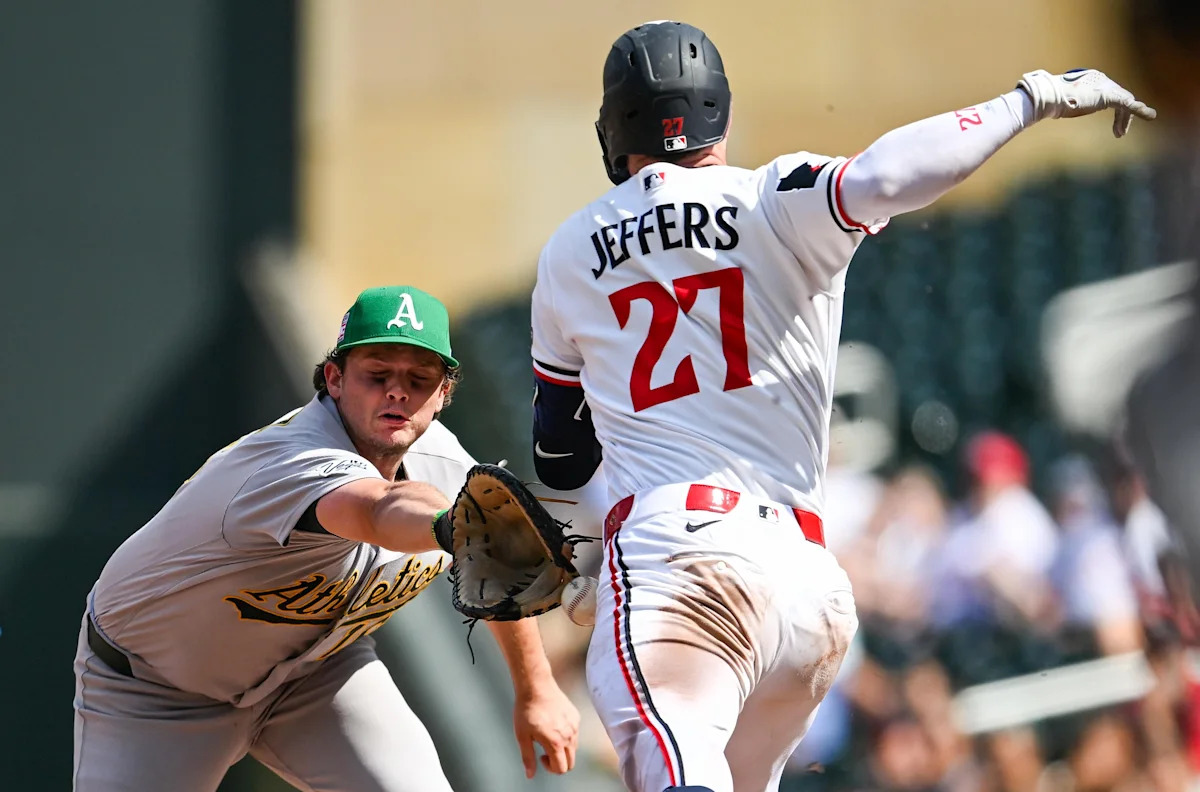
Easiest, when half the roster sits on the IL relegated to rooting from the dugout, is to blame the training and Strength & Conditioning staff. Yet this is a bit of a simplistic and knee-jerk reaction. Which trainer is to blame for Jamie Arnold taking a line drive to the face?
The flurry of injuries that decimated the A’s felled so many key players both on the big league roster and the minors. The list produces a pretty good team: Brent Rooker, Luis Severino, Nick Kurtz, Shea Langeliers, Jacob Wilson, Tyler Soderstrom, Joshua Kuroda-Grauer, JT Ginn, Leo De Vries, Jamie Arnold, all out for the season, and now Gage Jump likely following suit. Denzel Clarke and Zack Gelof also have missed appreciable time along the way.
Advertisement
That’s insane, but the injuries fall into various buckets so let’s examine the buckets…
Fluky and unpreventable
Kuroda-Grauer, who was humming along when one not-so-fine day he fouled a ball off of a ball and ruptured his testicle, and Arnold, whose cheek and sinus bones could not withstand a line drive that creamed them on the fly, suffered injuries absent any potential blame (other than perhaps not insisting every player wear a cup). These injuries demonstrate how not everything can be a referendum on the adults in charge.
Unrelated to preparation or diagnosis
Gelof’s knee laceration, incurred while sliding hard into the side wall where there was wire netting, is an example of an injury that cannot be traced to stretching, conditioning, or anything related to the preparation or diagnosis of the human body.
Advertisement
The same can be said of the unfortunate play where a poor Gelof throw caused Kurtz to get tangled up with the runner going by and the 1Bman’s thumb was a casualty of the collision. Most likely Wilson’s shoulder injury, the result of diving for a ground ball, also falls into the category of a “a baseball play” in which a perfectly conditioned body could still suffer the malady.
Most likey, Langeliers’ injury was also “just one of those things” as he tore a meniscus running the bases. One can question the strength and conditioning program when a player’s body doesn’t hold up to an ordinary event, but most often it’s just that if you run the bases 1,000 times 999 of those times it will go smoothly and once in a while it just doesn’t.
Ordinary injuries with room for questions
Now we get into the gray area, where you can easily say, “That injury happens around MLB all the time” and yet you can also ask, “Could it have been prevented?”
Advertisement
Rooker injured his knee, but it was not a single event. Rather it was pain that worsened over time, starting with a bone bruise contusion. A cortisone injection and rehab were supposed to alleviate the problem, but didn’t and subsequently tests revealed an articular cartilage tear and loose bodies in his left knee, leading to season ending surgery. Certainly there is room to ponder a misdiagnosis or poor decision-making along the way, but it’s not a slam dunk to draw any particular conclusion.
Soderstrom is another example where a player went down with a known injury, in this case a hip impingement, then tried to come back and “play through it” only to punt soon after and shut it down. One can reasonably question the wisdom of this decision, given how inevitably Soderstrom succumbed to surgery soon after.
Similarly, De Vries had a known shoulder issue that affecting his throwing at SS but continued to play for quite some time before eventually shutting it down, being diagnosed with a labrum tear and having surgery that will likely keep him sidelined for about 8 months. This is an especially troubling arc considering that had De Vries undergone surgery 6 weeks earlier he might be ready for the start of the 2027 season — but we also don’t know exactly when the labrum tore so we are left with as many questions as answers.
Severino, Ginn and Jump fall into a common category: arm injuries for pitchers because, well, pitching is really bad for the arm. Ginn’s is an elbow impingement, Jump’s shoulder soreness from impingement, Severino’s shoulder strain the most significant. Did the A’s staff do anything wrong failing to prevent these injuries from happening?
Advertisement
One could always ask whether the “between starts” regimen is the best possible one — teams differ around how bullpen sessions, long toss, treatment and the like are managed — and perhaps there could be better communication to catch problems in the earliest stages. (For example, Jump threw a fastball 91 MPH last night which could have been seen as a big red flag but went on to throw a couple dozen more pitches before exiting.) But pitcher arm injuries are hardly an “A’s special” and in fact the A’s have not been hit any harder than their opponents in this regard.
Post-injury response
Rooker and Soderstrom are examples of a puzzling response to managing an injury, De Vries possibly as well at the minor league level, but they are not the only ones.
Lawrence Butler looked very slowed down the first half of 2026 following his knee surgery and you wonder if the A’s whiffed not easing him in with a rehab stint at AAA and a more gradual return to full time RF duty with the big league club. Last year saw Wilson try to play through a hand injury that left him clearly diminished and both Wilson and Max Muncy had injuries from HBP in which a fracture wasn’t properly diagnosed the first time.
Advertisement
Conditioning
We don’t know why Denzel Clarke keeps suffering soft tissue injuries, particularly to his hamstrings, but this issue cropped up again while rehabbing a separate injury (bone bruise). Last season, Clarke missed significant time after injuring his right adductor muscle rounding 3B to score on a base hit.
All bodies are different and you shouldn’t be too quick to judge who comes to the party with a little more baby fat than his peer. Nonetheless it’s hard to imagine that Kurtz wouldn’t benefit from a slightly more svelte physique and Butler came to camp looking like he had “bulked up” in ways that only hampered his mobility.
Just looking at all the bodies on the field it’s not hard to imagine where some improvements could be made in the “strength and conditioning” realm — but fans are also far from strength and conditioning experts and players have considerable say in how they manage their own bodies.
Advertisement
Like I said, when you take a deep dive you are left with more questions than answers. But it’s the internet, so here’s where you get to weigh in with what you think the answers are despite the apparent murkiness of the landscape. The only part we are all likely to agree on is that the A’s have a far better team on the IL than they can put on the field, and if the team is to be competitive going forward that script needs to flip. Somehow.
Read the full article here


