




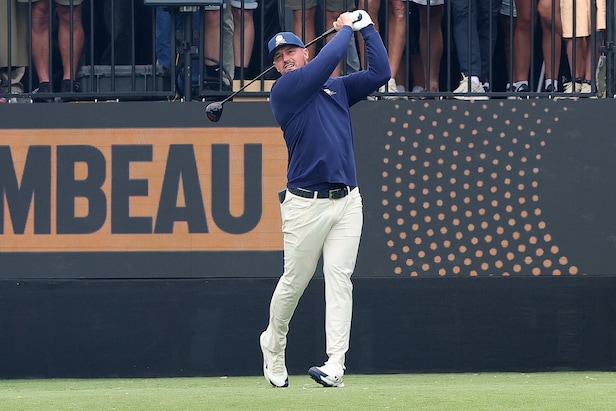
Bryson DeChambeau has never been shy about staking out a position, and his latest one is sure to ignite the debate over the impending (albeit contentious) equipment rollback that will commence with the golf ball in 2030 for all golfers.
Speaking ahead of this week’s LIV Golf event in South Africa, DeChambeau was asked whether the equipment arms race or raw athleticism deserved more credit for tour players bombing it farther than ever before.
Advertisement
His answer was unambiguous.
“If you want to say that a driver back in 2009 is worse than now, I would actually disagree with you on that,” he said. “I think they’re relatively the same and not much has changed. You can’t change it that much with the rules being the way they are.”
It’s a bold claim. The average driving distance on the PGA Tour was 302.8 yards in 2025—a roughly 15-yard jump from the tour average in 2009 (287.9 yards). Assuming driver technology has played a role in the distance spike isn’t a stretch.
DeChambeau isn’t blind to the numbers—he just thinks they’re telling the wrong story. His broader argument is more nuanced than a simple equipment dismissal. He’s quick to point the finger at the person holding the club. “I think it’s a lot more the athletic ability, and not being as afraid to go after shots or swing harder or be more aggressive,” he said.
Advertisement
That part is hard to argue with. Launch monitors, elite fitness routines and a generational willingness to go all-out have all moved the needle in a real way. Nobody’s disputing that.
But crediting the athlete shouldn’t require discrediting the engineers who spent two decades sourcing new materials and optimizing MOI and aerodynamics to make every off-center strike more playable.
Even Golf Digest’s most recent testing with the Golf Laboratories swing robot confirms drivers are getting longer by reducing the penalty on off-center strikes. The size of the head hasn’t changed, but what’s inside certainly has.
The robot data makes one thing clear: The gear is doing a lot of heavy lifting. Put a 2009 swing into 2009 equipment, and you’re leaving real yards on the table. The same could be said if Scottie Scheffler or Rory McIlroy were tasked with playing a full season with a circa-2009 model. Equipment and athleticism aren’t competing explanations. Simply put, they’re multipliers.
Advertisement
Where DeChambeau does find firmer ground is on the rollback debate. Rather than simply opposing the change, he frames it as a question the governing bodies haven’t fully answered yet. “What are the bodies of golf trying to accomplish?” he asked. “Are they trying to preserve the traditions and history of the game, or are they trying to grow the game, because those are two different things.”
It’s a legitimate distinction. Roll back the ball and you’re threading a needle—protecting classic courses for pros while potentially alienating the next generation of fans who showed up precisely because watching someone carry a par 5 in two is genuinely thrilling.
“If you want to grow the game, that’s not how you get kids to hit the golf ball farther and enjoy it and want to be a part of this game,” DeChambeau said. “I like showing how much fun it is to play the game of golf, not how difficult it is.”
That’s a message worth hearing, even if the data and driver discussion complicates the equipment side of his argument.
Read the full article here


