




Do you remember how nice it was when the Jazz used to have a good defense? I won’t blame you if you say no – 2022 was the last defense Utah has put forth that has been above league average, and even then, everyone knew it was a paper tiger. In recent years, the Jazz haven’t even had the luxury of a fool’s gold defense; over the past 4 years, the Jazz have been rated the 23rd, 30th, 30th, and 29th best defenses, respectively. While frustrating to watch, it was permissible (and maybe even advantageous) for these tanking iterations of the team. But now? The Jazz expect to win, and win they will not unless that defense takes a major step forward. And if defenses are really built on the shoulders of giants, then whichever free agent center Utah brought in this offseason had better be a real gamechanger.
This is, admittedly, an unfair expectation for new Jazzman Jaxson Hayes. However, it is true that competent teams often rely on competent big men – my pick for the best 4 teams last season (Spurs, Thunder, Knicks, Timberwolves) each fielded 48 minutes of above-average center minutes. Hayes will likely be asked to play similar minute totals to fellow Western backups, such as Luke Kornet and Jaylin Williams, and a certain level of dependability is a must if the Jazz want to at least competitively spar with these rival clubs.
Advertisement
The question that naturally follows, then, is “Can he do it?”. In an attempt to find an answer, I went on a journey. NBA.com offers the wonderful feature to watch the plays that accompany every one of a players box score statistics from a season, and of that I took full advantage in conducting my comprehensive Jaxson Hayes deep dive. I streamed each of his shot attempts, assists, steals, blocks, and turnovers, all in very quick succession, to supplement the understanding of his game that I already held with me as a dedicated fan of the NBA. Now, out of the goodness of my heart, I’ll present my findings from this statistical expedition, so no other Jazz fan will have to repeat this rather repetitive task.
Before I begin, Jaxson Hayes’s personal history requires a disclaimer. This article does not attempt to determine the contents of his character, or whether it was “right” for the Jazz to sign him. Hayes’s issues with domestic violence are horrific, and a blemish on him and his basketball career. However, whether one likes it or not, Hayes is on the team now, and will likely play semi-meaningful minutes. For that reason, I will focus my analysis on Hayes as a basketball player, rather than Hayes as a person.
The Basics
Name: Jaxson Hayes
Advertisement
Height: 7’0
Weight: 220 Pounds
Wingspan: 7’3.5
Stats: 66 GP, 9 GS, 18.3 MPG, 7.5 PPG, 4.1 RPG, 0.9 APG, 0.4 SPG, 0.8 BPG, 76/100/65 (on 2 three point attempts)
Offense
BROOKLYN, NY – FEBRUARY 3: Jaxson Hayes #11 and Luka Doncic #77 of the Los Angeles Lakers look on during the game against the Brooklyn Nets on February 3, 2026 at Barclays Center in Brooklyn, New York. NOTE TO USER: User expressly acknowledges and agrees that, by downloading and or using this Photograph, user is consenting to the terms and conditions of the Getty Images License Agreement. Mandatory Copyright Notice: Copyright 2026 NBAE (Photo by Nathaniel S. Butler/NBAE via Getty Images) | NBAE via Getty Images
Immediately, I realized that watching every Jaxson Hayes shot attempt would be a much more entertaining exercise than when I did the same for Josh Okogie. While both are fairly simple players who do not deviate from their highly specialized role, Jaxson Hayes’s particular set of skills happened to align perfectly with Lakers superstar, Luka Doncic. So, while I was technically watching Jaxson Hayes interior shot attempts, the real star of most of these plays was Luka, making mincemeat of the defense in the pick-and-roll. This was engaging to spectate, sure, but sparks doubt about just how replicable Hayes’s production would be in a Luka-less offense. Doncic is likely one of the 5 best pick-and-roll operators in league HISTORY, and is one of the best big-man amplifiers in the league today. While Keyonte made huge leaps as a passer this past season, and Collier has immense natural talent, neither come close to any of the poise, accuracy, and creativity of Doncic. This fear of mine is reflected statistically – in the 404 minutes Hayes played without Luka, the Lakers offensive rating was 5.9 points worse than league average. With both of them on the court? 8.9 points better than league average. On-off numbers are finnicky, to be sure, especially in single season samples, but the numbers paint a picture that matches logic and the film.
Advertisement
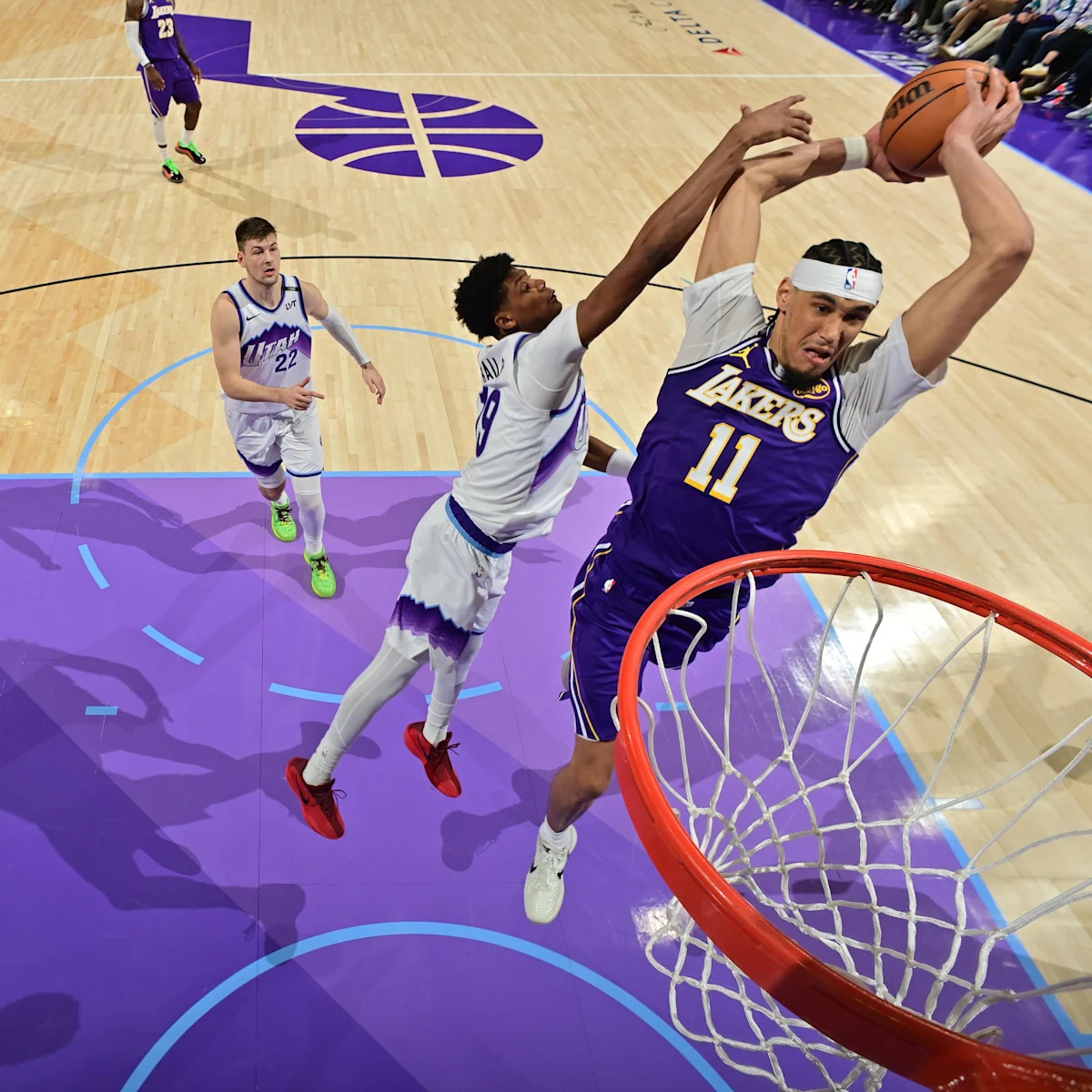
However, while the film clearly did show Luka and Hayes having a very synergistic relationship, I do not think that Hayes is completely dependent on Doncic. As a roller, I think Hayes is, while simplistic, rather effective. It all begins with his overwhelming, game-defining athleticism. Hayes covers ground, both horizontally and vertically, with explosive speed and range. His stride lengths are long, he gets off the ground remarkably fast, and he seems to stay in the air forever, which helps him both in the half court and transition. Additionally, while Luka is great at getting the ball to his teammates where they can score, Hayes first has to know where to be. After watching his shot attempts (makes and misses), I was impressed with Hayes’s understanding of space. He fills the areas he needs to fill, and is able to get open to catch Luka’s well-placed lob passes. With his athleticism and length, Hayes always seems to be in range for a dunk, and will place himself around the paint accordingly.
Put this all together, and Jaxson Hayes will perhaps be the best in-game dunker the Jazz have ever had.
(Before people get mad, yes, I know who Darrell Griffith and Jeremy Evans and Donovan Mitchell are. The argument for Hayes would be quantity+quality.)
Advertisement
I compared the simplicity of Hayes’s game to Okogie’s. Just as the majority of Okogie’s halfcourt attempts were catch-and-shoot three pointers, the majority of Hayes’s halfcourt attempts were catch-and-DUNK two pointers. For both, I got pretty good at anticipating how each shot attempt would go. If Okogie started to dribble in the film, I immediately got worried. Likewise, Hayes’s was by-far the most effective when he was asked to do as little as possible. Sometimes, he would fake a handoff to one of the Lakers 3 primary ball-handlers and attempt to drive to the rim, and this was rarely successful. Hayes isn’t the physically strongest guy, and when he’s driving into a set defense, he’s prone to get bodied off of his spots. While in a car, if you want to go forward, you shift to drive. If you want to go backward, you shift to reverse. Hayes functions in a similar way. He clearly has very distinct mindsets on offense that he struggles to switch between. While driving to the rim, you can tell he’s in the “score” gear and will be attempting a shot no matter what. He sometimes flashes pretty impressive passing (nothing crazy, but more impressive than you’d expect for a 0.9 APG center – NBA players are so good), but struggles to merge his passing gear and his scoring gear into one comprehensive offensive gear. For a player as simple as Hayes, this isn’t the biggest problem in the world – he isn’t often making the most complex decisions. In his limited role, it didn’t hurt his effectiveness too much; he still made his shots at a 76% clip, and the shot selection is rarely too abrasive. However, it certainly does limit his offensive ceiling, and means that he will likely continue to be slightly less than the sum of his parts on this end of the floor.
A few miscellaneous offensive notes;
-
Better touch outside of 3 feet from the rim than I expected. Didn’t take many, but his hooks and floaters were pretty efficient shots.
-
I don’t love his screening. Maybe it’s due to his weaker frame relative to other centers, but he sets a lot of slip or ghost screens which didn’t lead to much separation. Additionally, he uses his arms a lot in his screening form and sometimes starts to move a bit too early – expect a fair few moving screens this next season.
-
The offensive rebounding is nothing special, but if he does have adequate positioning down low, his combination of verticality and quick second and third jumps does help him a lot. Just doesn’t have the muscle to be too dominant of an offensive rebounder, however.
Defense


LOS ANGELES, CA – MAY 11: Jaxson Hayes #11 of the Los Angeles Lakers plays defense during the game against the Oklahoma City Thunder during Round Two Game Four of the 2026 NBA Playoffs on May 11, 2026 at Crypto.Com Arena in Los Angeles, California. NOTE TO USER: User expressly acknowledges and agrees that, by downloading and/or using this Photograph, user is consenting to the terms and conditions of the Getty Images License Agreement. Mandatory Copyright Notice: Copyright 2026 NBAE (Photo by Adam Pantozzi/NBAE via Getty Images) | NBAE via Getty Images
While far from a perfect defender, this is where Jaxson Hayes provides the majority of his impact. And, just like his offense, the strengths he provide on this end of the floor all rely heavily on his athleticism, which is legitimately in the 99th percentile of the 99th percentile.
Advertisement
Ground coverage is one the best skills you can bring defensively (if combined with some base level of basketball understanding), and Hayes is better than nearly everyone in the league at this one thing. His agility is legitimately freaky for a guy his size, and his motor revs pretty hot for a big man (except after he misses on offense – then, he’s prone to pouting before getting back on defense). He’s got the flexibility to change directions, the length and height to take up space, and the athleticism to get where he needs to be. On his good possessions, it feels that Hayes is nearly omnipresent – he can begin the play by switching onto a guard, following him closely on a drive to the rim, and then immediately pounce on a closeout to a corner shooter. His physical gifts give him such a high defensive ceiling on a play-to-play basis. For an example, look at the nimble feet he showcases following Hart to the rim, and the quick leaping ability to explode upwards and get the block.
It’s easy to slot Hayes into the rim runner, drop defense archetype, but defensively, that isn’t quite right. He really doesn’t spend too much time in the paint, and isn’t the most effective when trying to function as a traditional defensive anchor. He doesn’t have the most core strength, and can get bumped from his interior positioning by bigger drivers. Additionally, his timing and positioning in drop defense isn’t really anything special. He does not attempt to play defense like Rudy Gobert or Walker Kessler, but this does not mean that he is not effective. He actually seems to be more in the ilk of a Jaren Jackson Jr., flying in from the weak side to help his teammates and make momentum shifting blocks. Switching appears to his preferred pick-and-roll coverage, as opposed to the more traditional drop. While I didn’t count while watching all 52 of his 2025-2026 blocks, it seemed to me that the majority of his blocks came off of these switches – the ball handlers sizes Hayes up, gets a step on him, and gets blocked from behind once he reaches the rim. This defensive style clearly benefits his athletic makeup; his ground coverage and agility aren’t maximized if he is consistently staying as close as he can to the basket. This switching style helps get rid of open midrange shots (his opponents shoot 2.5% worse in that area while he is on the court), but is less effective near the rim, where his opponents shoot 1.7% better while he’s out there. Overall, opposing offenses are less effective while Hayes plays, largely because he’s so able to muck things up and semi-competently play a variety of different defensive roles (fine at drop defense, positive as a switcher, positive as a help side defender).
Once again, though, Hayes is not perfect. He’s rather jumpy at times, biting on fakes that he really shouldn’t be biting on. His weaker physical frame leads to issues rebounding, and likely means he will need to be paired with a strong rebounder in the front court. His positioning is sometimes off – defense is a game of inches, where being one step to the left determines whether your opponent scores or misses. The best defenders make that seemingly inconsequential step more often than the only slightly above average defenders, but the impact those steps make over a season are immense. It’s why it’s sometimes difficult to see just what makes a prime Rudy Gobert or Draymond Green substantially better defensively than their peers – at some point on the defensive possession, they made a step, which causes their opponents to, rather inconspicuously, miss more shots every game. Hayes simply makes that step less than the best of the best.
Advertisement
Still, he is an overall positive on this end, even if we shouldn’t be expecting some game-changing force. He produces big, momentum shifting plays, and those have value. When Keyonte George is on a hot streak during game 3 of the first round of the 2027 Western Conference Playoffs, and Jaxson Hayes swats a Reed Sheppard floater into the fifth row, The Delta Center will be rocking. That big-play potential means something to me, and solidifies my slightly positive evaluation of Hayes’s defense.
Conclusion/How It All Fits


LOS ANGELES, CALIFORNIA – MAY 11: Jaxson Hayes #11 of the Los Angeles Lakers reacts after a slam dunk against the Oklahoma City Thunder during the third quarter in Game Four of the Second Round of the NBA Western Conference Playoffs at Crypto.com Arena on May 11, 2026 in Los Angeles, California. NOTE TO USER: User expressly acknowledges and agrees that, by downloading and or using this photograph, User is consenting to the terms and conditions of the Getty Images License Agreement. (Photo by Luke Hales/Getty Images) | Getty Images
Jaxson Hayes makes stuff happen – you can feel when he’s out there – and the Jazz do need someone like that (the team seemed to recognize this, with another signing, Okogie, also being a real shaker). However, does he make enough good things happen to play in the postseason? I’m not as sure about that. I appreciate the battle-tested dynamicity that Hayes brings to the team. He’s not going to fade into the background like Filipowski or Cody or Brice or Bamba tend to do. Instead, he’ll inject around 15 minutes per game of chaos, and I believe that is valuable. I just don’t think he does anything quite good enough to project him as someone that can certainly play on the biggest stage, especially offensively. While his defense is loud, I worry how tangible his offense will be against strong interior opponents without the buoy of Luka’s dominant playmaking. In the playoffs, the Jazz can’t afford to be playing 4v5 offensively, if the weak link isn’t guaranteeing a rather impressive level of defensive fortitude. So, while Hayes is good enough defensively to be be a regular season positive, will that be enough in a 7 game series against the Spurs? The Thunder? That remains to be seen.
Advertisement
Luckily for the Jazz, they do have a rather versatile front court, with different options that they can mix and match. I’m particularly excited to see minutes with both Hayes and Filipowski on the court, as I think their strengths and weaknesses are pretty synergistic with each other. With his shooting, Filipowski can play at the power forward, and provides the front court rebounding to mitigate Hayes’s rebounding in that department. Hayes’s switching and ground coverage, on the other end, insulate some of Filipowski’s defensive weaknesses. I’d also like to just have a taste of a Nurkic+Hayes front court – in his younger years, Hayes nearly split his minutes 50/50 between power forward and center, and would provide a jolt of athleticism next to Nurkic’s more ground bound style. This only makes sense is Nurkic can maintain and improve his shooting numbers next year.
After this deep dive, I believe I am in the camp that Hayes will provide good, dependable production in the regular season, eating minutes at an above-replacement level. I also expect his minutes to decline precipitously in the playoffs, where Jaren Jackson Jr. may play more as a backup center (much of the synergistic benefits Hayes provides to Filipowski can be given by Jackson as well). While much has been said about the problems that arise from JJJ center minutes, it’s not like Hayes is some dominant rebounder either – will the Jazz be losing that much by replacing his minutes with Jackson? This is not an indictment on Hayes – the team isn’t paying him very much money, so if he is just a regular season minute eater, you can’t really complain. He dunks, he blocks, and he tries, all of which will be appreciated by a Delta Center crowd anxious for things to, once again, begin to happen.
Read the full article here


