





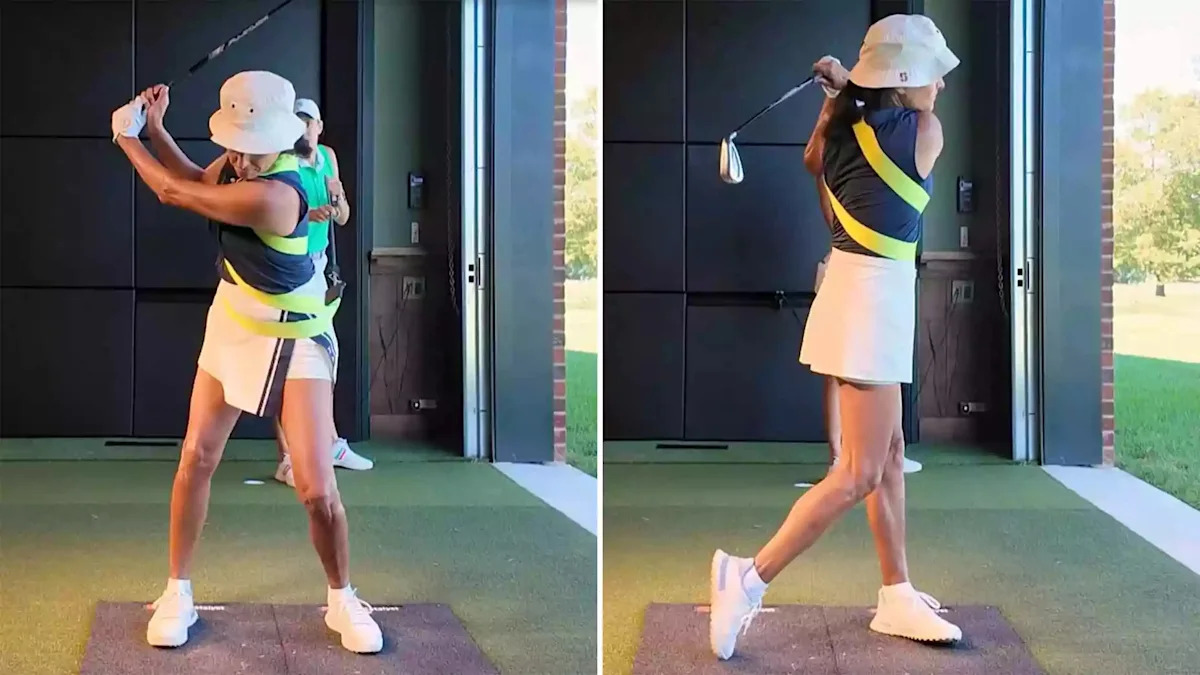
Anna is the kind of student every coach loves to work with. She played college tennis before she ever got serious about golf, and when she came back to the game as a mid-amateur, she brought that same competitiveness with her. In just over a year and a half of real work, her scores have come down from the 90s into the low 80s, with a few rounds even lower than that. That kind of jump doesn’t happen from a swing tip or two. It happens from a plan.
Morgan Hale, the director of instruction at The Creek, has been building that plan with Anna since the start. Foundational work on posture, on club face and path through the wedges, and on structure at the top of the swing. I get folded in for what we call our “performance sessions,” where I’ll join Morgan and PGA Tour trainer Kolby Tullier to combine golf instruction and fitness in the same lesson.
How Anna went from the 90s to low 80s
The first thing we addressed was how Anna used her lower body on the way down — or, more specifically, how she didn’t. Like a lot of players, she wasn’t using her trail foot to help clear her hips out of the way, so her upper body ended up doing work her lower body should have handled. We had her feel a push off that right foot at the top of the backswing, almost like she was jumping off it, to get the hip moving before anything else. Once she felt it, the difference in how freely everything else worked was obvious.
Advertisement
The other half of that equation is the lead foot. If the trail side pushes but the lead foot lifts or slides, you’re not clearing your hips; you’re lunging at the ball. We kept reminding Anna to keep that left foot grounded, chest staying behind the hip instead of diving toward the target. Stay on that foot, and the hip can turn around it instead of the whole lower body sliding toward the ball.
Anna caught a couple of shanks while she was working through this change, which is actually a good sign. A shank almost always means the path and the face are already close to where they need to be, and something small, a stray hand or an early release, is getting in the way in the last foot before impact. It’s a far better miss to be working through than the ones she came in with.
The last piece was her wrist position at the top. We looked at videos side by side, and the difference was obvious. A cupped left wrist left the face wide open, and a flatter left wrist got the face square to slightly strong, sitting on top of the ball instead of underneath it. We built that feel with a simple halfway drill, stopping the club at the midpoint of the backswing to check the face before ever finishing the turn to the top. Get the face right at the halfway point, and it tends to stay right the rest of the way up.
None of this is complicated in isolation. It’s a hip clear, a grounded lead foot and a flatter wrist at the top. What made it work for Ana was the same thing that makes any performance session work. There is an order and priority to how the swing work happens, and the stuff the swing coaches are incorporating works hand in hand with the work a player is doing on his or her body to support it.
Then it’s just a matter of following the process and seeing the good shots start happening.
The post How this golfer dropped her scores from the 90s to the low 80s appeared first on Golf.
Read the full article here