




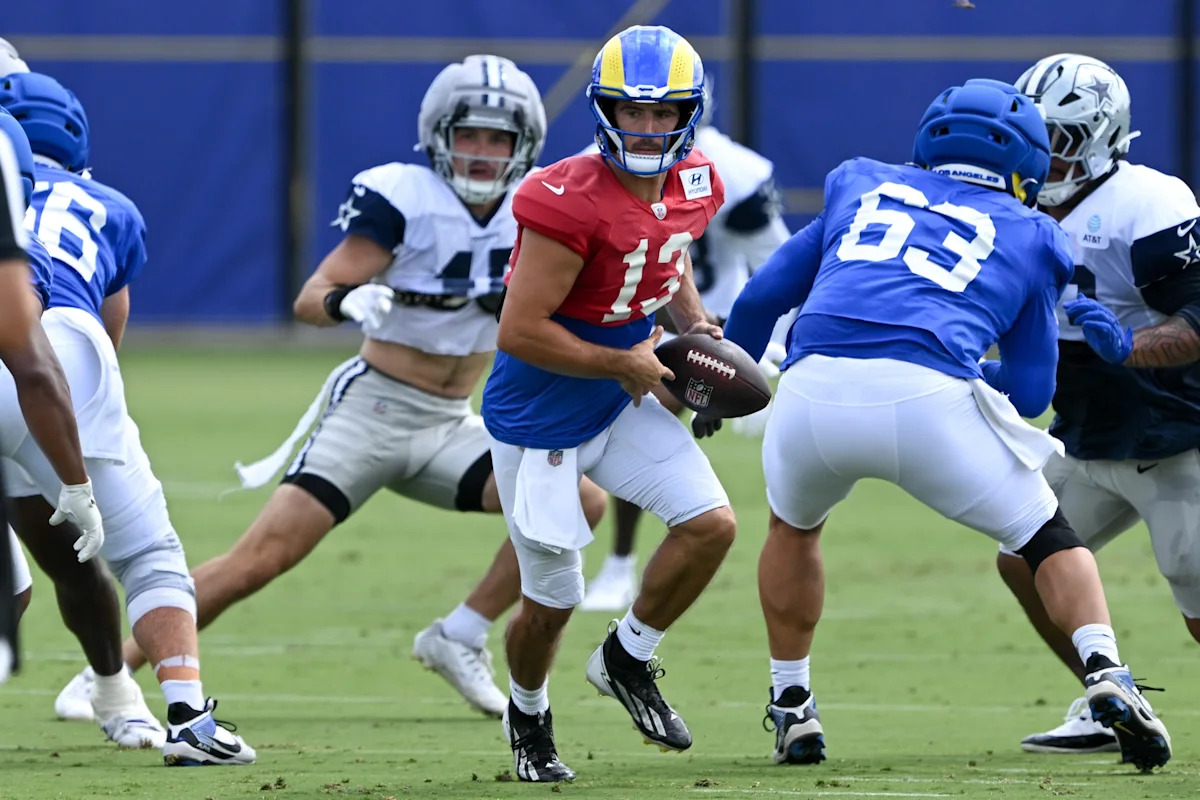
The Dallas Cowboys’ defense dominated the headlines coming out of Tuesday’s joint practice with the Rams. Justin Barron intercepted three passes, Dallas generated consistent pressure, and some of the early reviews from the Dallas side were understandably enthusiastic.
But what did the other side see?
Advertisement
I went through coverage from the The Athletic, ESPN’s Rams coverage, Rams on SI and the Rams’ own website to see what the other side made of Tuesday’s practice.
And the picture is more nuanced than some of the Dallas headlines suggest: the Cowboys’ defense made a real impression, but the Rams’ defense won plenty of important battles, too.
1. The Rams’ secondary mostly won the day
Nate Atkins of The Athletic explicitly says the Rams’ secondary “mostly won the day,” helped by the pass rush. His focus was on how Los Angeles dealt with a Dallas offense loaded with talent at quarterback, running back, receiver and tight end.
Los Angeles lived in lots of dime personnel, something it led the league in last season, but it can get more creative and versatile with McDuffie’s ability to play inside and outside, in addition to the growing versatility of Curl and Quentin Lake. McDuffie often slid inside in these settings, offering a second nickel cornerback of sorts to Lake, which threw off the matchups the Cowboys were hunting for by motioning Pickens and Lamb into the slot, or a normal method to expose the lacking coverage of most teams they face.
The result was that Dallas didn’t generate many explosive plays.
They did generate a couple of yards-after-catch opportunities with dumpoffs to running backs and tight ends in the flat or on play-action leak patterns that tapped into Prescott’s ability to extend the play with his legs. The only time the Cowboys came close to scoring a touchdown was in the red zone period, where Prescott’s dual-threat abilities manipulated the numbers so much that it’s that much harder to get a stop when he can find Ferguson in the back of the end zone, which happened a couple of times.
That’s an important counterweight to the Dallas-side narrative. The Cowboys didn’t simply spend the afternoon throwing at an overmatched Rams secondary.
Advertisement
2. Byron Young gave the Cowboys’ tackles problems
If there was one Rams defender who consistently caused problems for Dallas, it was Byron Young. Atkins describes Young repeatedly winning against Terence Steele with both speed and power.
Byron Young had a field day against Cowboys right tackle Terence Steele. He won with speed around the edge, one time so freely that he actually overran a sack that Prescott turned into a short scramble by dipping around his speeding body. He won with the bull rush at times, including one rep where he drove the pocket back so deep into Prescott that the Cowboys quarterback was left chucking the ball over McDuffie’s tight coverage on the outside just to get it away.
He had another rep where he lined up on the left side and threw Guyton into the running back for a quick run stop.
The observations from the Rams’ official website similarly highlighted Young’s pressure against Steele and his impact against the run.
The fourth-year outside linebacker made it a long morning for Cowboys right tackle Terence Steele. There was one two-play sequence where he led the pass rush generating pressure that collapsed the pocket so fast, it forced Prescott to scramble out of bounds, then Young won so quickly again on the next series he would’ve had a sack if not for the red non-contact jerseys worn by quarterbacks.
And all of this happened without Myles Garrett on the field.
3. Dallas forced the Rams to get creative against Pickens and Lamb
The Rams weren’t just sitting in their preferred coverage and hoping it would work against Dallas. They were actively adjusting to what the Cowboys were doing with their receivers.
Advertisement
Atkins specifically points to Dallas moving CeeDee Lamb and George Pickens into the slot to hunt for favorable matchups. The Rams responded by moving Trent McDuffie inside and using Quentin Lake and Kamren Curl in increasingly versatile roles.
In other words, Dallas’ personnel and alignment were forcing the Rams to get creative.
The Rams’ own reporting confirms that McDuffie was frequently moved inside during the practice, while Lake operated in a more flexible role. And the day’s biggest Rams coverage play came against Pickens:
The Cowboys tried to throw a quick shot to Pickens from the slot, but Lake was all over it, running the route for Pickens and stabbing the ball out of the air before running with it until he was tackled.
From the Rams’ perspective, Lake recognized what was coming and made a play.
Advertisement
From the Cowboys’ perspective, however, the play confirms that Pickens was being used as a movable piece to stress the Rams’ coverage, rather than simply lining up outside and running routes from the same spot all afternoon.
That is probably something worth watching as Dallas continues to develop its offensive identity.
4. Dak’s mobility still gave the Rams problems
The Rams’ secondary may have limited the Cowboys’ explosive passing plays, but Atkins repeatedly points to Prescott’s ability to extend plays as a source of success.
Dallas created some yards-after-catch opportunities with checkdowns and play-action leaks, but Prescott’s legs were also a factor. And in the red zone, his mobility became particularly difficult for the Rams to account for.
Prescott’s dual-threat abilities manipulated the numbers so much that it’s that much harder to get a stop when he can find Ferguson in the back of the end zone, which happened a couple of times.
That’s an encouraging detail for Dallas. The Rams could win individual coverage battles and still have a problem because Prescott can turn a broken pocket into a positive play.
Advertisement
The L.A. perspective suggests that Dak’s mobility remains a genuine structural problem for opposing defenses.
5. Dallas’ defense genuinely disrupted the Rams’ second-team offense
The Cowboys’ three interceptions are the obvious headline, but the L.A. reporting gives us another reason to take the defensive performance seriously.
The Rams’ website noted that Dallas’ defensive front consistently generated pressure, particularly against the second-team offense.
[Bennett] often received pressure from the Cowboys’ defensive front, but was still able to make plays down the field with a pair of interceptions mixed in by Barron over the middle.
The Cowboys’ defense was actually affecting the Rams’ quarterbacks.
So what did Los Angeles actually see?
The Cowboys did not simply dominate the Rams. But the Rams didn’t dominate Dallas either.
Advertisement
The most useful outside perspective may come from Rams on SI, which pushes back against trying to turn the practice into a decisive victory for either side:
“the answer is likely somewhere in the middle.”
And that is probably the fairest reading of the L.A. coverage.
From a Cowboys perspective, the L.A. perspective boils down to four things:
Dallas’ defense was legitimately disruptive. The Rams’ own reporting confirms that the Cowboys generated pressure and caused problems for the Rams’ quarterbacks.
The Cowboys’ offense created real schematic problems. The Rams adjusted their coverage specifically because Dallas was moving Lamb and Pickens around to create favorable matchups.
Advertisement
Dak’s mobility remained a major weapon. Even when the Rams won coverage, Prescott’s ability to extend plays and manipulate numbers created opportunities.
The Rams’ defense may be considerably better than last year’s. They limited explosive plays against a Cowboys offense that LA itself considers one of the league’s best — and did it without Myles Garrett.
So the most interesting conclusion from the L.A. side isn’t that Dallas’ defensive performance was overrated.
It’s almost the opposite.
Dallas’ defense really did have a strong day. But the Cowboys’ offense was good enough to force one of the NFL’s more intriguing new defenses to adjust its game plan.
Read the full article here


