




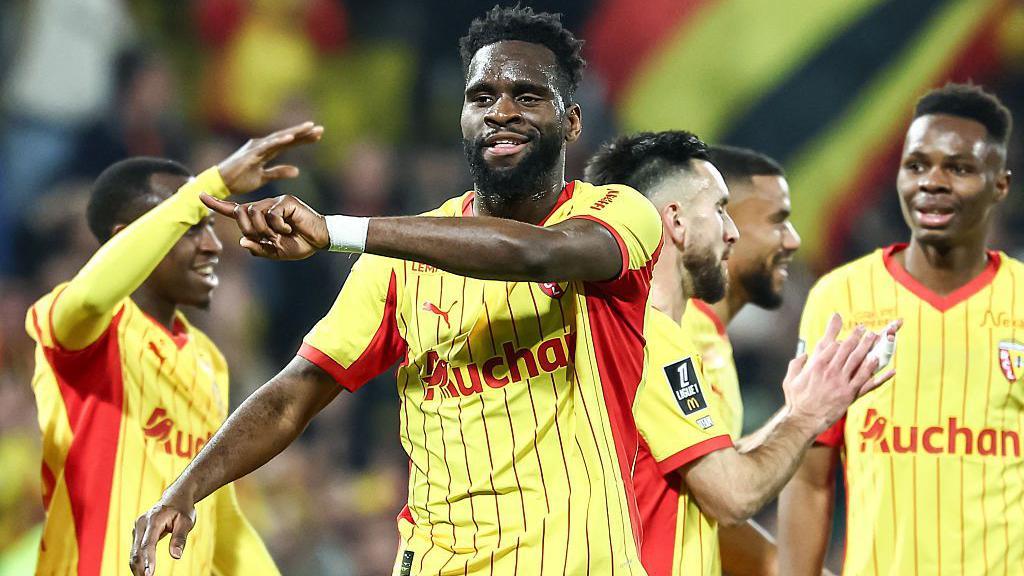
Lens were supposed to be gearing up for a potential Ligue 1 title-decider.
Yet with Paris St-Germain exempted from domestic action because of their Champions League commitments, the Sang et Or (Blood and Gold) will instead be hosting third-tier side Rouen for a friendly match on Saturday afternoon.
Advertisement
While the league authorities have made accommodations for other European campaigns in the past, PSG’s request did prompt vocal opposition from Lens.
In a statement published before the Ligue de Football Professionnel [LFP] convened, Lens had notably warned that the French top flight could become “a variable to be adjusted at the whim of the European imperatives of certain clubs”.
“Our intention wasn’t to pick a fight with PSG,” Benjamin Parrot, the club’s general director, tells BBC Sport.
“We wanted the schedule to be maintained as it was set out for teams like us, who have a budget and have built a squad around playing in the league and the Coupe de France.”
Advertisement
The league council’s decision, he points out, means Coupe de France semi-finalists Lens will end their league campaign with three games in the space of a week.
“It went to a vote and the decision was unanimous, which means that our arguments either didn’t get through or weren’t considered. Given that outcome, we’ll save our energy and focus on the rest of the season,” Parrot says.
Within four days, Lens managed to set up a replacement match.
“We would have played just once over a month. In terms of the team’s performance and fitness, organising a fixture became a necessity,” the club executive highlights.
Advertisement
Proceeds from the match will go to Reporters Without Borders as the club lends its support to Christophe Gleizes, the French football journalist who is currently imprisoned in Algeria.
Gleizes was handed a seven-year sentence in December for “glorifying terrorism” after travelling to the country to write about football club JS Kabylie.
The sentence was roundly condemned in France, not least in football circles.
“We were one of the first clubs that signed the petition calling for his release,” adds Parrot, a graduate of the same Parisian institute as Gleizes, who first joined Lens as part of the communications team.
Advertisement
Parrot, 40, is now one of three people overseeing the day-to-day running of the club, along with sporting director Jean-Louis Leca and head coach Pierre Sage. Like the former goalkeeper Leca, Parrot was promoted to the role in May of last year.
Boss Pierre Sage joined Lens last summer. They currently sit second in Ligue 1, four points behind PSG [Getty Images]
Sage, who broke on to the top-flight scene two seasons ago when he led Lyon’s spectacular recovery from the relegation zone to European football, joined a few months later.
“The three of us have a weekly meeting,” Parrot explains. “Pierre defines the profiles he needs, and Jean-Louis chooses the players along with the scouting team.”
Advertisement
Lens are, in the general director’s words, one of the “challenger clubs”, operating with only the 10th-highest wage bill in the league.
After several spells in the second tier, the 1998 league champions returned to the forefront of French football three years ago when they pushed PSG to within one point in the title race.
Despite recent success budget constraints remain, not least in the wake of successive broadcast deal collapses which have financially stunted French football.
“The club’s strategy is to keep costs stable, because we know that revenue will keep going down,” Parrot says, adding that much of the club’s revenue currently rests on unearthing gems in the academy and reselling them.
Advertisement
In December, Lens became only the third Ligue 1 team to own their home stadium, buying the property from the local authorities in a move which Parrot hopes will help diversify the club’s income.
“One season isn’t going to change our financial model or our identity. When you look at French football, we’re up against billionaires, sovereign wealth funds, or multi-club ownership. The objective [club owner] Joseph Oughourlian sets out is for us to break even.
“We’ll see what happens over the next month, but so far we’re on track to reach our objectives this season,” the director adds. “We’ve stuck to the wage bill we set out, we’ve brought a number of young players into the first team, and we’ve upgraded some of our infrastructure.”
For Parrot, it would be “pretentious” for the club to consider themselves as a model for other Ligue 1 sides in terms of navigating financial uncertainties.
Advertisement
“We do it out of necessity as well as philosophy. I think other clubs would like to spend more, but in our case it’s not part of our identity.”

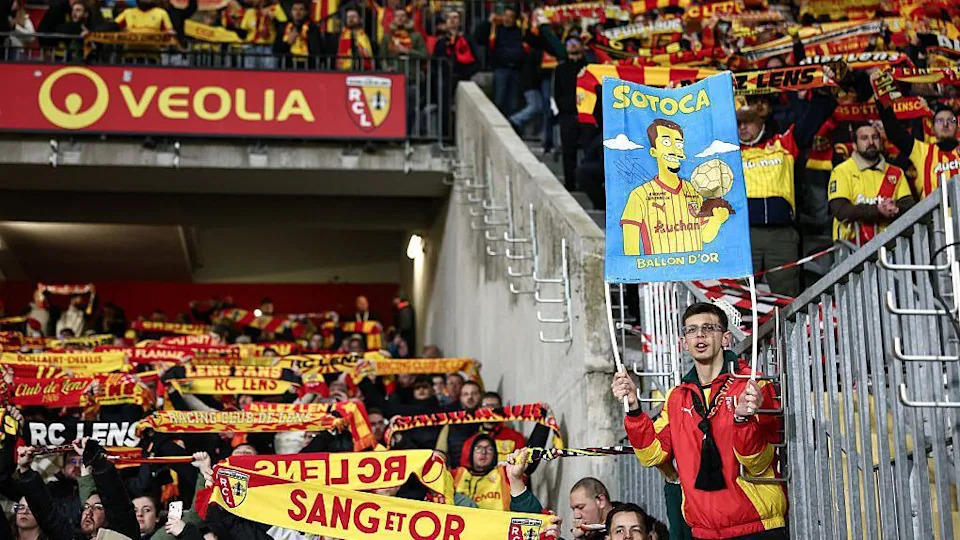
Lens regularly fill the 38,000-capacity Stade Bollaert-Delelis [Getty Images]
That cautious approach, Parrot says, is rooted in the club’s role as the standard-bearer for a former mining heartland.
“As a club which has its roots in the mining companies, and is based in an area with a social housing rate of 60%, we have a responsibility to be financially reasonable,” the director outlines. “I think it’s a historical aspect that we should respect.”
“The club definitely plays a socio-economic role,” Parrot continues, notably pointing to the local donations it makes through its foundation. “We’re in a region where the unemployment rate is the highest in the country and the median salary is among the lowest, so we try to do our bit.”
Advertisement
While the town itself only has a population of just over 30,000, its sizable catchment area within the Artois region of the north of France means it has no issue filling out the 38,000-capacity Stade Bollaert-Delelis.
Given the economic downturn the area suffered when the mines closed, it’s easy to draw a parallel with clubs across the Channel which are also based in former industrial heartlands.
“It sets us apart,” Parrot explains. “Our stadium is built on top of two former mines and is named after the director of the town’s mining company.
“When we sign a player, we give them a miner’s lamp. It’s a symbolic act; we explain how the lamp was used back in the day, and how it now guides Lens players.”
Advertisement
Every home match, the fans greet their players’ return for the second half with a rendition of “Les Corons”, a 1980s pop song paying tribute to the area’s mining heritage.
This year, fans unfurled an extensive tifo display marking the 120th anniversary of the Courrieres mine disaster, Europe’s deadliest accident of its kind, which killed 1099 local miners.
The club also celebrates Saint Barbara, the patron saint of miners, by wearing a commemorative shirt every year during an early-December home match.
This year’s Sainte-Barbe fixture, a 2-0 win over Nice, came in the midst of an eight-match winning streak.
Advertisement
Former Celtic and Crystal Palace striker Odsonne Edouard, Lens’ top scorer this season, headed in two near-identical goals, both assisted by left-back Matthieu Udol.
Much of the creative drive in this year’s Lens team has also come from summer signing Florian Thauvin. With 10 goals and seven assists in all competitions, the former Newcastle man is even contending for a spot in France’s World Cup squad.
“He’s the marquee player that we needed this season,” Parrot says of the 33-year-old.
“We might not have the financial leverage, but we can put forward other factors such as the confidence we put in them and our passion. Those arguments can only go so far, though, so his success will help.”
Advertisement
While a derby defeat to Lille last weekend did see them lose ground on PSG, Lens remain the most credible challenger to the league leaders heading into this season’s final straight.
Going toe-to-toe with the Parisians over the long term, though, remains a tall order for a club which has readily embraced its underdog status.


Read the full article here


