




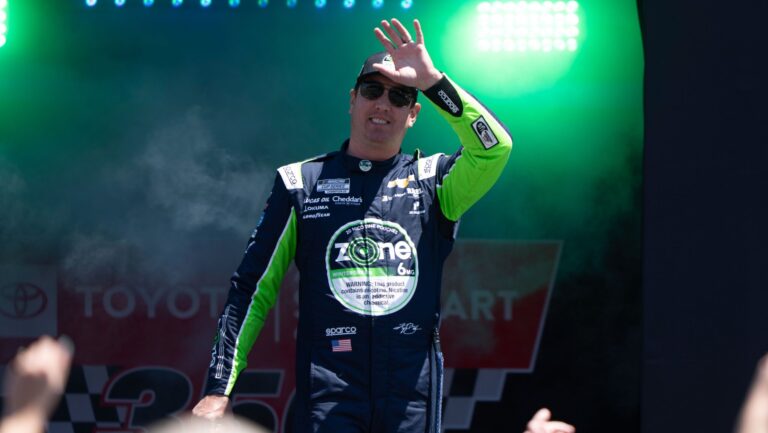
The shock that followed Kyle Busch’s death hasn’t settled — not in the garage, not among fans, and not across a sport that spent nearly two decades trying to keep up with him.
Because Busch didn’t just build a Hall of Fame career.
Advertisement
He built one of the most complete — and at times, most complicated — résumés NASCAR has ever seen.
The Numbers Are Impossible to Ignore
Start with what can be measured.
Busch won 63 NASCAR Cup Series races, putting him at No. 9 on the all-time wins list. Across NASCAR’s three national series — Cup, Xfinity (now the O’Reilly Auto Parts Series) and Truck — he amassed more than 230 victories, the most in NASCAR history.
That total isn’t just a record. It’s separation.
He added two Cup Series championships in 2015 and 2019, the 2009 O’Reilly Auto Parts Series title, and all-time wins records in both the O’Reilly Auto Parts Series and Craftsman Truck Series. By the end of his career, Busch had 234 victories across NASCAR’s three national series, including 63 in Cup, 102 in O’Reilly and 69 in Trucks.
Advertisement
But even those numbers don’t fully explain why Busch mattered.
A Driver Who Refused to Specialize
Most modern NASCAR drivers build careers around specialization.
Busch rejected that entirely.
He won at Bristol Motor Speedway eight times in the Cup Series, turning the half-mile into one of his personal strongholds. He added wins at places as different as Auto Club Speedway, Sonoma Raceway and Talladega Superspeedway, proving he could adapt to nearly every discipline NASCAR demanded.
And while others scaled back, Busch did the opposite.
At his peak, it wasn’t unusual to see him run all three national series in a single weekend — sometimes sweeping races, sometimes contending in all of them. In 2010 alone, he entered 35 Xfinity races and 21 Truck races while still competing full-time in Cup.
Advertisement
That wasn’t just versatility. It was endurance.
The 2015 Title That Changed Everything
If there’s one moment that defines Busch’s career, it’s 2015.
He missed the first 11 races of the Cup season after suffering a broken leg and foot in a crash during the opening weekend at Daytona. Under NASCAR’s playoff eligibility system, he remained playoff-eligible — but only if he could win.
He didn’t just win.
Busch returned that summer and rattled off five victories, climbing from outside the standings to a playoff spot before ultimately winning the championship at Homestead-Miami Speedway.
It remains one of the most debated — and most remarkable — title runs in modern NASCAR history.
Advertisement
And it cemented Busch as something more than just a prolific winner.
He was resilient.
The ‘Rowdy’ Era — And Why It Mattered
For much of his career, Busch leaned into the nickname “Rowdy.”
He was outspoken. At times confrontational. Willing to challenge NASCAR, his team, or anyone else in his path. He drew boos at driver introductions and rarely tried to quiet them.
But that edge served a purpose.
NASCAR has always thrived on drivers who create emotional reactions, and Busch understood that instinctively. Whether fans were rooting for him or against him, they were engaged.
He became one of the last true lightning rods in the sport — a driver who could shift the energy of an entire race weekend simply by being in contention.
A Career That Bridged Generations
Busch’s career began in NASCAR’s late-2000s boom era and stretched into a modern landscape shaped by Next Gen cars, shifting schedules and evolving fan expectations.
Advertisement
He won races in multiple generations of Cup cars. He competed against veterans of one era and rising stars of the next. And through it all, he maintained a level of performance that rarely dipped for long.
By the time his career reached its later stages, Busch wasn’t just competing.
He was measuring himself against history.
More Than a Hall of Fame Career
There’s no debate about Busch’s place in the NASCAR Hall of Fame.
The wins, championships and longevity make that inevitable.
But his legacy goes further than that.
He redefined what it meant to be a full-time NASCAR driver in the modern era — not just someone who showed up on Sundays, but someone who raced whenever there was an opportunity to compete.
Advertisement
He embraced the spotlight, even when it wasn’t always flattering. And he delivered results that forced even his harshest critics to acknowledge his place among the sport’s elite.
In the end, Busch didn’t just leave behind numbers.
He left behind a standard — one built on volume, versatility and a willingness to do things his own way.
And that’s what NASCAR is still trying to process.
Read the full article here


