



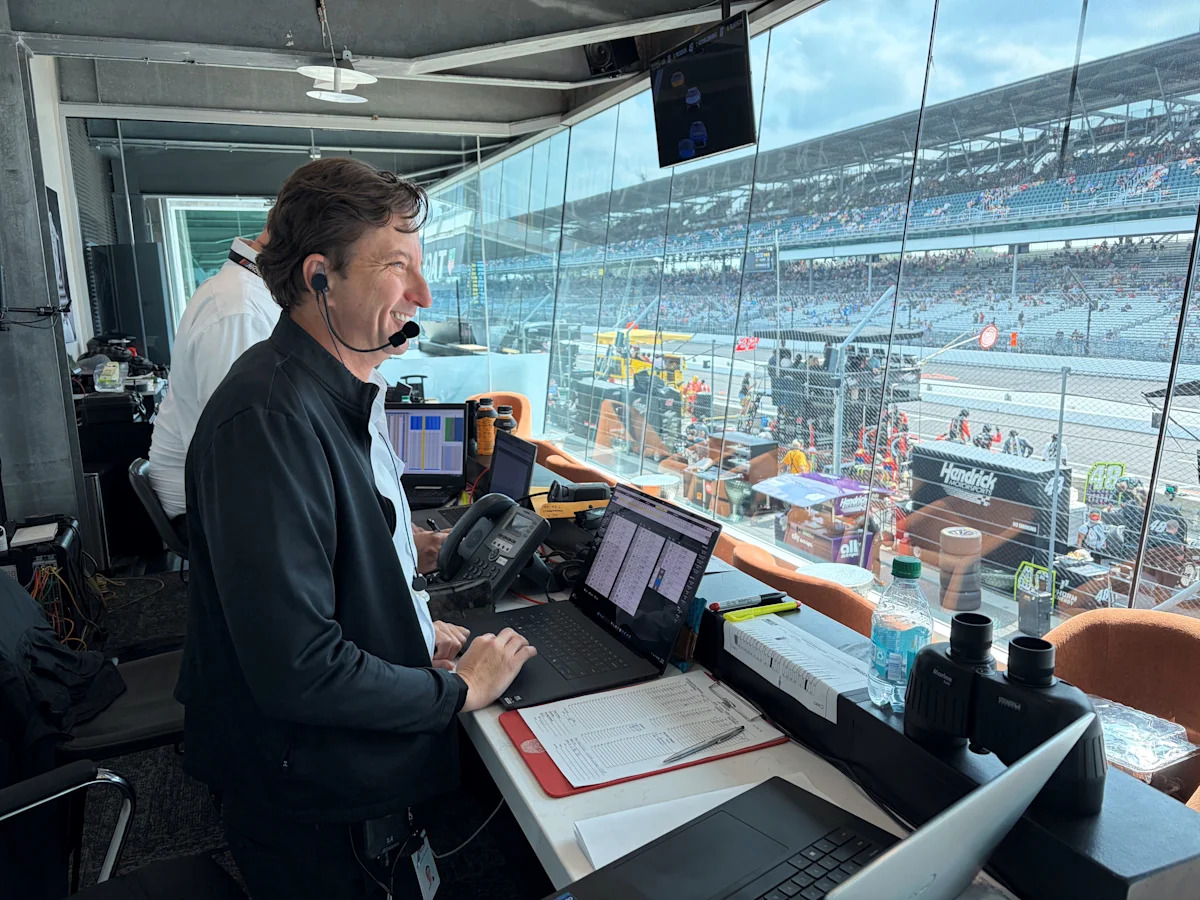
While millions of fans see races unfold from the grandstands or their living rooms, Kyle McKinney watches them with a different purpose.
“I joke that I get paid to watch races,” McKinney said. “But you’re watching with purpose. You’re intently following every lap, every position and everything that’s happening throughout the field.”
Advertisement
As NASCAR’s chief scorer, McKinney leads the department responsible for timing and scoring across the NASCAR Cup Series, NASCAR O’Reilly Auto Parts Series, NASCAR Craftsman Truck Series and ARCA Menards Series. His team tracks every lap, position and finish throughout each race weekend, combining electronic data, camera footage and human review to determine official results.
For McKinney, the path to becoming one of NASCAR’s key behind-the-scenes officials started as a fan.


McKinney’s connection to racing began long before he worked inside NASCAR. Growing up in Rockville, Indiana, he spent weekends at the track with his father and grandfather, developing an appreciation for the sport that would eventually become his career.
When NASCAR brought the inaugural Brickyard 400 to Indianapolis Motor Speedway in 1994, McKinney was there as a teenager. He has attended every Brickyard 400, either as a fan or as part of NASCAR’s competition team.
Advertisement
“I’d be the guy at school watching the race on Sunday in my dorm or apartment,” McKinney said.
After graduating from Purdue University with a communications degree, McKinney moved to North Carolina hoping to build a career in motorsports. He initially thought that would come through marketing or public relations, but his first opportunities came through the operational side of racing.
A friend who helped run Charlotte’s Dirt Track asked McKinney to help with whatever was needed — keeping track of cars, working the scoreboard, painting school buses for novelty races and helping prepare the facility.
“It was a 25 bucks-a-day type thing,” McKinney said. “It was meaningless pay, but it was a lot of good experience too, just learning the business side and the operations side of a racetrack.”
Advertisement
Those early experiences showed McKinney that timing and scoring matched the way he viewed racing. People noticed his ability to follow races and keep track of the field without relying on technology.
That attention to detail eventually opened the door to NASCAR.
“I think it’s the paying attention,” McKinney said. “Really paying attention and having to draw on the rules and procedures of putting on a race that I don’t think the casual fan understands.”
Today, timing and scoring is one of NASCAR’s most important behind-the-scenes operations, but the work begins long before drivers take the green flag.
Advertisement
McKinney and his team spend race week preparing scoring systems, race-control technology and the data needed to track the field. The operation typically includes 14 to 15 people each weekend, with several working behind the scenes to manage the equipment, cameras and systems that support official results.
By the time cars hit the track, much of that preparation is already complete.
“There’s a lot of clerical involvement that I have to do before a race,” McKinney said. “Then you sit down, you actually kind of do the race and it’s kind of the relaxing part to some extent because that’s what you’ve been working five days for.”
Once the race begins, the preparation gives way to complete focus.
Advertisement
“Race-wise, it is three hours of being honed in,” McKinney said. “When I watch a race, I’m following the leader nonstop.”
That concentration is critical because every scoring decision — from lap counts and restarts to close finishes — depends on accurately tracking the leader and the field behind them.
The way NASCAR tracks races has changed significantly since McKinney joined the sport full-time in 2003. What once relied primarily on a single timing loop at the start-finish line has evolved into a much more advanced system involving multiple timing loops around the track, electronic transponders, pit road monitoring and finish-line cameras.
But McKinney said technology has not replaced the human judgment needed to interpret the information.
Advertisement
“It’s a tool, not the end-all, be-all,” he said. “There still has to be the human element verifying it all.”
That balance becomes especially important during close finishes, when NASCAR reviews multiple sources of information before making an official ruling. While technology can provide the data quickly, McKinney and his team are responsible for making sure that information is accurate before the result becomes official.
After more than two decades in NASCAR Competition, McKinney has watched the sport evolve from a small operation with a few computers and equipment cases into a highly technical system built around advanced technology and a dedicated team.
But his connection to racing has never been just professional.
Advertisement
Every time he returns to Indianapolis Motor Speedway, McKinney gets a reminder of why he fell in love with racing in the first place.
“It’s still pretty neat,” McKinney said. “They tease me about it being my Disneyland or whatever else. It’s just pretty cool, the history of the place.”
McKinney’s name will never appear on a leaderboard. But every official result carries the work of the team he leads.
So what does he hope people remember about his time as NASCAR’s chief scorer?
“That I didn’t screw it up,” McKinney said with a laugh.
After more than two decades in the role, that answer captures McKinney’s approach to the job: adapt, prepare and leave NASCAR’s timing and scoring operation in a better place than he found it.
Advertisement
Jessica Garcete is an IndyStar sports reporter. Get IndyStar’s motor sports coverage sent directly to your inbox with our Motor Sports newsletter. Subscribe to theYouTube channel IndyStar TV: IndyCar for a behind-the-scenes look at IndyCar and expert analysis.
This article originally appeared on Indianapolis Star: He never misses a lap: Hoosier native Kyle McKinney’s eye for detail powers NASCAR’s scoring
Read the full article here