




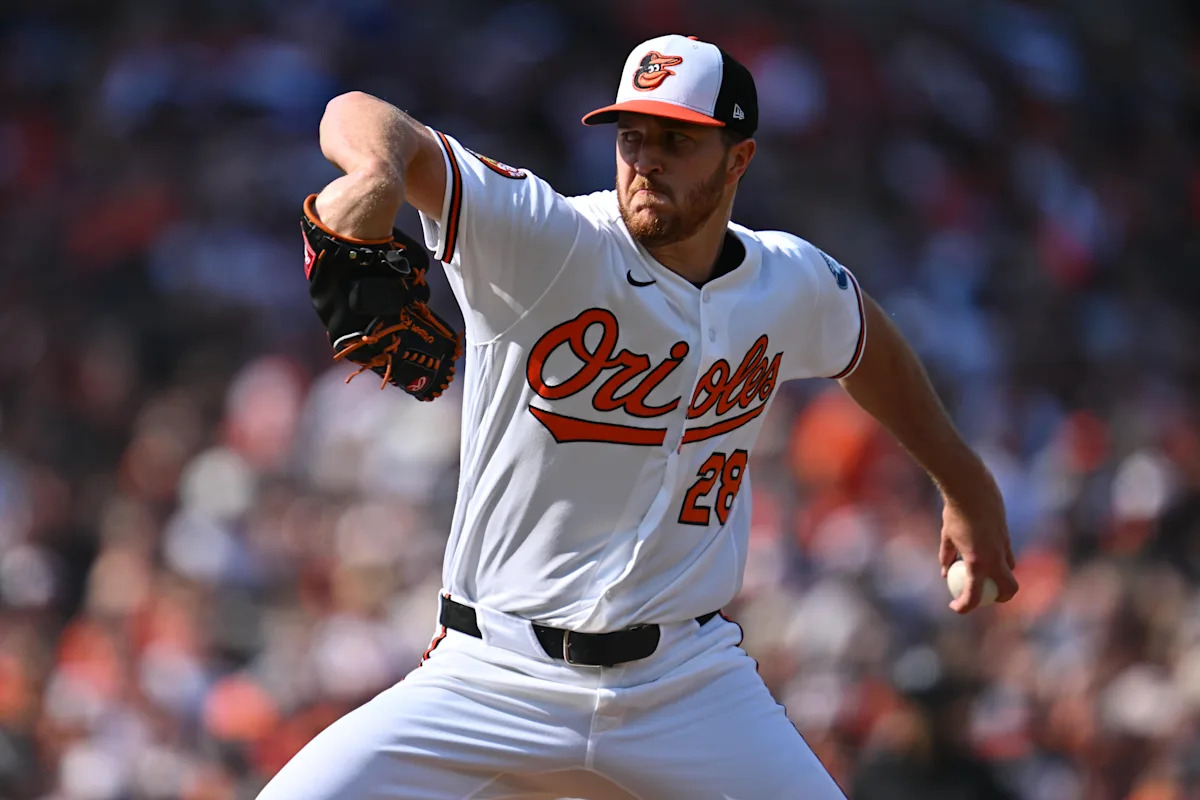
Much of the focus X this past offseason centered (as it always seems to) on the Orioles’ ability to upgrade their pitching rotation. Mike Elias and the front office may not have traded for Tarik Skubal or signed a top free agent (Cease, Valdez, Suarez), but they did show a refreshing aggressiveness in adding starting pitchers. They traded for former Rays top prospect Shane Baz (and subsequently signed him to a five-year extension), while bringing in veteran right-hander Chris Bassitt and re-signing 2025 Opening Day starter Zach Eflin.
The identity of the Orioles’ franchise was largely founded on their great rotations in the 60s and 70s. And because of this identity, Baltimore’s relative starting pitching scarcity over the last two decades has often made for plenty of worry, frustration and pessimism throughout Birdland. The 2026 rotation, as undoubtedly the most talented group of starters assembled by Elias, will look to put some of that pessimism to bed as they play a key role in the Orioles’ quest to return to the playoffs.
Advertisement
After last night’s loss against the Rangers, we’ve now seen four of the five make their first start of the 2026 season. After seeing the top four starters in action for the first time, let’s break down the good and the bad from the Orioles best arms.
Trevor Rogers (7.0 IP, 3 H, 4 BB, 5 K vs. MIN)
Grade: A
According to No.2 starter Kyle Bradish, there was never really any doubt that Rogers would be the Orioles’ Opening Day starter. After watching the reigning Most Valuable Oriole march through the Twins order last Thursday, it only confirmed that manager Craig Albernaz made the right decision.
After a magical run that saw him post a 1.81 ERA across 18 starts, there was the lingering question as to whether Rogers could be as effective in 2026. Instead, he was better. The southpaw’s plan of attack was the same as the one he carefully crafted last season: use his four-seamer to attack righties up and in, while pairing it with a low and away changeup to keep hitters off balance. He even showed off some improved velocity on his fastball, touching 95 and 96 in the early innings.
Advertisement
The Orioles’ lefty never relies heavily on his cutter or curveball. However, each time he went to one of his breaking pitches against Minnesota, it seemed perfectly set up and executed—as evidenced by the 50% whiff rate on the curve and 33.3% whiff rate on the cutter.
Rogers’ knack for navigating traffic also showed up in full force versus the Twins. Rogers tied a season-high from 2025 with four free passes, but also set an Orioles career high by rolling three double play balls. Despite not having the same strikeout stuff as Bradish, Rogers excels in pressure situations, as the Twins consistently mustered only weak contact in going 1-for-10 with RISP against the Orioles’ ace. Rogers’ best start from last year saw him pitch eight shutout innings, so the fact that he “only” threw seven scoreless takes him from an A+ down to an A.
Kyle Bradish (4.2 IP, 2 H, 3 R, 2 ER, 3 BB, 4 K vs. MIN)
Grade: C+
Advertisement
Early on in his outing against the Twins, Bradish looked like the dominant force we saw at the end of the 2025 season. He opened the game with a Bradish classic, firing an elevated two-seamer past Kody Clemens to open his 2026 account with a K. He’d punch out Josh Bell in the 2nd on another two-seamer, before burying a slider to get Clemens swinging and end the 3rd.
After those threw scoreless innings, Bradish ran into a bit of bad luck, followed by the effects of the bad weather. In the 4th, Byron Buxton led off the inning by bouncing a curveball up the middle, reaching after just barely beating the throw from Jeremiah Jackson at 2B. Buxton then benefited from some Baltimore defensive blunders, with a bad throw from Colton Cowser in CF allowing him to tag up from first, while a failed back pick by Adley Rutschman allowed him to go to third. The error by Adley would mean Bradish’s first run of the season was unearned, after a sac fly brought Buxton home to score.
Bradish then seemed to run out of gas early Saturday, as he suffered a noticeable dip in velocity and control in the 5th. After sitting around 95mph with his two-seamer in the early innings, his velocity fell to around 91-92 at the beginning of the 5th. Bradish tried to compensate by leaning on his breaking balls, but ended up walking leadoff batter Trevor Larnach after failing to locate his slider. Three pitches later, Bradish tried to challenge Royce Lewis with a two-seamer up and in, but instead it ended up and in the left field bleachers.
It’s worth mentioning that the game time temperature was in the mid-40s, meaning Bradish’s early exit could be due to the difficulties keeping your arm warm that come in cold temperatures. And yet, it’s hard to give him a higher grade, given the loss and the feeling that his afternoon was incomplete.
Advertisement
Shane Baz (5.1 IP, 7 H, 4 ER, 0 BB, 4 K vs. MIN)
Grade: C-
Fresh off the announcement of his five-year/$68M extension, Baz’s first start as an Oriole got off to a rocky start. After a 1-2-3 inning in the 1st, Baz was shelled in the second inning against the Twinkies. After three singles and a bases-clearing double, the 26-year-old right-hander was staring down the barrel of a 4-0 deficit two innings into his career.
From there, Baz showed grit in putting up 3.1 scoreless innings to close out his start, allowing the Orioles offense the time they needed to stage a comeback. The former Ray also showed plenty of promise in grinding out 16 outs against Minnesota. His knuckle curve was especially sharp, limiting Twins hitters to a .167 average while generating two punchouts and a 40% whiff rate. His cutter was equally effective, holding Minnesota batters to a .143 and picking up two Ks on cutters up and away to Buxton and Lewis.
Advertisement
Baz doesn’t grade out as highly as Bradish because, while he did get two more outs, he also gave up that big inning while pitching in more ideal conditions. And yet, like his fellow hard-throwing right-hander, the newest Orioles starter flashed the kind of stuff that suggests better outings are on the horizon.
Chris Bassitt (4.1 IP, 6 H, 4 ER, 4 BB, 3 K vs. TEX)
Grade: D
Bassitt tried to pull off the same high-wire act we saw from Rogers, only for his soft contact to turn into soft hits and runs on the board for the Rangers. The 37-year-old veteran got unlucky in his first inning as an Oriole. A pair of singles (that could’ve been outs) turned into a run when an awkward comebacker forced Bassitt to rush a throw home, allowing a run to score as the throw skipped past Adley at the plate.
Advertisement
That unfortunate opening frame turned into further frustration as Bassitt struggled to put away hitters in the 2nd. The right-hander commanded his sinker well, but seemed to struggle with putting hitters away. Multiple times during the Rangers’ three-run rally, Bassitt tried to sequence his sinker low and in with a fastball up, only to badly miss on the fastball. Texas hitters had seven swings and misses against Bassitt’s curveball, but he only generated three total outs and one strikeout on the breaking ball.
Bassitt has the veteran savvy and a six-to-seven pitch mix that should allow him to bounce back this weekend against the Pirates. His Orioles debut, however? That certainly fell flat.
Read the full article here


