



Moments after we park on the street, he gets out of the car and checks that it is safe for us to be here. In search of some guidance, or permission, he consults a nearby sign while I just watch from the passenger seat, convinced my presence is of no help.
Until I know it is safe, and he wishes to stay, I keep my seatbelt on and look through the window for signs of my own. I see him standing there, hands on hips, but have a hunch he is struggling to process the relevant information. The constant rubbing of his chin gives him away. So too the anxious glances to his left and right. I also know that he is dyslexic and that he only grasped the value of reading when his brother, Randy, teased him about his illiteracy as a child. “What does this say?” he would often ask his big brother, to which Randy would reply: “Learn to f***ing read.”
Advertisement
As it happens, it wasn’t until he had time to kill in prison that he actually did. I remember him once saying to me, “That’s my biggest accomplishment, learning how to read,” before telling me how proud he was to have read The Autobiography of Malcolm X. “I called my mother when I finished it.”
Chances are, even if he could read the sign, he would lack the capacity to decipher it, I fear. He has too many distractions, you see. Too many memories, too many worries, too much on his mind. It is, for a reader, a bit like continuing with your book having just received bad news. The eyes and brain no longer connect and do the job you require them to do. Your narration is interrupted. Intrusive thoughts prevail.
“I’m almost sure it’s legal parking because I’m not in the bus lane,” he says to me, his voice loud enough to alert a few people on the street. He then turns to these passersby and confers with them instead. Guiding two of them to the sign, he asks if it is safe to park in this area and receives a positive response, something like, “Yes, you belong here. Don’t worry.”
Even so, the approval of strangers does nothing to remove the tension both in his shoulders and on his face. He still isn’t sure we should be here, I now start to think. Or rather, he isn’t sure we should stay.
Advertisement
Back at the car he offers me his best impression of someone confident, comfortable. He was once a fighter, after all. A tough one at that. “Believe it or not, I do a lot of business down here,” he says, referring now to his trucking business. “I do a lot of deliveries here. I’m always up and down this highway. I think about it whenever I go past. All the time … all the time.”
Service men and women look out from the the USS Intrepid.
(Spencer Platt via Getty Images)
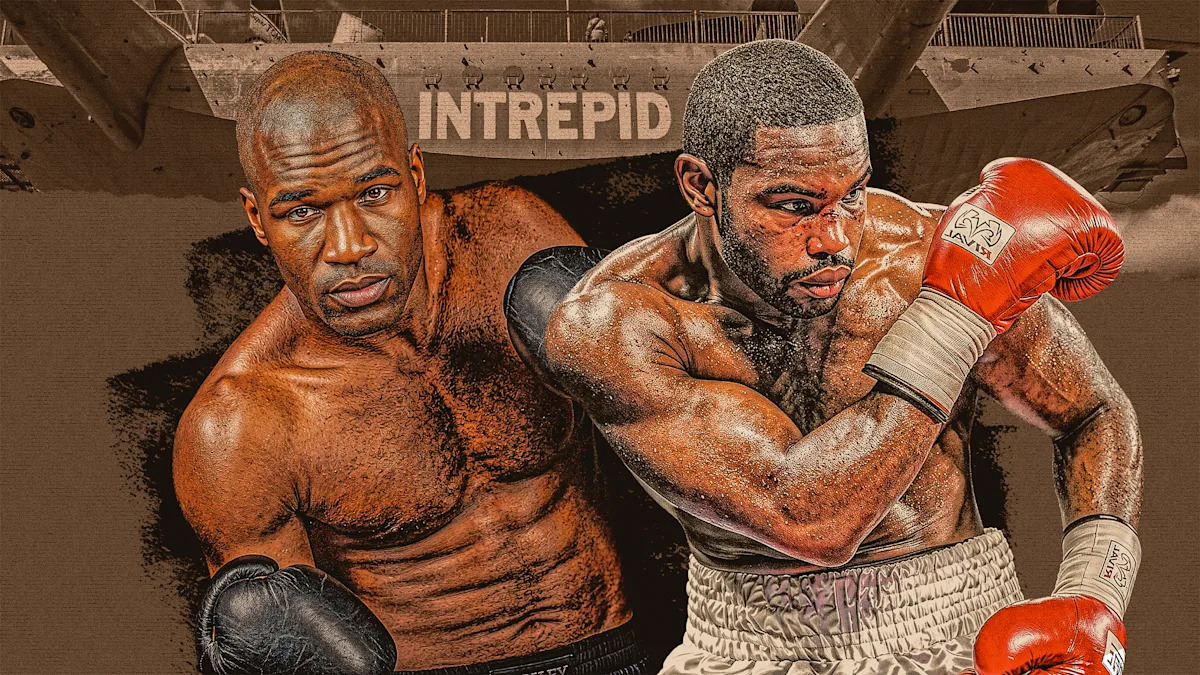
The “it” to which he refers is not the Hudson River, nor even the USS Intrepid, our next port of call. It is instead what happened aboard the USS Intrepid on June 26, 2001. That was the night they allowed, for the first and last time, a boxing ring onto the iconic World War II aircraft carrier; a ring in which Beethaeven “Bee” Scottland, a southpaw from Maryland, was knocked out in the 10th round of a light heavyweight fight, televised live on ESPN. It was also the night George Khalid Jones, a southpaw from New Jersey, celebrated his knockout win, then prayed for his opponent upon understanding what winning in boxing can sometimes mean.
Five days later, alas, Scottland had tragically passed away from injuries sustained in the bout and Jones, whose hands were responsible for the damage, didn’t know what to say or do. Since then, he has never been able to look at the USS Intrepid the same way. He too has never been quite the same.
Advertisement
“I’d never even heard of the Intrepid,” he says as we now tiptoe toward it, careful not to unsettle anyone. “It was exciting because I’d never been involved with the military and this was my chance to be involved with something in the military. It was a big thing, too, being on ESPN and all. A bunch of people came out.” His voice begins to fade as we watch men, women and children queue to gain entry to what is today the Sea, Air and Space Museum. “People still talk about the fight,” he whispers to me. “It’s sad how you’re remembered for something like that.”
Suddenly, while in the queue for tickets, a foghorn emits a loud blast, the effect of which is not dissimilar to that of a horror-film jump scare. It is a jolt Khalid neither expects nor needs, though the sound is more apropos to our surroundings than a prizefight, it must be said. In any case, we react to the shock and discomfort by laughing. We then watch as weak parents fail to tame unruly kids or do all they can to silence them with screens or sweets. One child, a small boy, screams at his mother: “I don’t want to! I want to go home!”
I now check on Khalid, who, unlike the child, keeps his thoughts to himself. At least on that subject. “You ever been on a ship like that?” he asks as we pass through a turnstile. “I don’t think I’m excited about cruises. My wife wanted to do one and I was like, ‘You never seen Titanic?’ That was the first thing on my mind.”
Another foghorn blares out, no less jarring than the first. “We might need to get used to that,” says Khalid.

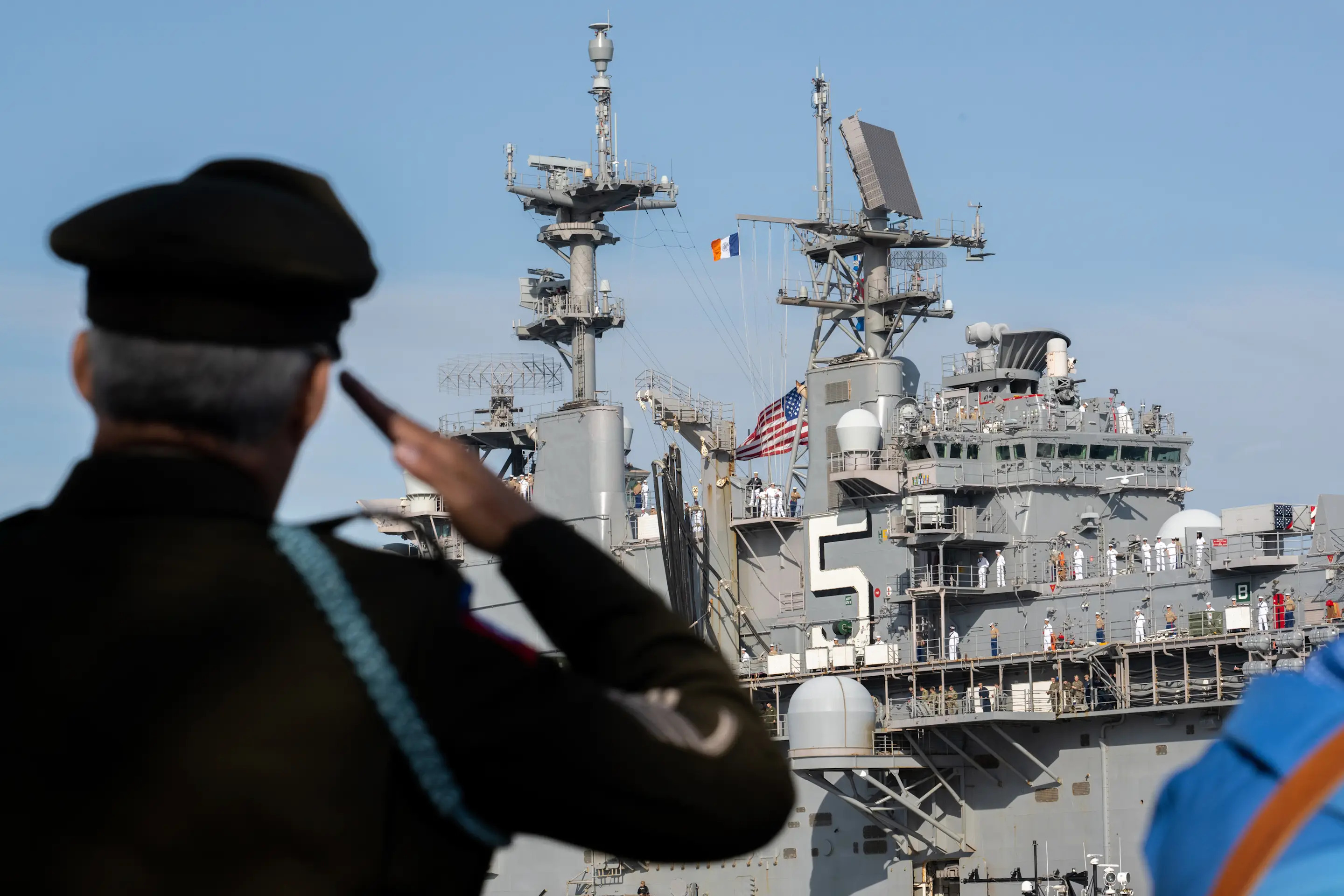
U.S. Army Staff Sgt. Banjamin Marrero salutes from the USS Intrepid.
(Alexi J. Rosenfeld via Getty Images)
Had David Telesco, the original opponent, not injured his hand in training, Beethaeven Scottland would have been nowhere near the USS Intrepid on the night of June 26, 2001. He would have instead been at home with his wife, Denise, and their three children. He would have remained at middleweight, his natural fighting weight. He would have never shared a ring with George Khalid Jones.
Advertisement
“I didn’t want him to fight Khalid,” says Derek Matthews, the coach who trained Scottland to box from the age of 12 and then watched him die in New York at 26. “I pleaded with him not to take that fight. Khalid was a monster. He was too big and too strong and left-handed — and owned by [promoter] Lou Duva. ‘How can we win this? It’s not possible, Bee.’ I told him that.
“Bee shouldn’t have been in there with those kinds of guys. He was a middleweight. If he would have stayed at 160 [pounds] and listened to me about his diet and all that, he could have been a champion. But Bee was pretty stubborn on some stuff and he was so good that he could sometimes beat bigger guys.”
The hope, for both Scottland and Jones, was that a statement win on ESPN would land one of them a shot at Roy Jones Jr,, the then-light heavyweight champion of the world. Of all the reasons to accept the fight, that was the primary one, Matthews says, with the prospect of a world-title payday — “big enough to support his family” — every bit as alluring as the chance to win a world title.
According to Jones, for agreeing to fight Scottland on ESPN, he was paid “something like $12,500 or $13,000,” while Scottland “probably got $7,500.” It was no wonder then that both men were looking ahead, dreaming of brighter days, content to risk it all.
Advertisement
In fact, the dream, such as it was, was enough to have Scottland risk taking fights out of his preferred weight class against opponents possibly out of his league. It was also enough to have Jones treat every fight as if it was his last and every opponent like a thief out to rob him and his family.
“We were at the Mickey Mantle restaurant doing an interview,” Jones recalls, “and I said, ‘I’ve trained so hard I think I’m going to kill somebody.’ We do that interview on the Friday and the fight is on the Tuesday. On the night of the fight ESPN then showed a tape recording of that interview. Then it happened.
Advertisement
“I believed it,” he stresses. “I was dropping guys with body shots. I was hitting people and could feel it all the way up my arm. You try to do damage. You try to punch through your opponent.
“I once saw the eyes of one of my sparring partners roll back in his head. This was a guy I used to have good sparring sessions with, but it got to the point where it was just one-sided. I was thinking, ‘Man, I’ve got to feed my family, so I need to hurt this guy.’ It was kill-or-be-killed and I really believed it. If you believe that, you go places. I said to myself, ‘I don’t mind dying because this is what I believe in. I’d rather die here than anywhere else.'”
It wasn’t just the words of Jones that had folk feeling uneasy on the Intrepid that night. It was also his form — ending 11 of his previous 12 wins by stoppage — as well as both his demeanor and reputation on the streets of Paterson, New Jersey. Whether in the ring or elsewhere, most who knew George Khalid Jones knew he was not a man to be tested. Best to avoid him, in fact. Head down, keep walking.
“Our camps got heated at one point,” remembers Matthews. “They brought us up on deck, but because the fight was being televised, it wasn’t quite time for us to make the walk. So they made us stand on the ship for about 15 minutes and our camps were now face to face. We wind up talking trash, as you would expect, but all it was really doing was pissing Khalid off. When I looked over at him, I got a good look in his eyes and I was like, ‘Man, I’m scared for Bee.’ I had to pretend to be confident but I was afraid for Bee because of how monstrous Khalid looked that night. The fight was televised and this guy had been training to knock a wall down. He then winds up fighting a smaller guy who can’t hurt him. It was like Bee had no chance. It was like it was set up for him to fail.”
Advertisement
Matthews now pauses. He then sighs the sigh of someone about to reluctantly break down what he felt was obvious. “Khalid was once in the heroin business,” he continues, aware, as many were, that Jones had from the age of 13 been forced to buy and sell drugs at the behest of his father. “He’s seen things in his life. A fight, a boxing match, was no big thing for him. Why we trying to rile him up? He was a street kid from New Jersey.
“It was the worst fight for Bee. He knew that going in. But they said stuff to him like, ‘Khalid had no amateur fights.’ What the f*** does that mean? He’s still a monster. The guy is not to be played with. Even if Bee was his size I would have avoided him. He was so heavy-handed.
“That night he had this guy with him who played basketball. They called him Tricks. He was a wizard with the ball. He did a Nike commercial on TV. I guess he’s from New Jersey and friends with Khalid. Anyway, he was there doing all these dumb basketball tricks and we had a big dude with us and I said: ‘Hey, Big Boy, grab that dude’s ball and kick it out into the water.’ We all start laughing, trying to make the best of the situation. It’s just small talk while we’re waiting; I’m really not trying to get nobody. But then I saw Khalid just mean-mugging. He was thinking, ‘You just wait for this bell. I’ll show you what it is.’ That’s when I got afraid for Bee, seeing Khalid up close like that. He was towering over Bee.”
I didn’t want him to fight Khalid. I pleaded with him not to take that fight. Khalid was a monster. He was too big and too strong and left-handed. ‘How can we win this? It’s not possible, Bee.’ I told him that.
For Matthews and anyone connected with Scottland, those pre-fight premonitions — negative thoughts bottled up and stowed in the name of preservation — now refuse to go away. Rather than leave, or just fade, they knock at doors, tap shoulders, beg to be invited in. Perhaps, 25 years on, the only memories crueler are the ones that started off small, almost inconsequential, only to take on a different meaning once a fight became a tragedy and every insignificant detail became significant.
Advertisement
“I think about it all the time, man,” says Matthews. “Usually after we got wrapped up [in the changing room], I’d go around the venue and start making some chatter about Bee. I’d say to people, ‘Watch this kid, Bee Scottland, he’s going to be somebody.’ I’d just be talking to people around the ring and stuff. That’s what I did: try to promote him.
“This particular time, though, it was weird, man. It was like he knew something was going to happen. This time he said, ‘Where are you going?’ I said, ‘I’m going out to do my thing — walk around and talk some trash about you.’ He said, ‘Yeah, man, I know. But why don’t you stay this time?’ I said, ‘For real?’ He said, ‘Yeah. Stay here with me.’ I said, ‘Alright.'”
Matthews sighs once more. Deeper on this occasion.
“First and last time they ever had a boxing match on that ship, and that ship was rocking a little bit that night, I’m telling you,” he says. “It was so eerie, man. There was just this weird-ass silence in the room. He actually called Denise at one point and asked her to recite the Lord’s Prayer. It was just a weird, weird night, man.”
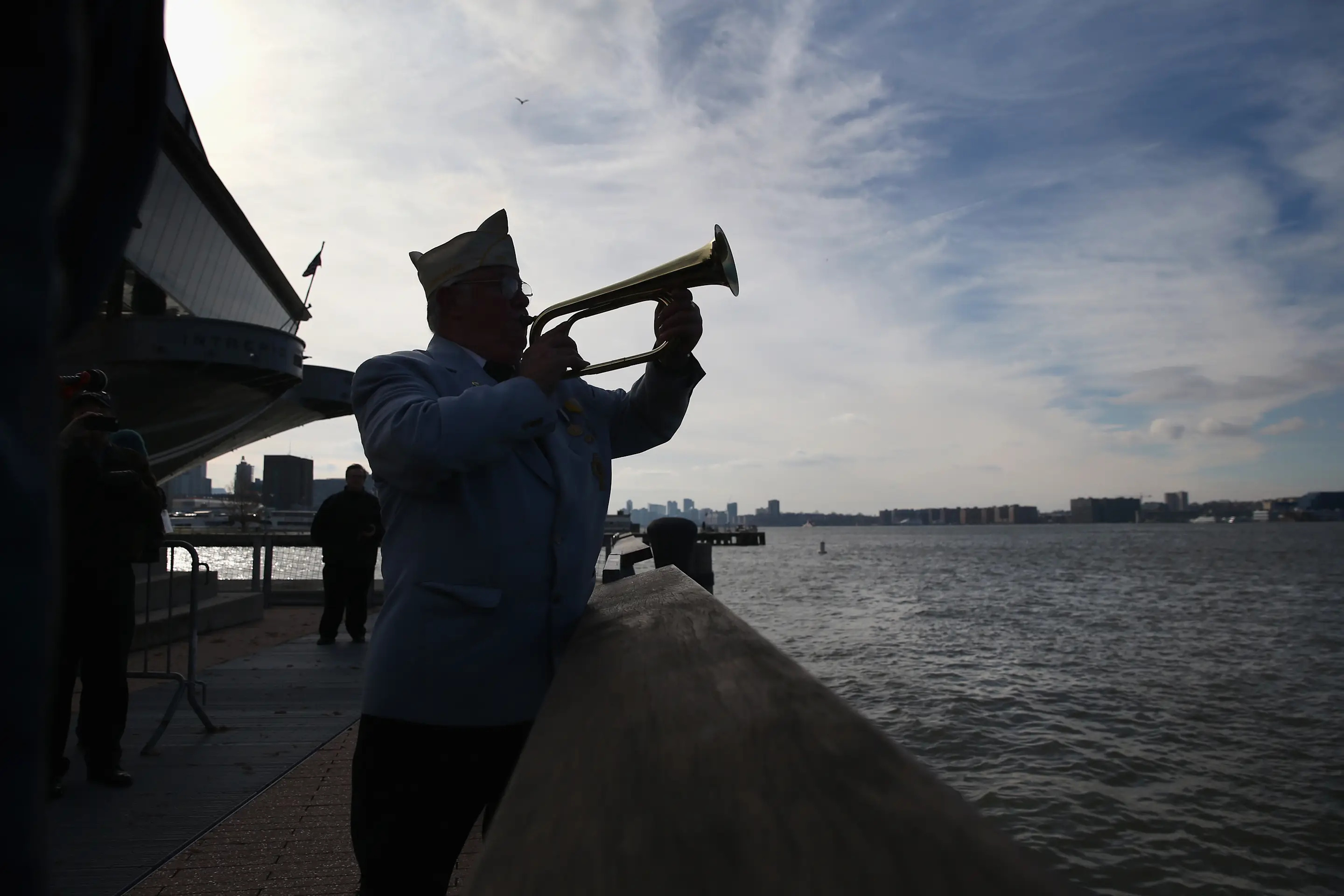
A bugler plays outside the USS Intrepid.
(John Moore via Getty Images)
In the opposite corner to Derek Matthews that night on the Intrepid was Naharo “Nettles” Nasser, a 28-year-old Palestinian tasked with ensuring George Khalid Jones, his fighter, did what most observers expected him to do: win, look good, pass go.
Advertisement
For seven of the 10 scheduled rounds, he had every reason to be pleased with his man, too, with Jones’ handiwork having sufficiently damaged the face and body of Scottland to produce a lead on the scorecards. But then, in Round 8, Nasser suddenly noticed that Jones had been hurt by Scottland, and that, despite his lead, he was showing signs of fatigue heading into the ninth.
“The round he got tired, I told him to box and use the jab smartly or stay away,” says Nasser. “I told him to box cleverly and take a rest. Then in the next round he stopped him.
“In a way it felt like it was all my fault. By telling Khalid to take the round off, it gave Bee that confidence to think he could win the fight. He stuck in there. It was the worst thing for him really.”
“In the eighth round, I was in trouble,” Jones agrees. “When I went back to the corner I was like, ‘Man, I don’t know if I’ve got it.’ He hit me hard. I’ll never forget that round. I was caught off guard: Boom! In the ninth round I played it slick and smart. Then, in the 10th round, Arthur Mercante [the referee] came over to us both and said, ‘Alright, guys, it’s a close fight. Let me see who wants it the most.'”
Advertisement
Yet, of course, desire would have no bearing on what happened next. Nor, to be clear, has a ring tragedy ever been the result of a boxer not wanting it enough. If anything, tragedy is often the result of a boxer wanting it too much.
Usually after we got wrapped up [in the changing room], I’d go around the venue and start making some chatter about Bee. I’d say to people, ‘Watch this kid, Bee Scottland, he’s going to be somebody.’ This particular time, though, it was weird, man. It was like he knew something was going to happen.
“It was painful to see him get hit so often but it didn’t look like he was going to get hurt,” says Matthews, who watched the tragedy unfold from Scottland’s corner. “I thought he would lose but didn’t think he would get knocked out or hurt. He was basically getting ready to pull it off right until the last minute of the fight. He threw a punch at Khalid and he got hit with a hard shot and it looked like he was going to go down anyway, like he was getting ready to faint. Khalid then hit him like two times on the way down.
“When he crashed to the ground, his brain probably rattled around his skull some more. I remember the guy [referee] was asking him, ‘Where are you?’ He said, ‘I’m in D.C. No, no, I’m from Maryland.’ Then he looked me right in the eye and one of his eyes just started floating over to the right. It was uncontrollable. It just floated over to the right. Then he just started snoring. He just laid there and started sleeping, snoring. That’s when I knew he was hurt pretty bad and not just knocked out.”
Such was the nature of their relationship, Matthews was always going to be the first to know, whereas the rest, particularly Jones, were initially in the dark. They saw Scottland at that stage as just another opponent on the canvas.
Advertisement
“I celebrated when he went down,” Jones says with regret. “I said, ‘Yeah, I told you what I was going to do!’ Then someone told me to stop. They said he ain’t getting up. I never celebrated like that again.”
Like Scottland, Jones had been conditioned to fight and celebrate winning a fight a certain way. He had also been conditioned to react to adversity a certain way; a way most mortals will never be able to fully comprehend. Until he knew better, Jones was firmly of the belief that a fighter should fight and that a trainer should provide only a stool, water, advice and a bucket. Never should a trainer stop a fighter from fighting, he believed, regardless of how the fighter appears to be faring in the fight.
“I wouldn’t have wanted the fight stopped if I’d been in Bee’s shoes that night,” Jones admits. “Also, if he had stopped the fight with Bee, I would have been mad. I would have been cursing him out.
“After that, though, I knew it was better to live to fight another day. I’d rather see someone take a loss than go down never to get back up.
Advertisement
“If I’m a trainer today I’m stopping fights too early rather than too late. I don’t care if the guy gets mad at me. I’ll tell him to keep the money and I’ll say, ‘One day I guarantee you’ll come back and thank me.'”
“After that, though, I knew it was better to live to fight another day.” – George Khalid Jones
(Westend61 via Getty Images)
En route to Bellevue Hospital, Derek Matthews repeatedly listened to one specific song in the car in an effort to figure out whether it was reflecting his state of mind or instead trying to send him a message. It wasn’t his kind of music necessarily, but the song “Crawling” by Linkin Park soon became the soundtrack to Matthews’ trips to and from hospital and had managed to insidiously crawl its way into his brain. Before long, his relationship with the song was no less complicated than his relationship with boxing.
“It would constantly be coming on [the radio],” he says. “If you hear the words to this song, man, it’s so eerie. ‘Crawling in my skin.’ He’s talking about a person in a coma. He’s talking about Bee that night.
Advertisement
“I bought the CD and guess what was on the cover? A picture of a soldier with wings on. Bee’s nicknames were ‘Bumblebee’ and ‘Killer Bee’ — things with wings.
“It was horrible, but I listened to that song all the way. Me and another fighter of mine, we drove up there together. On the ride back we were just silent. For the whole five-hour drive back from New York, no words were spoken. We just listened to music.
“I still have it on my playlist, but I turn it off when it comes on because it brings me down. I kept it on there out of respect, but now I turn it off. It just brings me sadness.”
I celebrated when he went down. I said, ‘Yeah, I told you what I was going to do!’ Then someone told me to stop. They said he ain’t getting up. I never celebrated like that again.
Between June 26 and July 1, the date of Beethaeven Scottland’s death, sadness was the thing uniting them all. Even for those who held grudges or hate in their heart, sadness became the common denominator. It was something they all shared, irrespective of their grievances or their perspective on the situation.
Advertisement
“I was getting updates all through the night, the next morning, and all the next week,” says Jones. “The more updates I got, the more I prayed this guy made it. The longer it went on, the more emotional I got. I was getting down, down, down. I was rooting for him so bad. I swear to you, I thought after a couple of days: ‘I wish it was me.’ Especially after I heard he was a good family man.
“Before that fight I knew nothing about him. All I knew was that he had a famous name [named after Ludwig van Beethoven, the German composer]. But then I looked at myself and was like, ‘Man, I was a corrupt guy. I did drugs. I sold drugs to pregnant women and little kids. I robbed people.’ But this guy you didn’t hear one bad thing about. So, now you start to question your faith. They say good people die first, but why?
“All I could do was think that maybe I’m here for a purpose. I started believing that. I started saying, ‘I’ve got to live now not as that criminal guy, but as a better person.’ I didn’t want to be the bad guy who ‘killed’ the good guy. I had to live this person’s life now.
“When I was a corrupt guy, they would have said it would be better if I had died. Now I’m a good person they shrug and say, ‘Well, it could have been anybody that night.'”
Advertisement
Unbeknown to Jones, there was a modicum of hope at first. Scottland was a fighter, after all, and this was now a fight. The hope was that if anybody could win it, he could.
“I was still kind of hopeful because I’d never been through nothing like this,” says Matthews. “The next day we were all in the hospital waiting room and the doctor came in to see us. He said, ‘The surgery was a success,’ and then tried to explain the details to us, but Bee’s family got all excited. They all started rejoicing like the doctor said he was going to be OK. But that’s not what he was saying. He was trying to explain something to us, so then he got mad. He slammed his pen on the clipboard and walked out. I noticed it. I knew there was something else he wanted to say. He kept saying, ‘He’s still in grave condition. He’s still in grave condition.’ But I’m not sure Bee’s family knew what ‘grave’ meant. They were just rejoicing.
“I followed the doctor out into the hallway and said, ‘Hey, Doc, can I talk to you for a minute?’ He said, ‘Yeah. You came in with the fighter, right?’ I said, ‘Yeah.’ He was then shaking his head at me and was looking at me like, ‘You’re a part of this. This is what y’all do.’ It was like he was disgusted with it – with boxing.
“I said, ‘Doc, have you ever seen this injury before?’ He said, ‘You know what’s strange? I was an intern at this hospital when Benny ‘Kid’ Paret was brought here [following his fight against Emile Griffith in 1962]. It was the exact same injury.’ I said, ‘Has anyone ever come back from this?’ He then just looked me right in the eye and said, ‘No.’
Advertisement
“I had hope until he said that.”

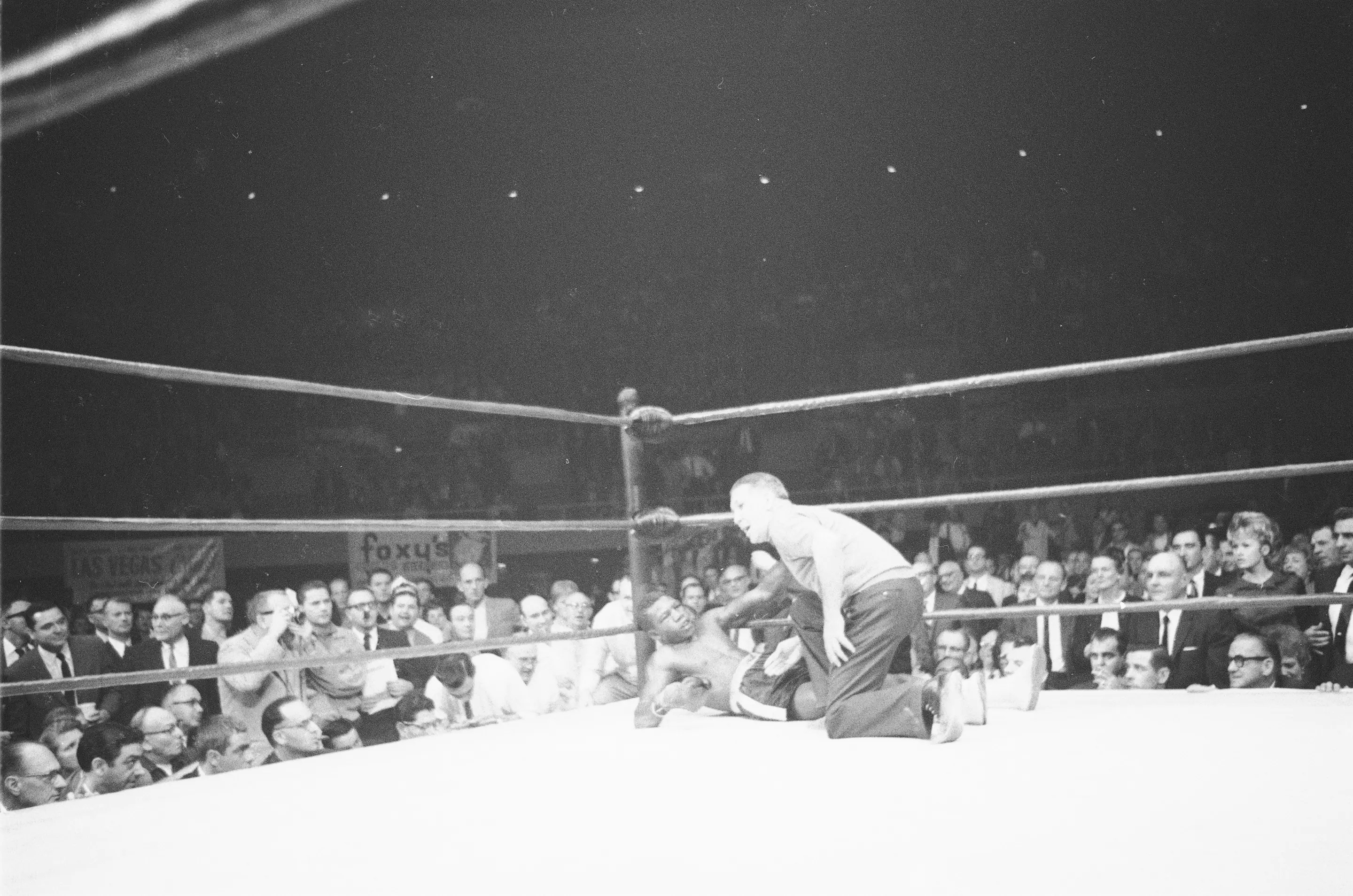
1962: Benny “Kid” Paret tragically died following a boxing loss to Emile Griffith.
(Marvin E. Newman via Getty Images)
In spite of the pre-fight planning, there was to be no world title fight against Roy Jones Jr. for George Khalid Jones. In fact, as he proceeded to stutter through his next 12 bouts, some found it hard to even recognize the southpaw as the same fearsome fighter who had once been in contention to challenge Jones Jr. Now, for reasons quite obvious, he was a lot more passive and circumspect in the ring. He had, having touched death, become the one thing no professional boxer can afford to become: human.
“I remember so vividly when he broke down,” says “Nettles” Nasser, Jones’ coach. “He was driving to the gym and running late. Now this guy was never late. He’s either five minutes early or right on time. He’s never late. But that day he called me because he was running late. I was like, ‘What’s up, man? Where you at?’ I then heard him crying on the phone, so I asked him what had happened. He said, ‘Man, my son called me,’ and yeah, that’s all it took. His son calling him had made him think about Bee Scottland’s kids.
Advertisement
“It’s a tragedy not just for the [Scottland] family but also for the fighter who was fighting the guy. It changes them all. They’re never really the same after something like that. In sparring Khalid was now more of a boxer than that seek-and-destroy guy he used to be. He wasn’t punching with bad intentions anymore.
“Two weeks after the fight I was alright. But he wasn’t. I think he just broke down. One phone call f***ed him. His son called him and said, ‘Daddy, when are you going to be home?’ He pulled over on the highway and just started to cry. That phone call really did something to him. It messed him up, unfortunately.”
For as long as he was still active in the ring, Jones was unable to confront what he and those closest to him deep down knew to be true. In the end, only defeats, three of them, set off the distress flares and led to his eventual rescue. Now it could not be denied. Whatever he once had, in terms of a threat to the world’s best light heavyweights, was no longer inside him. It was instead where Jones had left it, on the deck of the USS Intrepid.
It changes them all. They’re never really the same after something like that. In sparring Khalid was now more of a boxer than that seek-and-destroy guy he used to be. He wasn’t punching with bad intentions anymore.
“Sometimes I wished that fight had never happened because I then still would have had that killer instinct,” he says. “But then who’s to say I would have been the person I am today? I think I would have been more corrupt if that fight didn’t happen. I wouldn’t have been married or a good father. I would have been that same arrogant person. When that fight happened, it was God’s way of telling me to wake up and change my path.”
Advertisement
Matthews, meanwhile, didn’t go to work for four months, nor speak to anyone outside his tight-knit circle of family and friends. “A hole,” he calls it, and the only way out, he believed, was to make peace with the very thing that had led him down there in the first place.
“I tried a little,” he says. “A kid that I used to train pleaded with me to work his corner in the Golden Gloves and by then I had been away from the sport for a couple of years. I said, ‘OK, fine,’ and it became a kind of reunion for me. When people saw me there, they wanted to speak to me and we were all hugging and everything.
“Then the kid fought. He lacked experience but they put his name down and he happened to get the strongest kid in the bracket. His mom, his aunt and his grandmother were there and they’d never been to a boxing match before. The kid did good in the beginning but then he started getting caught with some hard shots and was knocked down. Then the mom, the aunt and the grandmother started screaming: ‘Stop it! Stop it! Don’t let him get hurt!’
“It was like a nightmare for me, man. The referee looked over at me. He knew what I was going through — he knew about Bee — and just shook his head. He let me know he was about to stop it and I nodded back. He then went and stopped the fight.
Advertisement
“That was the last time I was ever involved in a boxing match. The kid later got murdered in the streets over some robbery.”
Before we get off deck and return to the car, Khalid hands me his phone and asks me to take a photo of him on the USS Intrepid. He wants to send it to his wife, Naomi; show her where he spent the afternoon, perhaps make her proud.
In the picture I take he wears a plain gray T-shirt, black trousers, and raises the index finger on his right hand. It is, for whatever reason, a pose many boxers who stand before a camera choose to strike. It is not an allusion to any perceived superiority, nor does it suggest in this instance that a man now in his fifties still believes that he is number one. Instead, based purely on the expression on his face and the angle of his finger, the gesture seems to me more like an attempt to make a connection; a signaling to someone higher than him who may or may not be looking down on him at this very moment.
It is, more than anything, a reminder.
Advertisement
It is a reminder of a time and place and a reminder of how time has passed. It is a reminder to anyone who knows him that the man in the picture is not the man who was in the fight.

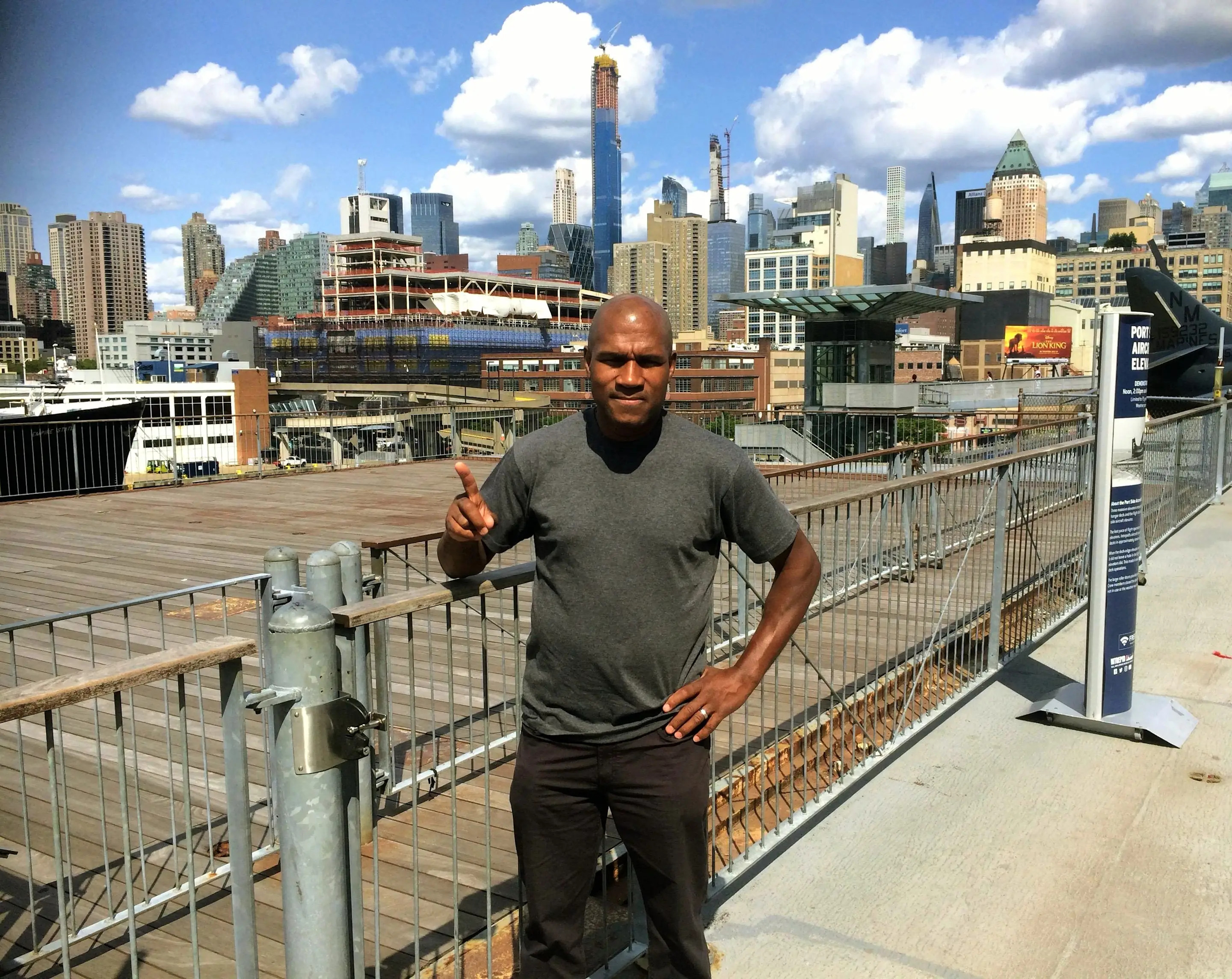
George Khalid Jones, 25 years later. (Elliot Worsell, Yahoo Sports)
Read the full article here