
ST. LOUIS — There might not have been a NASCAR stock car sitting inside, but it was hard for me not to think about racing while walking through the home of Anheuser-Busch.
During my brief stay in St. Louis, I had the opportunity to tour the Anheuser-Busch brewery and get an up-close look at one of the city’s most recognizable institutions.
Roundtable’s Tyler Jones and Nick Couzin at the Anheuser-Busch brewery.
The tour took us past the area where the famous Budweiser Clydesdales are housed and inside the operation where the beer is actually made. At the end, there was even an opportunity to taste beer that had been brewed only hours earlier.
Advertisement
There wasn’t anything specifically NASCAR-related that caught my eye along the way. But there didn’t need to be.
Few companies have been connected to NASCAR for as long — or left as recognizable a mark on the sport — as Anheuser-Busch.
That relationship dates back nearly half a century. Anheuser-Busch entered NASCAR sponsorship in 1978 with the Busch Pole Award before expanding its presence around the sport. In 1982, Budweiser became the title sponsor of NASCAR’s newly formalized second-tier national touring series.
Two years later, Busch took over the naming rights. For the next 24 seasons, the series became known to generations of race fans simply as the Busch Series, with the Busch Grand National name preceding it for much of that run.
Advertisement
The title sponsorship ended after the 2007 season, but Anheuser-Busch’s impact on NASCAR extended far beyond the name of a series.
Its brands have appeared on cars driven by a who’s who of NASCAR history. Cale Yarborough. Terry Labonte. Darrell Waltrip. Bill Elliott. Ken Schrader.
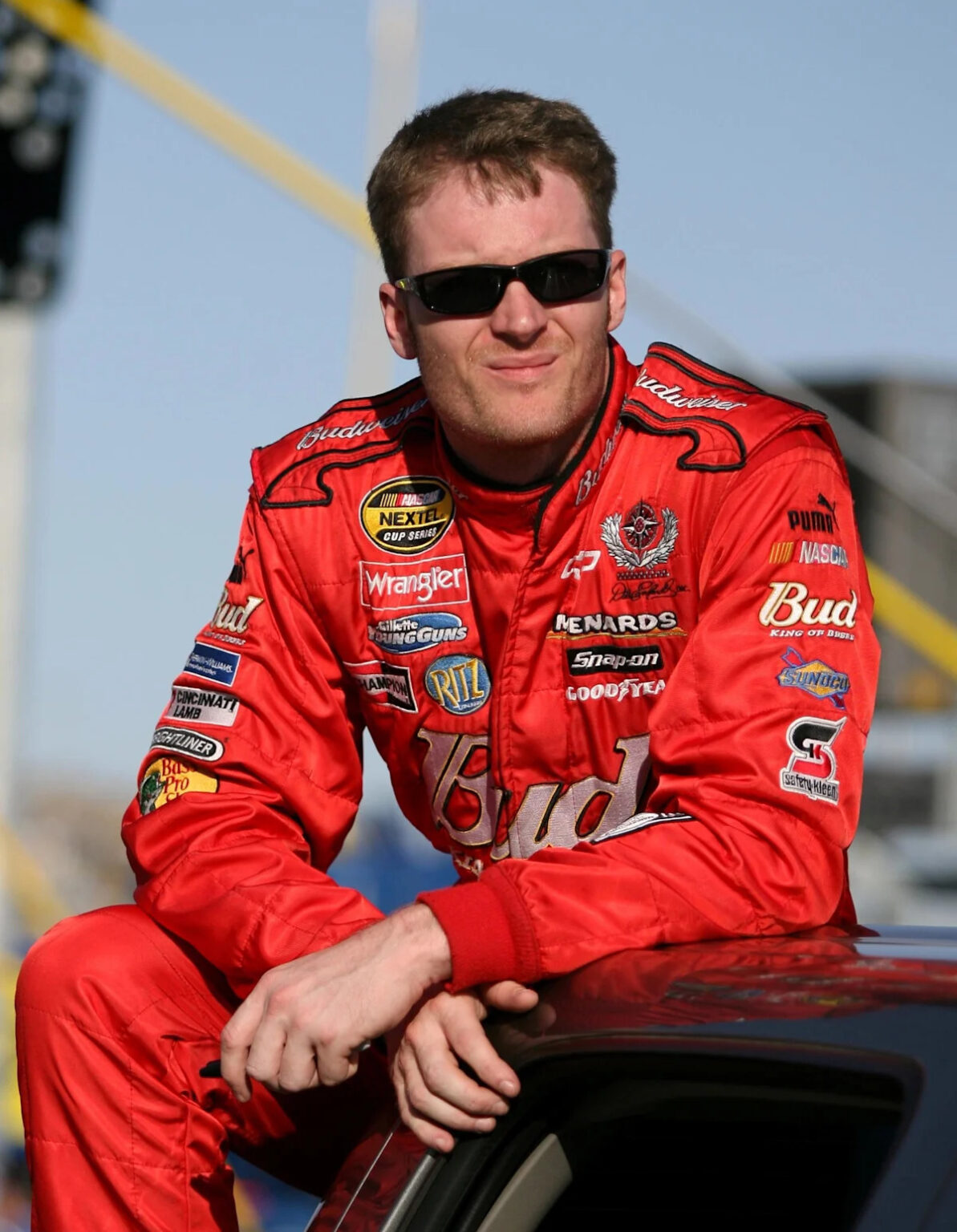
Then came perhaps the most recognizable pairing of them all. Dale Earnhardt Jr. and the red No. 8 Budweiser car.

More than two decades after Earnhardt first climbed behind the wheel, that red car remains instantly recognizable to NASCAR fans. It turns out that was exactly the point.
Earnhardt recently reflected on his relationship with Anheuser-Busch during an appearance on Bussin’ With The Boys, explaining that he was still so young when the deal came together that his father handled much of the business behind the scenes.
Advertisement
“At that time, the contract was $10 million a year,” Earnhardt said. “It was the biggest any driver had.”
Budweiser had previously been associated with Hendrick Motorsports, making the company’s decision to place such a significant investment behind an unproven Earnhardt even more meaningful to him.
“Bud was taking a chance on me to be good,” Earnhardt said. “It was really cool.”

Then he shared a memory that stood out a little more after spending time in St. Louis myself.
Earnhardt remembered August Busch arriving at the team’s offices with the Budweiser Clydesdales and their famous wagon. He also remembered making his own trip to St. Louis and walking through Anheuser-Busch.
Advertisement
“Just remembering being connected to an iconic brand,” Earnhardt said.
The same Clydesdales I had walked past during my tour were part of Earnhardt’s introduction to a partnership that would eventually become one of the defining images of his career.
But another story from Earnhardt helps explain why that image became so powerful. Budweiser and Bud Light might belong to the same company, but Earnhardt said there was some healthy internal competition between the brands. So he once floated an idea.
“You know what would be cool? If I drove a Bud Light car one race,” Earnhardt recalled telling them.
Advertisement
The response? “Hell no. You’re never driving a Bud Light car.”
It’s a funny story, but it also reveals something about the way Anheuser-Busch approached NASCAR. The company understood the value of identity.
Earnhardt said Budweiser rarely wanted to dramatically change the appearance of his car. From the grandstands, fans were supposed to immediately recognize the red No. 8 as the Budweiser car.

“They loved that you could look from the grandstand and immediately know it’s their car,” Earnhardt said.
Compare that to today’s NASCAR sponsorship model. Multiple companies can appear as the primary sponsor of the same car throughout a season, with paint schemes sometimes changing from one week to the next.
Advertisement
As Earnhardt pointed out, that makes it much more difficult to build the visual equity that once connected a driver, number, sponsor and paint scheme into a single identity.
Show a longtime NASCAR fan Dale Earnhardt’s black No. 3 and they know exactly what they’re looking at.
The same is true of Jeff Gordon’s rainbow No. 24. And Dale Jr.’s red No. 8 Budweiser car.
“Right away when you show fans this car, it triggers their nostalgia,” Earnhardt said. “I ran that same car for five, six, seven years.”
That continuity helped make Budweiser part of Earnhardt’s identity during his rise into one of NASCAR’s biggest stars.
Advertisement
When Earnhardt left Dale Earnhardt Inc. for Hendrick Motorsports after the 2007 season, Anheuser-Busch’s NASCAR story continued.
Budweiser eventually partnered with Kasey Kahne before moving to Kevin Harvick in 2011. Harvick carried the brand through his 2014 Cup Series championship season and into 2015.

Then came another evolution. Beginning in 2016, Anheuser-Busch shifted its primary NASCAR branding back to Busch and Busch Light with Harvick and Stewart-Haas Racing.
Harvick carried that relationship through the end of his driving career in 2023 before the company moved to Ross Chastain and Trackhouse Racing beginning in 2024.

IMAGN IMAGES via Reuters Connect
Different generations. Different teams. Different brands. The connection has endured. That’s what stood out to me after walking through Anheuser-Busch’s St. Louis home.
Advertisement
NASCAR itself looks dramatically different than it did when the company first entered the sport in 1978. The cars have changed. The championship format has changed. The schedule has changed. Even NASCAR’s second-tier series — once so synonymous with Anheuser-Busch that fans simply called it “the Busch Series” — has gone through multiple identities and is now the O’Reilly Auto Parts Series.
Yet Anheuser-Busch is still here. The logos have changed. The drivers have changed. The cars certainly have changed.
But nearly 50 years later, the relationship between one of St. Louis’ most iconic companies and NASCAR continues. Since 2020, Busch has been on board as one of NASCAR’s premier Cup Series partners.
And maybe Earnhardt’s red No. 8 explains better than anything why it has lasted. Build an identity. Stick with it. Give fans enough time to form a connection.
Eventually, a sponsorship can become something more. It becomes part of the history of the sport itself.
What’s your favorite memory with Anheuser-Busch and NASCAR?
Read the full article here