







Across the NFL, rookies have reported to their minicamps, organized team activities (OTAs) have begun, and mandatory minicamps are right around the corner. Let’s catch up with some of the top storylines of the past couple weeks.
(Stats via TruMedia unless otherwise noted.)
Advertisement
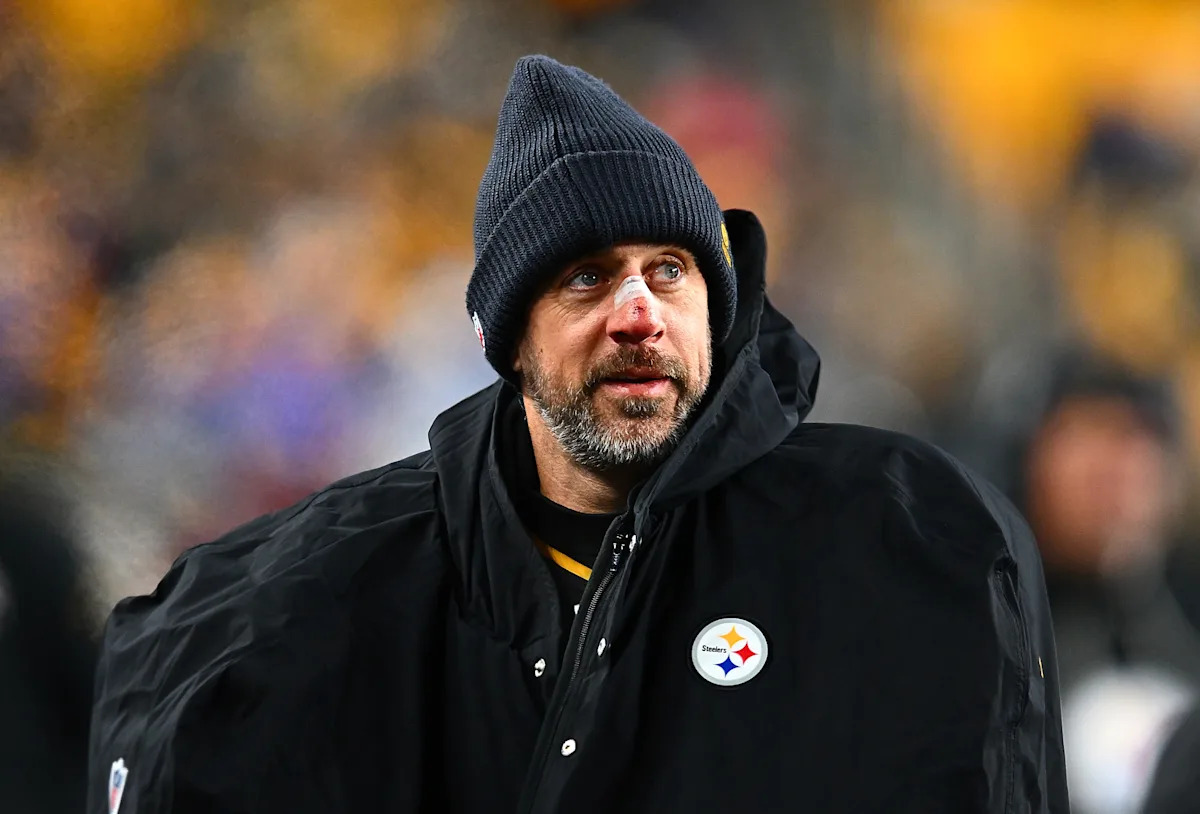
Aaron Rodgers might be retiring one year too late
Aaron Rodgers, in his return to the Steelers on a one-year deal, said this week that this was going to be his last season in the NFL. One last run for one of the greatest quarterbacks in the history of the game and future first ballot Hall of Famer. He’ll be teaming up with his old coach Mike McCarthy for the final season of this particular show as the Steelers try to … win a playoff game?
It’s long been accepted that the Steelers were largely going to run back last year’s roster, but it doesn’t seem like they’re too concerned whether or not this is a good idea — and neither is Rodgers himself. This looks destined to be another stuck-in-the-mud Steelers offense that features the inherent dangers of an aging, declined Rodgers playing even worse than he did last year.
Play 2026 Soccer Pick ‘Em with FOX One and make your picks for the world’s biggest soccer tournament
Advertisement
Among the 40 quarterbacks last year to register at least 190 dropbacks, Rodgers ranked 26th in expected points added per dropback (0.01), 24th in yards per dropback (5.98), 37th in first down conversion rate (26.8%), 36th success rate (40.8%) and 39th in air yards per attempt (5.9). In other words, he was pretty bad on a down-to-down basis. His league-leading 2.52 seconds to throw also encapsulated how physically limited he has become. He’s just trying to get the ball out as fast as possible because he doesn’t have the athleticism that he used to possess.
Of course, that is completely reasonable! Rodgers will turn 43 in December, he’s not supposed to be at the peak of his powers. The fact he can credibly be considered an NFL-level player still is a remarkable achievement in its own right — but not everybody gets to be Tom Brady. Rodgers’ performance last year did look and feel better than the recent slew of post-Ben Roethlisberger quarterbacks the Steelers have thrown out there, but that doesn’t mean it was actually good. Just slightly better than what they had. He wasn’t nearly good enough last season for the team to be so passive at quarterback and just wait for him to sign a contract right before OTAs started.
It’s just awfully complacent for a team with an aging defense that needs to be maximized, but it does seem like after this season the Steelers will just have to bite the bullet and try to acquire a young quarterback with real potential. Perhaps Drew Allar can be that guy with a year on the bench, but he was only a third-round pick. A declining quarterback well into his 40s is not the answer they’re looking for, and it seems unclear what their actual goal is this year.
Advertisement
But that’s not different from any other recent Steelers’ seasons, so, God bless ‘em. Let’s see if Mike McCarthy has access to the same cauldron of dark magic that Mike Tomlin did for another painful 10-7 season.
2026 schedule is a massive stress test for the future of the league
The NFL has long been spreading their corporate empire via game scheduling, with the 2026 season serving as a new frontier for the future of the league. Between international games and games being broadcast on streaming services, the NFL is attempting to be more visible than ever. There are debates to be had over whether or not this expansion is a good idea, but ultimately the NFL is going to keep trying to grow and push the limits of its global gains, with the players taking on the physical toll of that growth.
There’s no going back to the standard 16-game schedule with predictable game times and locations (or even 17 games, soon) — 2026 represents the NFL’s true swing at expanding what can already be considered a cultural hegemony. All through the power of inventory.
Advertisement
The NFL will be playing a record nine international games this season, with 10 games already approved for 2027 (and an eventual goal of every team having an international game each season). That includes a game in Melbourne, Australia between the 49ers and the Rams and a new game in France. Beyond that, the season opens on a Wednesday and there’s a new Thanksgiving Eve game that will be exclusively streamed on Netflix. While it’s easy to just look at a piece of paper that shows the NFL’s schedule, this is decidedly a lot.
A lot of streaming interfaces, a lot of stress on the players themselves, more days of the week to be watching the NFL — this is a stark contrast from the league that many fans grew up with over the course of their lives. There are some benefits to being on streaming apps and playing more games overseas, but this season is going to be the first dip in the water at how expansive and prevalent the league desires to become.
This gets a fat “TBD” because we don’t even really have information on things like what happens when you play a game in Australia and then have to come back for a Week 2 game that’s happening 9-10 days later. It’s a stress test that already has a determined outcome, because the NFL is not going to suddenly decide that they have enough and it’s time to stop growing. The impacts on the game itself will be a murky crystal ball at what the league will look like after the next collective bargaining agreement in 2031, if not sooner.
Advertisement
Jacoby Brissett, we salute you. After starting 12 games last year for the Cardinals, with just enough quality football, Brissett found himself walking back into Arizona with the idea that he would be the starting quarterback again. However, he also realized that he’s not getting paid like a starting quarterback, which prompted his decision to hold out from team activities until that was fixed.
Let’s get one thing out the way: This is funny. A team that many project to be among the worst in the league in a hellish division at the start of a rebuild has their bridge quarterback holding out. The eventual outcome of this holdout is almost guaranteed to have no real impact on the course of the season; it’s essentially irrelevant as far as league hierarchy goes. However, that doesn’t mean Brissett is necessarily wrong to take this stance, because … why not?
Brissett is set to have a cap hit of roughly $9.2 million this season, ranking 25th among all quarterbacks this year and his $8 million in guaranteed money currently ranks 35th in the league. Those numbers place him in line with rookies and veteran backup quarterbacks. In fact, Gardner Minshew, who the team signed this offseason, is making more guaranteed salary this year (about $2.9M) than Brissett ($1.5M).
Advertisement
This is where things can become a matter of perspective, but there are two things that are empirically true here: Brissett is not a rookie quarterback or a quarterback on a rookie deal, and he was objectively not the Cardinals’ backup quarterback last year. This isn’t to say that Brissett should get a market rate deal or anything like that, but if Malik Willis and Aaron Rodgers can make $22-23 million in cash this year, placing them right above the cutoff for backup quarterbacks, then it’s not unreasonable for Brissett to desire the same.
Unfortunately, the timeline of the Cardinals’ rebuild (and the general quality of Brissett’s play) is what makes this holdout feel somewhat preposterous. They’re not winning anything this year and Brissett, who really does provide tangible value to an NFL team, is obviously not going to be the team’s long-term quarterback. Arizona has no real incentive to pay him, unless they also view him as the bridge quarterback for whoever the team drafts next year. Considering they signed Minshew and picked Carson Beck with the first pick in the third round, there’s no need to do anything. Brissett isn’t going to elevate them past the 49ers, Seahawks or Rams. This is a long-haul rebuild that adds a level of incompatibility with Brissett’s desires.
Find NFL tickets on Gametime | More NFL team schedules
That doesn’t mean Brissett shouldn’t be trying this, though. As a 33-year-old journeyman, this very well may be his last chance to get a contract extension as a (presumptive) starting quarterback. If they say no, well, that’s life. Regardless, there’s no reason for Brissett not to ask for this considering his specific standing as a returning veteran quarterback. There’s also not much of a reason for the Cardinals to budge, making this a low-stakes holdout for everyone — except Brissett.
Advertisement
The lonely hero attempts to forge his destiny against the oligarchy before it’s too late. For that, we salute you, Jacoby. Whether or not you get that deal, the effort is understood and appreciated.
Joe Brady, Jesse Minter and Mike McDaniel all have something in common
The coaching carousel that followed the regular season was defined by the overwhelming pressure that tends to come with big-ticket quarterback play. Two of the most established head coaches in the league, John Harbaugh and Sean McDermott, were fired coming off winning seasons in which their respective teams had to endure the imbalance of attrition that inevitably bites every NFL — but it’s not like their final seasons were abject disasters.
The Ravens powered through four games without Lamar Jackson and still nearly made the playoffs with a Week 18 loss pushing them out. Buffalo (read: Josh Allen) just had way too many mistakes against Denver, but even then they were almost able to punch their ticket to the AFC championship game. These are only failures relative to expectation, which is fine, but it just means that new coaches are walking into immensely pressurized situations.
Advertisement
These specific coach movements here immediately map out how dire the respective ownership groups view their situations to be. Jesse Minter was hired in Baltimore (where he coached from 2017-20) to immediately improve the defense and get it back to championship caliber after an inconsistent run the past few years. Joe Brady was promoted to head coach after the Bills fired McDermott, and considering that was the only big firing they made, the expectation is for Brady to improve upon McDermott’s success — in other words, get to the Super Bowl, because that’s the only thing left.
This offseason even featured a former head coach in Mike McDaniel turning down opportunities to continue that role elsewhere in order to sign on as the offensive coordinator with the Chargers. Most offensive coordinators don’t walk into the door with immediate, serious pressure, but McDaniel had substantial success calling plays in Miami, is seen as an upgrade over Greg Roman and finally has an uber-talented quarterback in Justin Herbert. Considering every team coached by Jim Harbaugh seems to have a high enough floor to make the playoffs, improvement can only mean going on a run to the Super Bowl.
Advertisement
Quite frankly, it was reasonable for all three of those teams to feel like they needed to make a major shakeup, even if Buffalo’s process was fairly shaky. They have legitimate franchise quarterbacks that are all multiple years into their second contracts. The window is now, and while getting to the playoffs should always be seen as good, after time that level of success begins to feel diluted — but the expectations decidedly aren’t. Even if Bills team owner Terry Pegula says it’s not a Super Bowl-or-bust situation for Brady, it has to be. They’ve been to the playoffs six straight seasons with two AFC title game appearances. The only feasible next step is rapidly making a Super Bowl appearance. The same applies to Jackson, who was drafted in the same year as Allen as they enter their ninth NFL seasons. While Herbert is a couple years younger than Jackson and Allen, his baseline-level ability to drag broken offenses to the postseason leaves very little margin for error on the expectations for the Chargers’ offense.
These moves also highlight an undeniable truth about what they’re trying to accomplish: All of these moves happened within the AFC, specifically at the projected top of the conference. Success for one would have to mean the failure of the others, and that’s before including the rest of the conference. Even though fans and loud people on TV seem to forget this every year, only one team wins the Super Bowl. It’s a fair goal for these teams to have, but it also means there won’t be much of a grace period in the event of a slow start. These teams don’t have time for that.
There won’t be too much to glean from reporting on OTAs, but how these coaches begin to build the foundation does matter as they try to build squads that have the borderline unreasonable expectation of improving when they’re already on top of the mountain.
Read the full article here


