





Mariners players have a plethora of team-issued t-shirt options to choose from. One of the most popular designs comes from the high performance team, featuring a modified Rod of Asclepius on the front, where the wings are swapped for the Mariners trident; on the back, (AVAIL)ABILITY, with “ABILITY” highlighted in white. It’s a play on the old chestnut “the best ability is availability” – a slogan meant to encourage players to center the importance of proper conditioning.
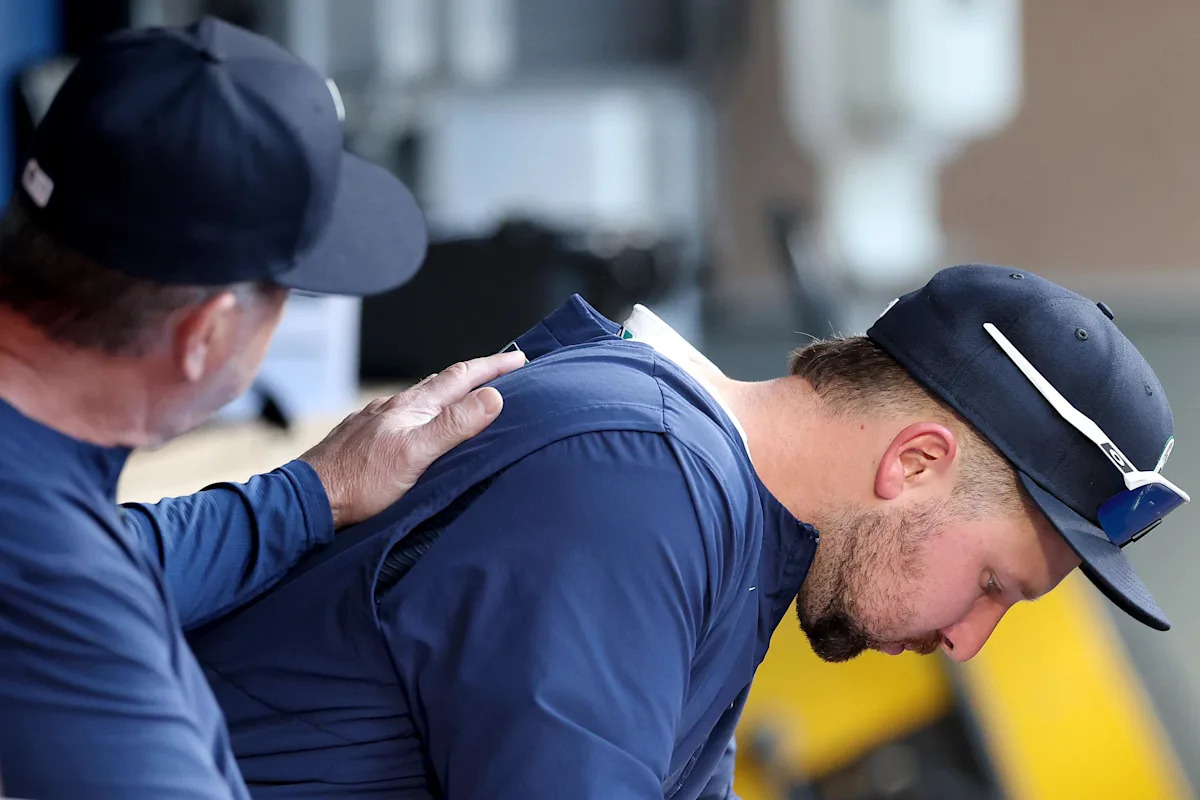
But it’s important that availability never overrule the needs of the body: something Cal Raleigh might have run up against after landing on the IL for the first time in his career.
Advertisement
“To be honest, I wanted to play,” Raleigh said, meeting with the media on Friday. “I wanted to see if I could do it – to what extent it was going to affect me, and I told the trainers, if it ever got to a point where I was hurting the team or I couldn’t go anymore, I’d let them know. And essentially it just got to that point where I didn’t want to hurt the team.”
For those who grumble about players pushing through playing hurt, put oneself in Raleigh’s shoes: he’s an everyday catcher, used to shrugging off daily bumps and bruises that would require a weeklong stay in a Victorian-era convalescent asylum for the rest of us mere mortals. And he’s not just any catcher; he’s the Mariners’ iron man, either leading or being near the top of the leaderboard for innings caught every year of his career. Anyone who has watched any significant amount of Mariners baseball has seen Cal Raleigh get knocked down seven times and stand up eight – often in the same game. Therefore, we can forgive Raleigh, for whom pain hums constantly like an overhead fluorescent light, for thinking he could push past this latest ailment, one in a long string of problems faced, fought with, and conquered.
The question, now, is if Raleigh can forgive himself, or at least find a détente with the nebulous forces of baseball injury luck.
“It’s tough,” he said. “You get frustrated, because you know…it’s nothing really I could have controlled or done better. I prepared the same way, and it just kind of happened on a swing. So it’s out of my control. Something that doesn’t normally happen. So, you know, obviously frustrated. But I’m optimistic that it’s going to get better.”
Advertisement
It’s understandable why this situation is especially frustrating for Raleigh, who works tirelessly to control the controllables – not just for himself, but for his entire pitching staff. His work ethic is legendary: always one of the first players in the building, his daily agenda presidential in density, rarely idly scrolling his phone at his locker, never goofing off in the player lounge. Even a half-decade into his big-league career, Raleigh doesn’t seem to know what to do with himself on an off-day, wandering the clubhouse in squishy foam slides and loose athletic shorts, iced coffee clutched in hand; relaxed, but unable to disconnect entirely. Back at spring training, he left for the WBC like a concerned parent leaving his pitching staff with the babysitter, double-checking everyone knew where the important numbers were, lingering at the door, jokingly demanding to be sent updates from the media on if his pitchers were misbehaving in his absence.
But Raleigh isn’t having to go through this experience – his first time landing on the IL – alone. One of his closest friends on the team, Luke Raley, just went through this same injury last season. Raleigh recounted watching his friend, whose dedication to “availability” rivals his own, struggle to even swing a bat, and has taken the advice from his equally-tough friend to heart.
“It was just so hard on him, mentally,” Raleigh said. “And we knew what kind of teammate he was, so watching him go through that last year was really hard. And we talk a lot, so that’s something – I obviously had to listen to him about it.”
Obliques are notoriously tricky injuries to rehab, in that they won’t present with soreness until the muscle is called upon, often when it’s too late to be mitigated – especially not in baseball, a sport that is all about core rotation. Raley has talked about his own struggles with the uncertainty that comes with this particular injury.
Advertisement
The good news for Raleigh is that according to Mariners GM Justin Hollander, the scans the team just got back are “similar or slightly improved” from the ones he had done early in May, when Raleigh first felt the discomfort, meaning Raleigh didn’t further injure himself trying to play through the injury. When pressed to put a grade on the strain, Hollander said a one, not even a one-plus.
Raleigh had an anti-inflammatory shot on Friday and will be shut down for the next week, minimum. Once any trace of lingering soreness is gone, the team will re-evaluate, and if all looks good, he’ll be cleared to restart baseball activities, most likely in Arizona. Hollander said that based on the scans, he doesn’t anticipate a lengthy layoff, but emphasized how careful the organization needs to be given the nature of the injury.
“We want to make sure that when he’s next in the game, he’s doing it with full confidence and pain-free. The hesitation that can come with not knowing if it’s going to hurt a little bit when you swing, or when it will hurt, is probably not good for him or for us.”
The Mariners think sending Raleigh to Arizona will be the best for his recovery: he’ll have a full staff of rehab experts to work with, access to equipment and training facilities they don’t have space for in Seattle, and the complex league teams to get competitive at-bats against. He’ll be able to focus solely on his rehab.
Advertisement
But it will also involve Raleigh having to be away from his team and fully disconnect for the first time, in-season, in his career. Unless, of course, he talks the Mariners out of it.
“If that involves Arizona, that involves Arizona,” he said on Friday, apparently having not listened to Hollander’s declaration that he would be headed there. “But if they need me here and they need me to do things off the field, then I will gladly stay and do that as well.”
Of course he’d gladly stay, tear up the list of important numbers and send the babysitters home. But would it be the best thing for him? Maybe not. Even before the injury, Raleigh was off to a tough start to the season, perhaps a knock-on effect from missing regular spring training while at the WBC. Now, he’s been handed an opportunity to take a step away – being strong-armed to do so, in fact. What might the baseball gods be asking Raleigh to learn from that?
“I don’t know,” he said, brow furrowed. “Patience, maybe?”
Advertisement
“Obviously, the last few weeks have not been great, performance-wise, health-wise, so I don’t know. Maybe just take a step back and just take a deep breath, relax a little bit, maybe watch the game from a different point of view and see where I can get better, what I can do better as a player, as a leader, as a teammate. Usually you don’t have that kind of time to reflect during a season, but within this scenario, maybe that’s something that I can do better.”
Cal Raleigh has been given the gift of time to reflect – a gift not asked for, maybe not wanted, but a gift nonetheless. A time to decide what “(avail)ability” might mean for him, going forward.
Read the full article here