





The Anaheim Ducks are one of the final eight teams left standing in the NHL Stanley Cup Playoffs. They upset a perennial cup-contending Edmonton Oilers squad in six games in the first round and will be up against another cup-contender in the second round: the Vegas Golden Knights.
Ducks head coach Joel Quenneville, with the help of his coaching staff, out-coached Oilers head coach Kris Knoblauch in round 1, and will have to pull out all his tricks once again if he’s to defeat brand new Vegas head coach John Tortorella.
Advertisement
Five Anaheim Ducks Storylines Ahead of their Second Round Series vs the Vegas Golden Knights
Ducks to Face Golden Knights in Round Two of 2026 Stanley Cup Playoffs
Tortorella has only been the Knights’ head coach for eight games heading into the playoffs after they shockingly parted ways with Bruce Cassidy. Vegas went 7-0-1 down the stretch under Tortorella and dispatched the Utah Mammoth in six games in their first-round series.
It’s unclear if, how, or to what extent (beyond lineup alterations) Tortorella can make changes throughout the course of a long series, behind the bench of a new team, but Quenneville will have to win five key matchups if the Ducks are to win four games in the next seven and advance to the Conference Final.
Alex Gallardo-Imagn Images
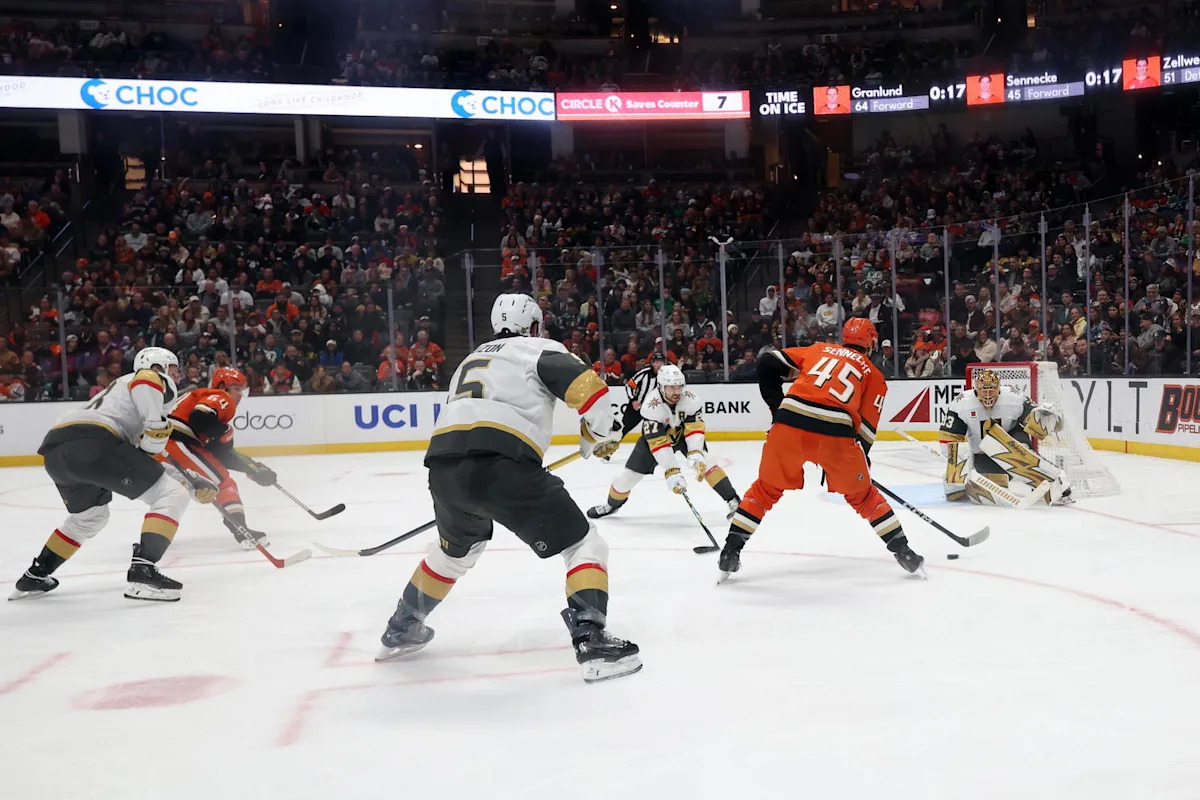
If the Conn Smythe Trophy were awarded after one round, a very strong case could be made for it to be awarded to Ducks defenseman Jackson LaCombe. LaCombe scored nine points (1-8=9) in six games, tied for second in playoff scoring and leading all defensemen, dominated underlying metrics, dictated play on every shift, and effectively shut down (or severely limited) Connor McDavid, the world’s best hockey player.
Advertisement
If Quenneville continues to hard-match LaCombe against his opponent’s top player, LaCombe’s next assignment will be Team USA teammate, 2026 Olympic Gold Medalist, and 2023 Stanley Cup Champion Jack Eichel.
Tying LaCombe, Eichel scored nine points (1-8=9) in six games against Utah in the first round, while averaging 24:22 TOI/G, and offers a completely different challenge for LaCombe than McDavid did. McDavid is far and away the fastest player in the NHL who does most of his damage off the rush and operates at a high rate of speed in every facet of his offense.
Eichel, not slow by any means and still one of the NHL’s best skaters, attacks more surgically and methodically. He utilizes his 6-foot-2, 206-pound frame to protect pucks with an elite glide and is one of the NHL’s best passers, displaying deception and throwing misinformation at every turn. He’s equally as dangerous off the rush or on the cycle.
Eichel prefers to carry pucks low to high in the offensive zone and across the blueline, looking for and opening dangerous seams. Like with McDavid, it will require all five skates on the ice to properly limit his impact, but LaCombe will need to be smart not to drift too far from the net front and remain in good positions.
Advertisement
Any goaltender will echo that they aren’t playing against the opposing goaltender, but rather the opposing team as a whole. However, in this particular series, Ducks netminder Lukas Dostal will have to out-duel Vegas netminder Carter Hart, and out-duel him significantly, if the Ducks are to have a chance at advancing beyond the Golden Knights.
Through the first round, traditional numbers suggest that Dostal and Hart have been two of the worst goaltenders in the playoffs, with Hart finishing with better numbers.
Hart finished his first round series by allowing 18 goals on 167 shots (.892 SV%) and saved -0.13 goals above expected (GSAx). The eye test suggests a slightly different narrative, as he let in several goals from distance, without a screen, and/or through his body (between his arm and his torso).
Advertisement
Dostal’s numbers were far worse in the first round, as he allowed 20 goals on 158 shots (.873 SV%) and saved -4.61 GSAx. His eye test suggests he was better than those numbers, but unspectacular nonetheless. His rebound control and puck tracking (typically two staples of his game) left a lot to be desired, but none of the goals (of very few) could be classified as “soft.”
Dostal either allowed goals with screens in front of him, off of deflections, and/or from incredibly high-danger areas of the ice. If he could see a shot, he typically saved it, but he wasn’t able to “steal a game,” and he didn’t come up with a “big save that he wasn’t supposed to make” very often.
The big saves he does make often go unnoticed, as his primary strength as a netminder is his positioning, and he makes difficult saves often seem routine. However, with what Vegas strives to accomplish on offense, Dostal will need to make those big, athletic saves he’s not supposed to, and he may have to “steal” a game or two.
Both goaltenders have the skill sets to dictate a series from their respective creases, but neither had to for their teams to advance to the second round. One may have to, however, if they intend to backstop games in the third round.
Corinne Votaw-Imagn Images
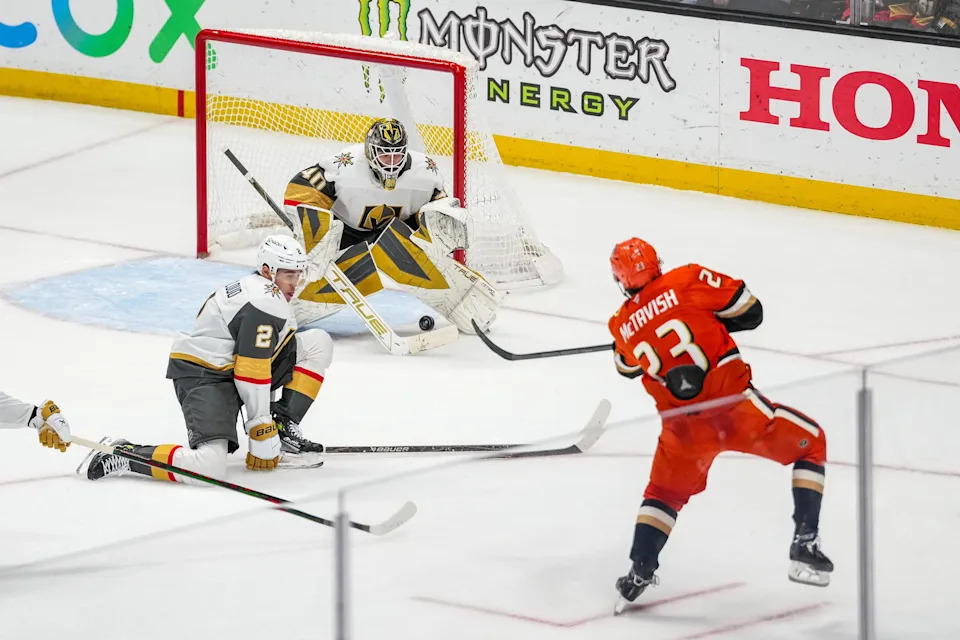
In the regular season, Vegas boasted elite special teams, featuring the sixth-best power play (24.6%) and seventh-best penalty kill (81.4%). That continued into the playoffs, as they currently have the fifth-best PP (20%) and third-best PK (93.8%).
Advertisement
The Ducks are a completely different study, as they had middling to poor special teams in the regular season (18.6% PP, 76.4% PK). Their penalty kill remained unimpressive through the first round (71.4%), but it didn’t bite them, as they are the least-penalized team in the playoffs to date.
Anaheim’s power play flipped a switch, however, in the first round, and was one of the greatest factors that led to them defeating the Oilers in six games. With two units finding cohesion and chemistry after 82 games of trial and error, the Ducks scored eight power play goals on 16 attempts in round one.
With the assumption that Vegas’ power play will remain productive and Anaheim’s penalty kill will continue to allow goals at a similar rate, the Ducks’ power play will prove ever-important once again in the second round, as will a continued discipline from Anaheim to limit their own trips to the penalty box.
The Ducks’ top line (Gauthier/Kreider-Carlsson-Terry) accounted for six of the Ducks’ 14 goals at 5v5 in the first round and were on the ice for seven. Vegas opted not to match a pair or line against Utah’s top line in their first-round series with much consistency, but the gap between Utah’s first line (Crouse-Schmaltz-Keller) and their second line (Yamamoto-Cooley-Guenther) isn’t as drastic as Anaheim’s.
Advertisement
Utah’s top line did see slightly more ice against Vegas’ top pair (McNabb-Theodore) than they did against their second pair (Hanifin-Andersson). If Vegas’ top pair has remotely the success they did against Utah’s top line, Anaheim’s depth scoring will be more vital to their success in this series.
Anaheim has the offensive prowess down their forward lineup to supplement Terry and Carlsson at the top, with a potent blend of veterans like Mikael Granlund and Alex Killorn alongside talented youth like Beckett Sennecke and Mason McTavish. McTavish and Sennecke got their first taste of playoff hockey, and both project to thrive, stylistically, in that environment. However, both will hope to increase production and factor into more dangerous plays in the second round.
Kiyoshi Mio-Imagn Images
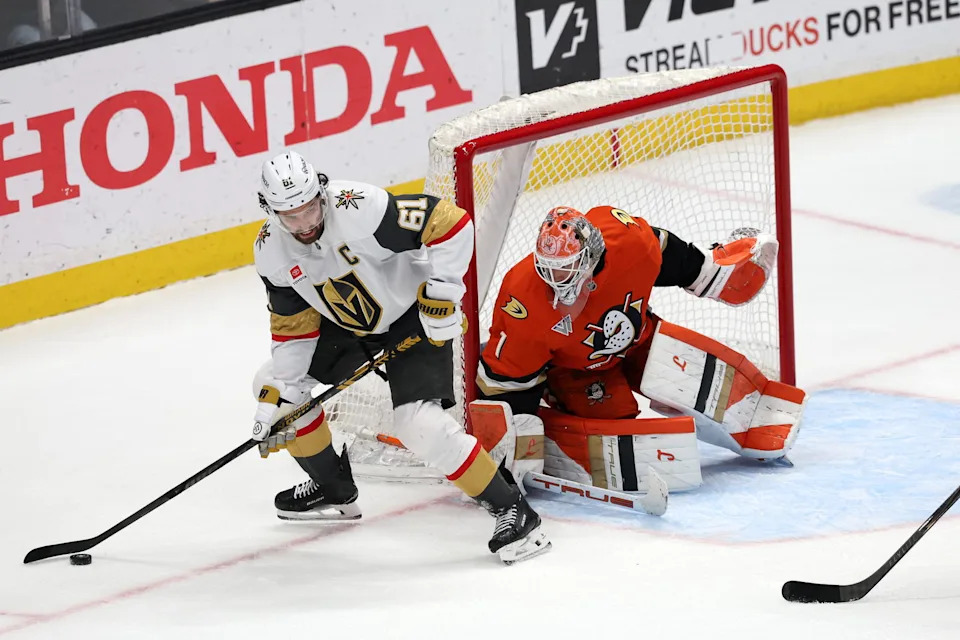
At various points in the 2025-26 season, the Ducks struggled to defend every facet of on-ice play. While adapting to a new coaching staff that brought in a new system, the Ducks had sorting issues defending the rush and made poor pressure decisions at the offensive blueline. However, the area that consistently pained them most was defending the front of their net.
Advertisement
Though they’ve improved when defending cycles, they are still susceptible to getting beat back to the front of the net from the perimeter, and they can still get caught puck watching when plays shift sides of the ice laterally.
When pucks are funneled to the crease from the perimeter, the Ducks struggle mightily with boxing out, tying up sticks, and clearing rebounds.
Vegas is as polished as they come on the cycle. They can work pucks low to high for point shots, dominate possession below the goal line, and sustain pressure for minutes at a time. They’re at their best when their best players (Mitch Marner and Jack Eichel) skate pucks up the walls and across the blueline, drawing defenders out of position to open seams and passing lanes.
Anaheim’s centers will have to make astute decisions on whether and when to pressure in those situations, and defensemen will have to limit their temptation to drift too far from the crease. When defending the net-front, they’ll also have to work tirelessly to eliminate screens, tips, and second-chance opportunities. Easier said than done.
Advertisement
As with any series, this Ducks roster stands a chance to win four of seven, especially with Quenneville behind the bench. However, the execution will need to be nearly perfect, and they’ll have to come out on the positive end of these five matchups to do so.
Three Areas Key to the Ducks Round One Victory over the Oilers, Ducks Win Series 4-2
Takeaways from the Ducks 5-2 Win over the Oilers in Game 6, Ducks Win Series 4-2
Adjustments the Ducks Will Look to Counter to Avoid Game 7
Read the full article here