





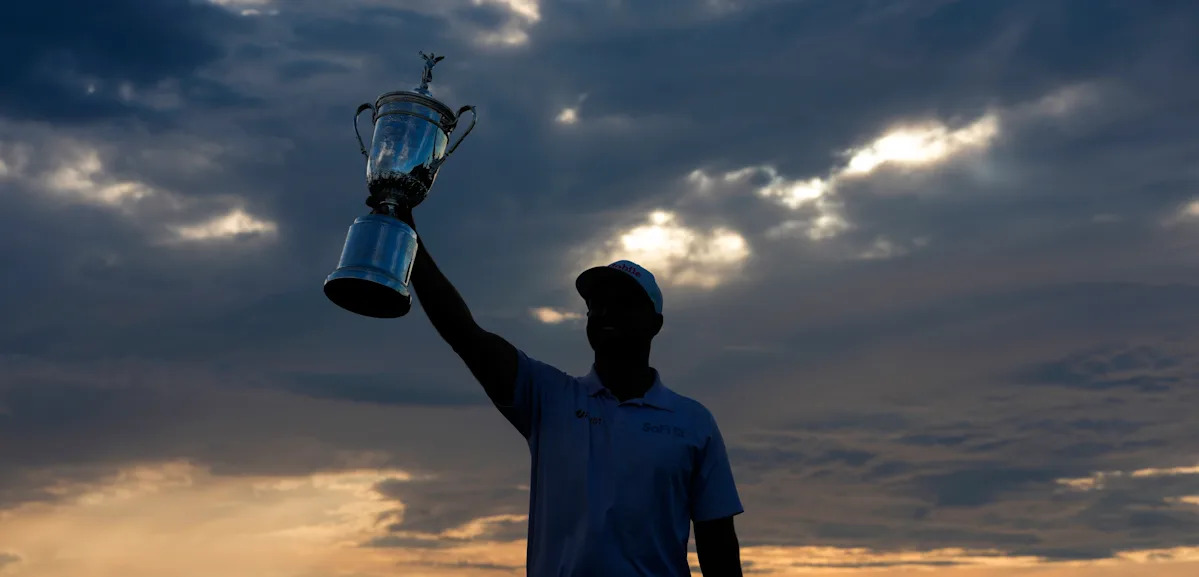
For all of the chatter around Clark, there is now a very simple way to describe him: two-time U.S. Open champion. That’s more U.S. Open wins than Scheffler, McIlroy, Snead, Mickelson, Faldo, Ballesteros, Norman, Singh, Schauffele, Collin and Justin Thomas…combined.
SOUTHAMPTON, N.Y.—It can be exhausting trying to keep up with all the narratives around Wyndham Clark. He was a can’t-miss-kid who became a bust. Then, over the last three years, his shape-shifting has accelerated: surprise U.S. Open winner, TV star, boorish chud, contrite everyman seeking a redemptive arc and then, during a tense final round of the 126th U.S. Open, the most hated man in New York (non-Wemby division). The fans at Shinnecock Hills, if you can call them that, cheered his missed putts and shouted for every drive and approach shot to find a bunker, or the fescue, or Hades. It was the most outrageous gallery behavior since…last September, when the Ryder Cup was not-so-coincidentally played on the same island. The hostility toward Clark was stunning for an American playing in his national championship. Given Clark’s 6-stroke lead at the start of the final round, some sodden yahoos could probably justify their behavior as just wanting a dramatic finish. Others wanted to witness history, with his playing partner Scottie Scheffler going for the career Grand Slam. But much of the animus is undeniably of Clark’s own making: the smashed locker at least year’s U.S. Open, a hurled club that could have wiped out a volunteer, etc. The snark slingers on Golf Twitter certainly haven’t helped his public perception. Yet all of those rowdy Noo Yawkers did the seemingly impossible: they made Clark a sympathetic figure.
“It was him against the world,” Clark’s delirious father Randall said walking off the final green after his son squeaked out a one-shot victory over Sam Burns. “Without question, that was the single most challenging round he’s ever played. So much pressure, so much stress, but he was a warrior. He took so many bullets out there but he never gave in. I am so incredibly proud of him, I think my heart might burst.”
Advertisement
For all of the noise around Clark, 32, there is now a very simple way to describe him after his gritty performance at Shinnecock: two-time U.S. Open champion. That’s more U.S. Open wins than Scheffler, Rory McIlroy, Sam Snead, Phil Mickelson, Nick Faldo, Seve Ballesteros, Greg Norman, Vijay Singh, Xander Schauffele, Collin Morikawa and Justin Thomas…combined. Clark has now conquered one of the citadels of the sport, what McIlroy this week called “ the best championship test in the country.” And Clark did it on Sunday by going eyeball-to-eyeball with Scheffler, the game’s best player. Love him or hate him—and there are plenty of folks on both sides of the aisle—Clark’s skillset is undeniable, and now so too is his resume. In his finest hour, he offered up yet another persona: humbled champion. Accepting the trophy on the final green, Clark said, “New York didn’t really like me but I love you guys. You know, I get it.” And here the crowd—gasp—cheered for Clark. He continued, “Some of it was self-deserved. Some unfortunate things [happened] last year that I really regret. I’ve been sorry multiple times and I’m still sorry so hopefully I can win you guys over eventually.”
We shall see if this latest reinvention sticks. To quote a cynical old Nike ad starring Tiger Woods: Winning takes care of everything. Clark already knows that life is more complex than that.
The person they think they’re rooting against is not the person he really is.
He is the son of a former Miss New Mexico who herself was one of nine kids of an Army colonel. Lisa was a go-getter who rose to national sales director for Mary Kay Cosmetics and she was the one who first took young Wyndham to the driving range when he was a 3…and she was pregnant with her third child. Randall played out of Cherry Hills Country Club in Denver, famously the site of Arnold Palmer’s only U.S. Open victory (and a William Flynn design like Shinnecock). Randall didn’t want his son wasting too much time on video games so he told him he couldn’t have a PlayStation until he made an eagle. Wyndham promptly made a hole-in-one with a driver on a 125-yard par-3. He was six years old. Wyndham grew into an all-around jock who played two years of high school basketball, and a flashy character who picked up his prom date in his Mom’s pink Cadillac. But Lise was diagnosed with breast cancer during her son’s freshman year playing golf for Oklahoma State. She died that summer. “She told me before she passed that she just wanted me to play big, to play for a bigger purpose and something greater than myself,” Clark told GolfWeek’s Beth Ann Nichols twelve years ago. “I’ve kind of just taken that into this season and hopefully into the rest of my life.”
Advertisement
Clark in high school, circa 2011
Needing a fresh start, he transferred to Oregon and by 2017 was the Pac-12 player of the year. He turned pro that summer, successfully apprenticed for a year on the Korn Ferry Tour and then reached the big leagues. A bomber with an exceedingly delicate touch, Clark had all the tools, but he turned into his own worst enemy. He was often consumed with rage on the golf course. Sports psychologist Julie Elion connected that to Clark’s unresolved anger at having his mother taken from him at such a young age. Clark’s journey to make peace with his past was a central plot in the second season of Netflix’s Full Swing, and Clark outdueling McIlroy to win the 2023 U.S. Open at Los Angeles Country Club gave the show a perfect Hollywood ending.
But stardom had its own challenges. The ‘23 U.S. Open was only Clark’s second career win. Straining to quiet the naysayers, he let a handful of tournaments get away. By this spring he had won only once since LACC, and even that had had an asterisk because the final round at Pebble Beach had been washed-out in 2024. But Clark hard-launched a new girlfriend at this year’s Masters, Emily Tanner, a model and owner of Over Social Agency, an influencer and content marketing firm. Not surprisingly, she has brought out a softer side of Clark on Instagram; he garnishes her every post with more than enough heart-eyes emojis. “He is honestly one of the most calm people I know,” says Tanner. “He doesn’t have a temper at all. So, yeah, it’s upsetting because the person they think they’re rooting against is not the person he really is.”
Advertisement
Clark’s new reservoir of patience showed on the golf course. Playing late in the day on Thursday, he was idling at two-under on a day of low scoring when the wind died. Clark took full advantage, going birdie-birdie-eagle to key a 64 that was a testament to his all-around excellence: 1.54 strokes gained off the tee, 2.71 with approach play and a whopping 3.97 with the putter. Clark scuffled a bit on Friday but held his ground with a 69 and then he grabbed the tournament by the throat on Saturday, shooting a 70 despite hitting only nine of Shinnecock’s devilish greens. Clark pulled off a series up-and-downs that Harry Higgs called “absolutely insane.”
The lead was six—a freighted number ever since Greg Norman’s implosion at the ‘96 Masters—but Clark seemed unbothered. “He was so calm and happy all week,” says Tanner. “Even this morning [on Sunday] we were just laughing from the second we woke up.”
And then Clark entered the crucible. “We were playing 9, which is parallel to 1, and when he hit his drive on the first tee we could hear fans yelling for it to go in the fescue,” says J.T. Poston, who finished tied for fourth. “That was different.”
I like Wyndham, I think almost everyone out here does. Yeah, he’s been vilified, but he’s a good dude, he’s a good person. You can see he’s trying hard to overcome whatever mistakes he’s made.
Advertisement
Clark looked a little shellshocked, bogeying three of the first seven holes while Burns birdied four of the first eight. Just like, the lead was sliced to one, and the barbs reigned down on Clark. (My personal favorite: “It’s a bad day to be a locker!”) But Clark dug deep, flighting a gorgeous wedge that danced around the hole at 10 for his first birdie of the day. “I mean, his ability to curve it and put an insane amount of spin on it, he’s up there with Scottie and Rory,” says Higgs. “So when the greens get super crusty, he can find ways to fit it into flags. Whereas maybe myself and others have to land it short and get it to chase back there and it’s much tougher to hit it close than if you just come in through the air.”
While everyone else stopped making birdies Clark got another crucial one at the par-5 16th, giving him a two-shot cushion. He closed out the tournament with his best lag putt of the day on 18, from 52 feet. Happiness is a tap-in to win the United States Open. In the swollen grandstand there might have been a few people who actually clapped. “I mean, the crowd was tough today,” Scheffler said. “I mean, New Yorkers, they are tough people. Being in the arena is not for everybody, and I think it shows a lot about Wyndham, how he handled not only this golf course but I think the crowd today as well. He is a well-deserving champion.”
Clark called the victory “redemption,” which might be a little rich. But his colleagues have already forgiven him for any trespasses. “I actually laugh at him at times,” says Bob MacIntyre. “I say he’s the most European of the Americans. He just likes to have a laugh. He’s very approachable.”
Advertisement
Says Higgs, “We’re not robots, we’re definitely not perfect, that’s for sure. Sometimes frustration just boils over and I’m no saint either, certainly. I like Wyndham, I think almost everyone out here does. Yeah, he’s been vilified, but he’s a good dude, he’s a good person. You can see he’s trying hard to overcome whatever mistakes he’s made. The bottom line is we’re all psychos for doing this for a living and you can’t judge someone on their worst moment or two. You have to give people a little grace and see how they respond to adversity.”
In the long history of the U.S. Open, rarely has a player faced as much adversity as Clark did on Sunday. Like it or not, he met the moment.
Read the full article here