





The NFL’s offensive meta has been undergoing a serious shift in recent seasons. On average last year, the team rate of plays with three-plus receivers on the field fell by over five percentage points, as more teams than ever leaned into heavy personnel packages, some with a fullback but mostly with two- or three-plus tight ends on the field.
Some of the best teams in the NFL were at the forefront of this offensive trend, most notably the Rams, who made a sharp pivot to 13-personnel (one receiver and three tight ends) midway through 2026. The league showed us that many teams intended to follow this emerging style as eight tight ends flew off the board on Day 2 of the NFL Draft, with a heavy emphasis on true in-line Y tight ends going well ahead of consensus draft boards.
Advertisement
Join or create a Yahoo Fantasy Football league for the 2026 NFL season
It makes sense. The NFL, for years, lived out of 11 personnel and spread looks — from 2019 to 2024, 15 teams played 11 personnel on over 61% of their snaps compared to 12 last year as the league-wide average fell — to the point that defenses responded by getting lighter and faster. In a game made up of moves and countermoves, it was inevitable that teams would eventually try to get big bodies on the field and re-emphasize the run game. This has also led to more dynamic pass concepts out of those heavy sets than ever before.
From a fantasy football standpoint, you would think that this leads us to focus more on tight ends (and we’ll look at which teams are leaning into these multi-tight-end looks this year) but the actual beneficiaries are usually wide receivers. Last year, teams had an explosive play rate of 21% and averaged 8.6 yards per play when throwing to wideouts out of 12- and 13-personnel, compared to 14% and 7.2 yards per play when throwing to tight ends. The main reason you get into these heavy looks is to beef up your ground game, marry your run and pass looks and then throw the football down the field against advantageous coverage looks from base defenses.
As Ryan Heath from Fantasy Points notes, wide receivers saw a 35% increase in their yards per route run and 16% increase in their target per route run when going from looks with three or more wide receivers on the field, to two or fewer. Those numbers are 11% and 2% when looking at tight ends.
Advertisement
So here, we’ll specifically look at which wideouts might be set to see the biggest boost from teams that are already living in heavy personnel looks and those that might follow the trend in 2026. Of course, some of this will be pure guesswork and I’m bound to miss a team or two that leans into this during the upcoming season.
Bread and butter teams — Who’s already doing this well?
Los Angeles Rams
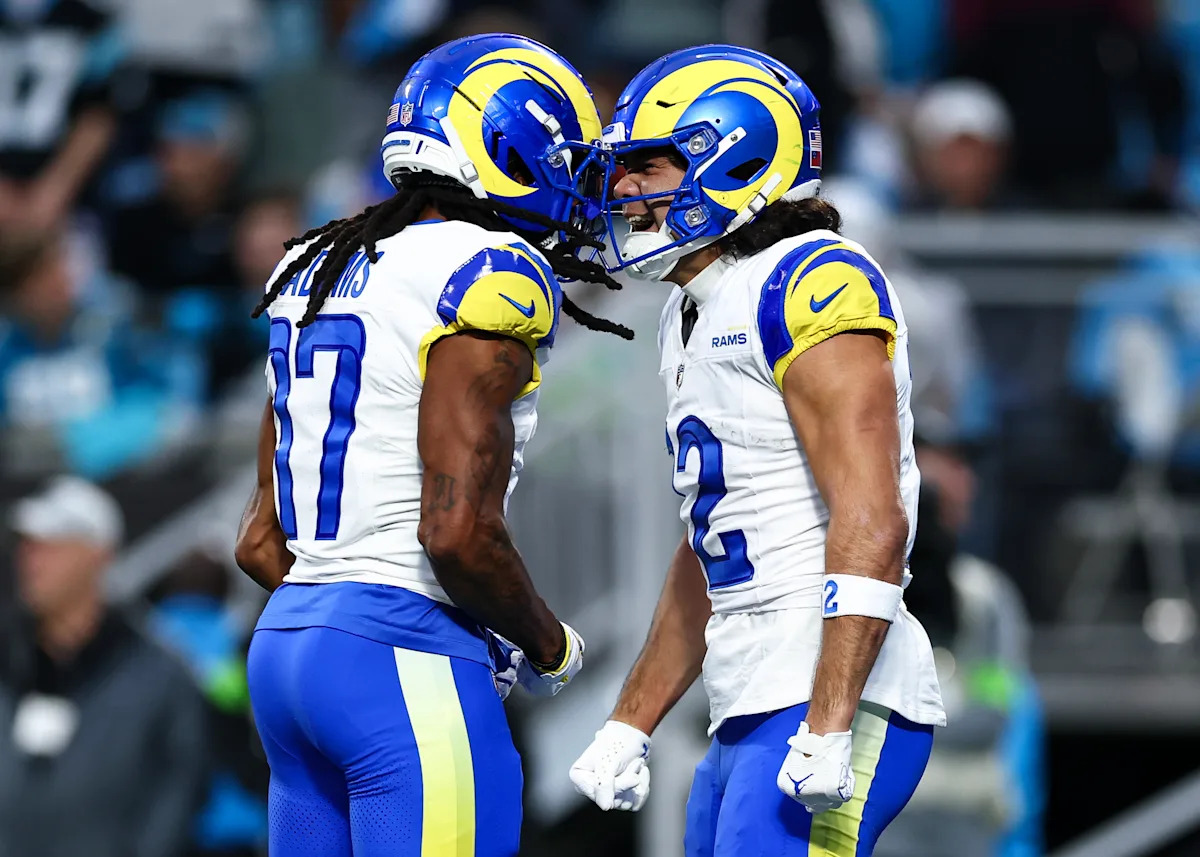
The Rams were the poster boys for the heavy personnel revolution, most notably by getting into 13 personnel on a whopping 31% of their snaps in the regular season. Los Angeles led the NFL in EPA per play out of 12- and 13-personnel sets combined last year. They added another tight end to their deep stable by selecting Max Klare in Round 2 of the NFL Draft.
Advertisement
Wide receiver(s) who benefit: We know the receivers who will benefit from the heavy personnel looks here. At this time, there is a severe dropoff from Puka Nacua and Davante Adams to the rest of the Rams’ receiver corps. Nacua took 232 snaps out of 12 and 13 personnel in 19 total regular and postseason games last year, while Adams took 141 in 17 games. Konata Mumpfield was second with 178 in 20.
Adams caught a whopping nine touchdowns out of these looks and should be a factor around the goal-line once more. Still, Nacua should be the fine per-route efficiency booster, as he was last year when he led the NFL with an outrageous 6.19 yards per route run out of 12 and 13 personnel.
Seattle Seahawks
While its tight end usage wasn’t as high as some of the teams above, Seattle was still 29th in 11 personnel usage because it was one of the heaviest fullback teams in the NFL. Seattle returns its top two tight ends in the extremely underrated AJ Barner and Elijah Arroyo, and fullback Robbie Ouzts. We should expect them to lean into these formations quite often.
Advertisement
Wide receiver(s) who benefit: Jaxon Smith-Njigba ran 150 routes out of 12 and 13 personnel last year and averaged 4.91 yards per route run. He was targeted on 35% of his routes from those groupings. He was the best example of this receiver-consolidation theory last season and will likely keep it going in 2026.
Chicago Bears
The Bears ranked fifth in plays out of 13 personnel and seventh in 12 personnel. They were a top-10 offense by multiple measures last year and ranked seventh in explosive play rate, specifically out of 12 and 13. Ben Johnson is already well-established as one of the elite play-designers and callers in the NFL, in both the run and pass games. Chicago has a budding star at tight end in Colston Loveland, a veteran in Cole Kmet and took a tight end on Day 2 of the NFL Draft in Sam Roush. We can expect to see them lean into heavy personnel quite often.
Wide receiver(s) who benefit: The group was already going to heavily consolidate down to two members, Rome Odunze and Luther Burden III, after DJ Moore’s departure. Guys like Kalif Raymond and third-rounder Zavion Thomas will be key role players but not target-earners.
Advertisement
That first duo will be on the field when they go to 12 and both Odunze and Burden have credible cases to be the lone receiver in 13. Burden is an explosive play waiting to happen, while Odunze is a fantastic separator who is an excellent blocker. The Bears wideouts should see the boost of volume and efficiency-hog tendencies that WRs get in these looks — draft them both.
Pursuing the trends — Who will follow suit in 2026?
Buffalo Bills
The Bills run fewer heavy personnel sets than you expect and ran the 13th-most plays out of 11-personnel last season. In an ideal world, I think they’d love to get more looks where a combination of Dalton Kincaid, Dawson Knox and Jackson Hawes are on the field together. They ranked third in EPA per play out of 12- and 13-personnel sets. Some of Kincaid’s in-line and blocking limitations put a cap on how much they can run, however. It’s worth noting that they lost fullback Reggie Gilliam to the Patriots in the offseason, which may limit how much 21- and 22-personnel they can use in 2026.
Advertisement
Wide receiver(s) who benefit: Last season, Keon Coleman led the team with 161 snaps out of 12, 13, 21 and 22 personnel for the Bills. There is no chance that it will happen again in 2026, nor will we see Tyrell Shavers, coming off an ACL, be second with 151. New receiver DJ Moore was the guy on the field the most for Chicago in those groupings last season. He’s a shot-play threat from the X-receiver spot and should hold that gig for Buffalo.
Jacksonville Jaguars
The Jaguars kicked off the run of in-line tight ends on Day 2 of the NFL Draft by selecting Nate Boerkircher well ahead of his expected positioning at the 24th pick in Round 2. GM James Gladstone said the “trend” was part of the thought process in taking Boerkircher. Jacksonville had the eighth-highest rate of 11 personnel last season, so they have some room to dip down into other groupings. Still, they have four wideouts they’d like to get opportunities, so I don’t expect them to go full Rams- or Seahawks-level of heavy personnel, even if they experiment with the looks more in 2026.
Wide receiver(s) who benefit: This is one of the most difficult ones to read among the list. If we’re just going off traditional position designations, Brian Thomas Jr., as the classic X-receiver, would get the nod. However, I’m not sure the staff trusts him and he didn’t record a single catch out of 12 or 13 personnel from Week 10 on. Jakobi Meyers is the best blocker in the group and he led the team with 91 snaps and 46 routes out of 12 and 13 after he arrived in Week 10. Parker Washington was efficient with a team-best 2.64 yards per route and is an explosive player on downfield breaking routes.
Advertisement
Yet, if the team is going to use Travis Hunter on package plays only as a wide receiver — which is not a certainty at all — these limited looks as the ISO receiver allow him to have a small assignment and route menu while presenting chances for downfield plays against man coverage.
Bottom line, we truly don’t know the answer to this one. We might not get one until the games start and even then, it could be a rotation or subject to change, which is how I feel about this team’s receiver room in general.
Houston Texans
The Texans took Marlin Klein with the 27th pick of Round 2 to give them another true tight end presence alongside Dalton Schultz, who garnered 64% of his targets when lined up in-line, the seventh-highest rate among tight ends with over 40 looks. Klein is a blocker who is certainly set to help a run game that has ranked 31st in success rate since 2023, when C.J. Stroud entered the NFL. Klein will also give them more pass-game flexibility than they had last season when they had to go to jumbo packages with a sixth offensive linemen.
Advertisement
Play 2026 Soccer Pick ‘Em with FOX One and make your picks for the world’s biggest soccer tournament
Wide receiver(s) who benefit: Jayden Higgins could fit as a size-based option who blocks well in the run game as the ISO receiver in 13 personnel. Still, my bet is that Nico Collins ends up being the guy, as he’s their pure X-receiver and is an elite press-man coverage-beater. Collins is one of my favorite wideouts in the league and could feast against base defenses on downfield looks in these packages.
Los Angeles Chargers
The Chargers signed Alec Ingold, a Dolphins fullback, to follow Mike McDaniel and blocking tight end Charlie Kolar in free agency in March. Right after the draft, they circled back for tight end David Njoku. You can bet they will not come close to their usage of three-receiver-plus looks (fifth-most) as they did in 2025. Everything points toward more heavy personnel to improve the run game in Los Angeles this season.
Advertisement
Wide receiver(s) who benefit: My guess is that Ladd McConkey ends up running the most routes out of 12 and 13 combined because he’s an every-down player and the most consistent separator of the bunch. He has the best shot at seeing a JSN-style efficiency crank-up with the Chargers going heavier in 2026. However, 2025 rookie Tre Harris did lead the team with 169 snaps out of 12, 13, 22 and 21-personnel combined last year as the team really valued his run blocking. He is someone with an X-receiver skill set as a vertical option at Ole Miss and could throw a wrench in projections for McConkey and Quentin Johnston, if he sticks in this role.
Arizona Cardinals
The Cardinals already played a good bit of heavy personnel under Drew Petzing over the last few years, ranking sixth in 12-personnel rate (29%) and third in 13-personnel rate (13%) between 2024 and 2025. That was with in-line tight end Tip Reiman dealing with injuries last year. Obviously, Trey McBride is awesome but fellow move tight end Elijah Higgins also flashed last year. Expect all of these guys to see the field and these multiple-tight-end sets to follow Mike LaFleur from the Rams to the Cardinals.
Advertisement
Wide receiver(s) who benefit: Over the last two seasons combined, Michael Wilson has taken 17.5 snaps per game out of 12 and 13 personnel and Marvin Harrison Jr. has taken 17 per game. If you just look at 13 personnel, Harrison leads the way with 108 snaps to 89 for Wilson in fewer games played. He averages a beefy 3.6 yards per route run and has scored four touchdowns. It’s a new coaching staff and Wilson’s toughness and blocking ability could get him the nod in those looks; he also happens to be a legitimately great receiver. However, I remain bullish on Harrison’s ability in isolation. I will be taking the plunge into an offense with route concepts that better fit his game this year.
New England Patriots
The Patriots barely leaned into heavy personnel packages last year but that is destined to change. They took Eli Raridon, who our own Nate Tice loved as an in-line guy, with the 31st pick in the third round, added another in-line option in Julian Hill as a free agent and the aforementioned fullback Reggie Gilliam. New England badly needs to get more physical in the run game and this is a big part of its answer.
Wide receiver(s) who benefit: Right now, Romeo Doubs is the favorite to be the team’s starting X-receiver. He was typically the isolated receiver in heavy packages for the Packers. Of course, the team is heavily rumored to be the one trading for AJ Brown on June 1. If he’s on the team, my guess is that the role goes to him.
Advertisement
New York Giants
The Giants were fifth in 11-personnel rate from 2023 to 2025 (68%) under Brian Daboll and the prior coaching staff. That number is going to come down this season with John Harbaugh coming over, and the roster moves reflect that. The team already employs an in-line tight end in Theo Johnson but added a move option in Isaiah Likely and another true blocker in Chris Manhertz. The addition of Pat Ricard at fullback only strengthens the heavy personnel signal. We can expect this team to run the ball with volume and live out of condensed looks.
Wide receiver(s) who benefit: If Malik Nabers was healthy, he would be the obvious answer to play every down and affect the game vertically out of heavy sets. He may not be ready for the start of the season and it would be a stretch, at this point, based on reports, to expect Nabers to be himself for most, if not all, of the 2026 season. Rookie Malachi Fields could fit into the mix as a blocking option and has a true X-receiver body type. Darnell Mooney is a vertical receiver and could get some shot plays. The lack of a healthy Nabers clouds the picture but my early lean is that Fields, as a handpicked option by this new staff, gets the heavy personnel bump.
Read the full article here