




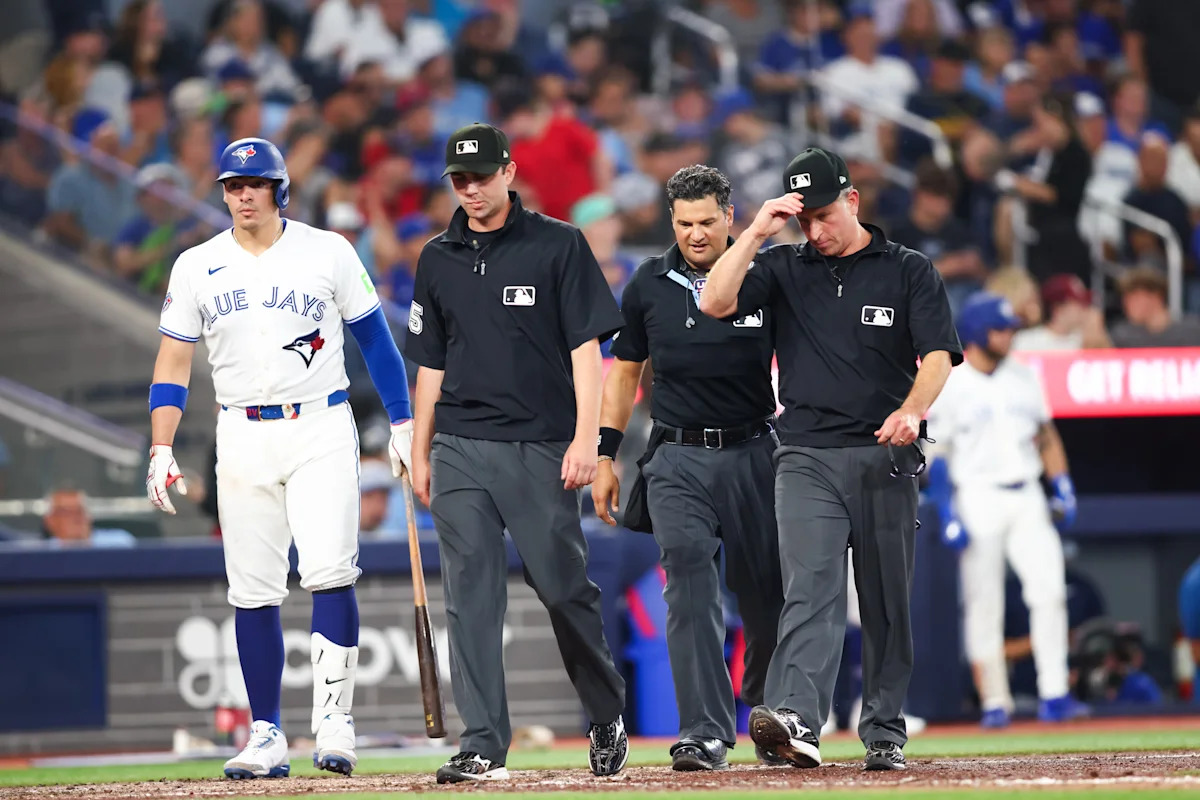
You’ve probably never seen this one before. It’s likely you won’t see it again.
In a fiasco during Monday’s game between Toronto and Boston that left everyone befuddled, Boston was awarded a very confusing run after two Sox baserunners and apparently some Toronto defenders forgot the out count.
Advertisement
When it was all said and done, the Red Sox were awarded a run despite the third-base runner’s failure to tag up before heading home. Umpires on the field didn’t even know how to explain it.
Let’s start from the beginning.
Baserunning blunder by 2 Boston runners
With one out, runners on the corners and the Blue Jays holding a 2-0 seventh-inning lead, Red Sox center fielder Ceddanne Rafaela hit a deep fly ball that was caught for an out in center field.
The broadcast graphic correctly displayed that there was one out while Rafaela was at the plate. But the scoreboard at Toronto’s Rogers Centre incorrectly displayed two outs.
Advertisement
Anthony Seigler was at third base, and Nick Sogard was at first. Both apparently trusted the home-field scoreboard or simply had the out count wrong in their heads. They took off at the crack of the bat, believing there were two outs.
The Blue Jays got the ball back to first as Sogard was rounding the bases, so Sogard was called out for the third out of the inning.
Or so everyone thought.
It appeared as the game went to break between half-innings that Boston had squandered a chance to tag and cut Toronto’s lead to 2-1. But that was just the beginning of the saga.
“So, OK”
After the break in the action, umpire and crew chief Chris Guccione greeted the crowd with “So, OK.”
Advertisement
Buckle up.
He then attempted to explain why Boston might’ve scored a run despite the third-base runner failing to tag up. But he wasn’t sure, and his case wasn’t convincing. Meanwhile, the on-field umpiring crew was checking in with replay review in New York for their opinion.
“What we have here is — we have a time play,” Guccione continued before stumbling over his words. “… When the third out was made at first base with the runner not tagging up, the runner that was on third base also did not tag but crossed home plate before the third out was made at first base.”
Guccione offered no explanation as to why the run might count despite the third-base runner failing to tag up.
Fifteen minutes later …
Then the umpires and New York’s replay-review center finally reached their verdict. Boston was awarded a run.
Advertisement
Here’s Guccione delivering the news.
“All right, after calling New York and getting it all straightened out, the run is going to score,” Guccione said, eliciting a cascade of boos from the Toronto crowd. “End of the inning, two runs for Toronto, one run for Boston.”
Got it? No? You’re not alone.
The Sportsnet broadcasters calling the game were perplexed as well. So their sideline reporter went to who else but Max Scherzer for an explanation.
Per that report, Scherzer said the Blue Jays argued that the home-plate umpire waived them off the field without allowing them a chance to appeal when an appeal would’ve allowed the Blue Jays to confirm that the third-base runner didn’t tag up.
Advertisement
That argument apparently failed. And baseball’s little-utilized fourth-out rule was triggered.
Because the Blue Jays went for the double-play at first base and the third-base runner scored before that third out was recorded, a time play went into effect, and the run counted. And because the Blue Jays didn’t appeal the lack of a tag at third base, the ruling of a Boston run wasn’t overturned.
Still confused? Join the club.
Here’s Guccione after the game, further attempting to explain things to a reporter.
“Both Boston runners, thinking there were two outs, just took off,” Guccione said, per MLB.com. “When the second out was made, now we have two runners who have failed to return and tag up correctly.
“At that time, the guy from third had crossed home plate and the guy who was at first was standing at second. Toronto knew he hadn’t tagged up and threw to first base to make the third out.
“Well, that’s a time play, meaning it’s not a force play. If it’s a force play, the run does not score automatically. If it’s a time play — meaning, ‘Was the out made before or after the runner crossed home plate?’ — in this case, the runner crossed before the appeal play was made [at first].
“In this play, it’s what you call an apparent fourth out.”
Ultimately, the fiasco didn’t matter in the outcome of the game. The Blue Jays held on for a 2-1 victory, and fans in Toronto went home wondering what they’d just seen.
Read the full article here


