





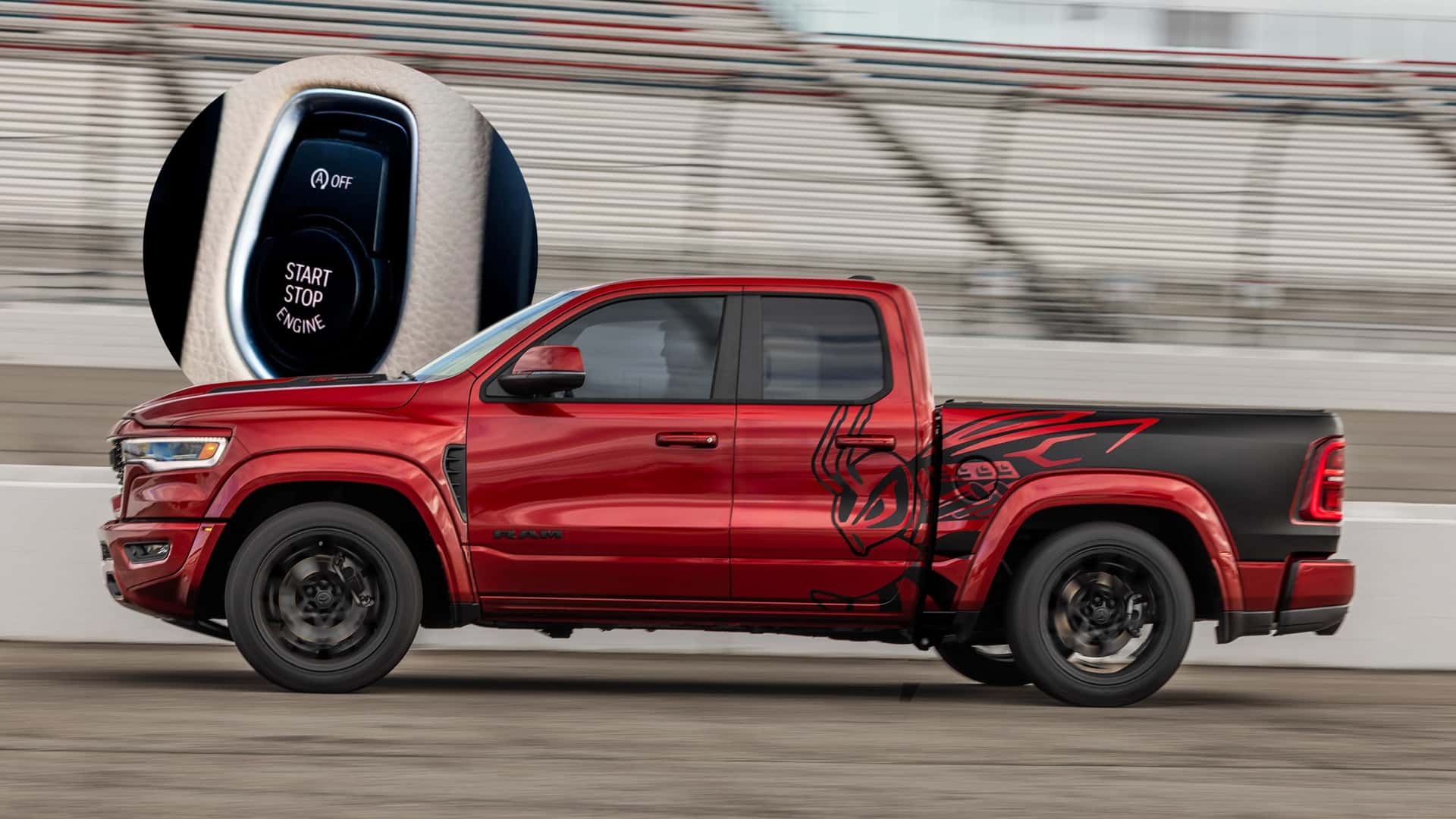
- Ram’s new Rumble Bee packs a supercharged Hemi and skips auto stop/start entirely.
- The move comes after recent EPA regulatory changes and fits the truck’s performance-first focus.
- Ram is leaning back into V8 power, bringing back models and options enthusiasts actually want.
Ram just dropped the new Rumble Bee—a badass street truck with a whole lot of horsepower under the hood. And you know what it doesn’t have? Auto stop/start. Praise be.
After the EPA rolled back the mandate for auto stop/start systems earlier this year, the Rumble Bee arrives without the fuel-saving feature across the range of available powertrains—the 5.7- and 6.4-liter Hemi V8s. For a truck built around performance, that’s not much of a surprise.
2027 Ram 1500 Rumble Bee 392
Photo by: Ram
It should be noted that the Rumble Bee’s chief rival—the Ford F-150 Raptor—does have automatic stop/start. Even Ram’s own 1500 RHO has it. But past Hellcat models like the Charger and Challenger skipped it too, along with the current Durango Hellcat, the latest Ram TRX, and now the Rumble Bee SRT.
Auto stop/start was originally introduced to help automakers meet federal fuel economy standards and reduce emissions. But with recent regulatory changes ending those incentives, Ram seems happy to move away from it—especially on high-performance models such as this, and it might proliferate to non-performance trucks, too.
After leaning hard into electrification, Ram is clearly shifting back toward big V8s and high-horsepower trucks. The company recently brought back the TRX with a supercharged V8 and reintroduced the Hemi option in the standard 1500 lineup, and buyers seem to be loving it.
So if you manage to snag one of these rare—and probably expensive—Rumble Bees, at least you won’t have to deal with your truck shutting off at every red light.

69
Source: Ram
Motor1’s take: Auto stop/start has never exactly been a fan favorite, so ditching it on a truck like the Rumble Bee feels like the right call. A street truck constantly restarting itself at stoplights just sounds wrong.
Read the full article here