




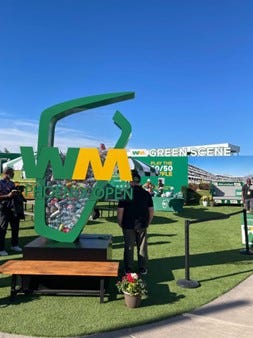
At the WM Phoenix Open, sustainability doesn’t look like a lecture.
It looks like beer cups without trash cans. A stadium that gets taken apart and used again. Food scraps turning into compost instead of landfill. A golf tournament so rowdy it barely resembles golf at all, yet quietly operates as one of the most sustainable sporting events in the world.
Advertisement
For many fans, the word “sustainability” can feel abstract or overwhelming, a catch-all term that sounds important but hard to pin down. At the WM Phoenix Open, organizers say the goal is to make it so easy that people participate without even realizing it.
“I think everybody has a little bit of confusion around what sustainability means and what they can do for the environment,” said Mike Watson, WM’s chief customer officer. “That’s why we really make it simple. You can see there’s no garbage containers on the course. You see compost, recycling.”
In layman’s terms, sustainability at the WM Open boils down to a few basic ideas: use less, reuse more and don’t waste what still has value. That philosophy is built into nearly every part of the tournament, from how the grandstands are constructed to what happens after fans toss away a drink.
The most striking example might be the 16th hole itself, a temporary stadium that hosts some of the loudest moments in professional golf. Despite its size and spectacle, the structure is designed to be reused.
Advertisement
“It’s wild to say,” said Lee Spivek, director of advisory services for WM. “This year it’s almost entirely aluminum. It’s going to be deconstructed, parts will be used at other events and the rest will be stored and reused year after year.”
Sustainability, Spivek noted, isn’t always driven by environmental ideals alone. Financial incentives matter too. But the result is the same: fewer materials wasted and less need to rebuild from scratch each year.
Lee Spivek, director of advisory services for WM, demonstrates how each bag of compost and recyclable material is meticulously sorted through to ensure everything is functionally recycled at the 2026 WM Phoenix Open.
That practical mindset extends beyond construction. During the tournament, food scraps are composted through Arizona-based partners. Wine and liquor bottles are turned into reusable glassware. Leftover food is donated to the local community. Even the cups fans drink from are designed with reuse or recycling in mind, including bamboo utensils and zero-waste packaging tied to fundraising efforts for WM’s Working For Tomorrow Fund.
Advertisement
“And what really makes me the most proud,” Watson said, “is it’s where our brand, the sport of golf and entertainment coincide.”
The fund, Watson said, reflects WM’s broader sustainability goals: resources that are renewable, energy that’s renewable and communities that thrive alongside them. At the WM Open, that philosophy shows up not just in operations but in how the tournament connects with the Valley.
“It’s more than a golf tournament,” Watson said. “It’s what we stand for around sustainability, being the People’s Open, connecting with the community and educating fans.”
What fans don’t see is the amount of planning required to make that education feel invisible.
Advertisement
“It is a lot of work,” Watson said. “Year-round preparation, hundreds of people here making sure this is a world-class zero-waste event.”

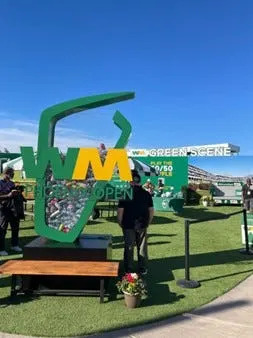
A view of the “Green Scene” at the WM Phoenix Open in 2026, which features an interactive art installation that allows fans to dispose of waste that ordinarily could go to a landfill but is instead recycled.
That behind-the-scenes effort has caught the attention of other sports leagues and venues. WM’s advisory services group, which grew from just a handful of employees a few years ago to nearly 40 today, now works with four professional sports leagues, more than 20 venues and a dozen golf tournaments nationwide.
“Large transient populations coming through with complicated supply chains describes so many circumstances,” Spivek said. “You can pull things out of this and make it relatable to basically any business.”
Advertisement
Even the tournament’s imperfections are part of the lesson. While the WM Phoenix Open diverted the vast majority of its waste from landfills, some materials were still disposed of due to logistical challenges. Organizers say transparency matters because sustainability isn’t about perfection but progress.
For the Thunderbirds, who host the event and serve as its charitable arm, sustainability has become inseparable from the tournament’s identity.
“We’ve spent a number of years with WM focusing on diversion programs for waste,” said Thunderbird and assistant tournament chairman Chris Camacho. “We’ve also looked at water conservation strategies to ensure we become the most sustainable tournament on the PGA Tour.”
For fans, the takeaway isn’t a stat sheet or a slogan. It’s the idea that sustainability doesn’t have to feel heavy, inconvenient or preachy. Sometimes it’s just about building systems that work, even in the middle of the loudest party in golf.
Advertisement
Kyle Mucerino is a graduate student at Northwestern’s Medill School of Journalism.
This article originally appeared on Arizona Republic: Despite party reputation, Phoenix Open’s sustainability leads the way
Read the full article here


