




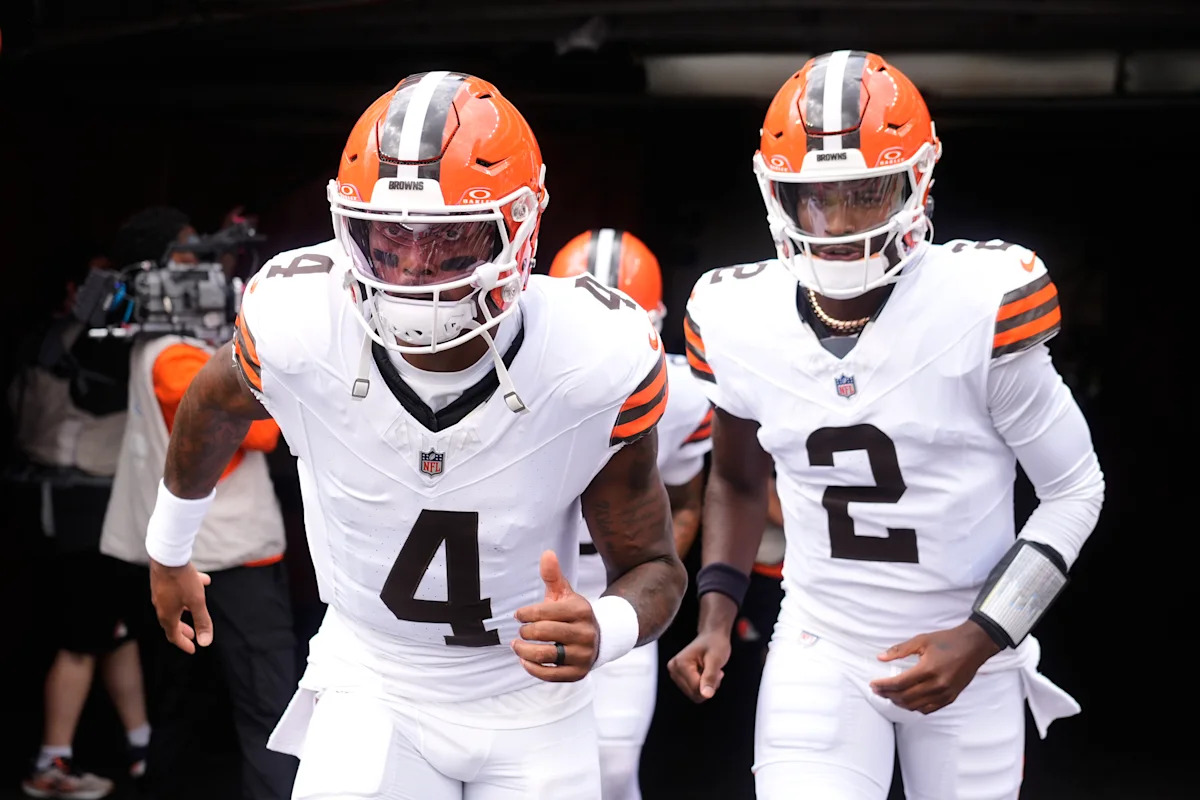
When Deshaun Watson booed the boos that rained down from fans on Saturday, the Cleveland Browns’ quarterback questioned not only his fan base’s actions but also their intentions.
“I think the whole world knows it has nothing to do with the performance,” Watson told reporters after the 31-7 loss.
Advertisement
The line left plenty to unpack about the history between quarterback and fan base. It also seemed to gain further relevance Monday when the Browns named Watson their starting quarterback for their season opener.
Because while Watson (accurately or not) believed fans’ boos had “nothing to do with the performance,” Cleveland’s decision to name Watson their Week 1 starter has plenty to do with it. If the Browns’ decision was about fan popularity or podium performance or medium- to long-term upside, 2025 fifth-round pick Shedeur Sanders would have received the nod Monday.
Play Yahoo’s new College Fantasy Football game: Create or join a league now!
Advertisement
Instead, a conversation about who gives the club its best chance to beat the Jacksonville Jaguars in Jacksonville on Sept. 13 unfolded.
Head coach Todd Monken chose Watson.
“You don’t ignore the fans and the tax that maybe something like that can put on the organization, but we also have to make football decisions,” a person with knowledge of the Browns’ decision-making factors told Yahoo Sports. “You also can’t be emotionally hijacked and not make what you think is the sound, right football decision.”
Multiple sources with knowledge of the Browns’ decision-making factors suggest: The decision to name Watson rather than Sanders did not arrive via a landslide. This was not a decision about who is “good” or “bad” and perhaps not a decision about who is the better or worse NFL quarterback.
Advertisement
“I do think there’s maybe a little bit of an element here in terms of what you value in terms of their relative strengths and weaknesses,” a second person with knowledge of the Browns’ decision-making factors told Yahoo Sports. “Deshaun’s athletic. You’ll have the operation right. He’s really good pre-snap. Shedeur, he’s accurate. He’s very, very poised in the pocket. He’s a good drop-back passer and he can create enough off schedule with his legs, but you’re not going to do QB designed run.”
Monken opted to promote the player with 72 career starts whom he believes is superior in nuances like the silent count required on the road, rather than the seven-start player whose quarterbacking skills may deserve the edge.


Cleveland Browns quarterback Deshaun Watson (4) is the starter for Week 1, but Shedeur Sanders (2) could still potentially start games later this season. (AP Photo/Carolyn Kaster)
(AP Photo/Carolyn Kaster)
Watson’s strengths — which are different from those of Sanders, whether or not they are better — won out.
Advertisement
For now.
That tenuous reality was clear even as head coach Todd Monken sandwiched a “this is not a week-to-week decision” comment between his notes that Watson is going to start “against Jacksonville” and “ultimately, we’re about Week 1.”
How much cushion does Watson have and what would prompt consideration for an eventual change?
Those are questions the Browns must ask themselves even before their regular-season starts.
Monken made clear on Sunday that he understands what’s expected as he fielded questions about Watson’s emotional outburst.
“The business we’re in is a performance-based business,” Monken told reporters. “It is what it is. When we expect a service, we’re going to be disappointed when we don’t get that service. If you go to a restaurant and your soup comes out cold, you’re going to be upset. If you order from the grocery store and six of your eggs are broken, you’re going to be pissed. So, I get it, that’s what we’re in. That’s why we’re paid what we are, to perform at a high level, and when we don’t, there are repercussions. We’ve run to this smoke.
Advertisement
“This is the job we’ve chosen, so this is part of it.”
After rocky weekend, what does Watson’s starting role mean?
For a stretch over the weekend, there was reason to wonder if Watson had forfeited the starting right that his offseason and training camp performance had narrowly earned him.
Insulting a fan base is rarely a winning strategy in professional sports. Insulting a fan base as a player years removed from strong performances and winning is still dicier. Watson’s apology on Monday, after he was named the Browns’ Week 1 starter, might resonate with some. His background facing allegations of sexual assault and misconduct, and the multiple injuries he’s suffered while costing three first-round picks in a 2022 trade and a $230 million fully guaranteed contract, make him generally unsympathetic to others.
Advertisement
But Watson’s Monday opening statement struck a different tone than he had since arriving in Cleveland.
“My emotions got the best of me,” Watson admitted of his Saturday comments in which he called Browns fans booing a “disrespectful” gesture. “I’m human. I take full responsibility of that. Moving forward, I want to make sure I put the best product out there for the team.”
He noted also that “I understand the frustration” from fans watching a losing product and believes winning will help him “earn the respect and loyalty of the rest of the fan base.”
Watson’s actions must echo and then speak louder than his words in the coming weeks. But in the short term, perhaps they send a message to Cleveland’s locker room that the club’s quarterback realizes his comments were a mistake.
Advertisement
Perhaps that was the point, if not the best possible outcome of Watson’s mea culpa. Did a large subsection of fans shift their core beliefs because their quarterback made a 2 1/2-minute statement? Unlikely. But did a locker room and coaching staff far higher on Watson than their fan base perhaps receive some reassurance that his lost-cool comments won’t become a norm? That’s more plausible.
Earning back some grace from colleagues after this weekend would be wise. Because not only did Sanders rise above the press conference drama Watson created, but Sanders also played better than Watson in the last benchmark of the decision that ultimately wasn’t close enough to close the gap in the competition. Evaluators say snaps with each phase of the roster matter. But when trying to predict Week 1 performance, each quarterback’s snaps with the starters ultimately prove most representative.
Thus Watson’s preseason Week 1 stat line of 11-of-15 passing for 126 yards and a lost fumble ultimately became a part of his win relative to Sanders’ Week 2 showing of 9-for-11 passing for 74 yards, a touchdown and an interception (plenty of caveats exist for each performance amid a preseason atmosphere and in-flux roster).
Watson’s early Cleveland games paled in comparison to his Houston Texans tenure, as his completion percentage dropped from 67.8% in Houston to 61.2% in 19 Cleveland games across three years. His production went from 269.2 passing yards per game in Houston to 177.1. Add in Achilles tears that will separate his last start and his next by 693 games, and questions abound.
Advertisement
But Watson is optimistic that teaming up with Monken will unlock some of his strengths that haven’t flashed recently.
“We haven’t showcased my full talent and ability to run in this offense, being able to run and being able to use my athletic ability, getting outside the pocket, being able to do some other QB-driven stuff,” Watson said. “So, I’m excited to see what we can cook up getting ready for Week 1.”
Why Watson’s starting nod doesn’t spell Sanders’ end with Browns
Browns decision-makers stressed on Monday: Giving Watson the early nod does not mean they’ve given up on Sanders.
Advertisement
No one’s saying publicly or directly that Sanders is likely to start later in the year. But consider Cleveland’s history of quarterback carousels and its two first-round picks looming in 2027: If Sanders is healthy all year, it will be a surprise if he doesn’t receive a start.
“Shedeur has improved a ton,” the first source with knowledge of the Browns’ decision-making process said, echoing Monken’s public sentiments. “You can argue where he’s coming from, fine, but he’s improved a lot. And he still could not be the better one. Or could not be the one that’s right. I don’t know why both can’t be true.
“Because the other guy is more ready or is the right choice, in our minds, doesn’t mean Shedeur sucks. Both things can be true. It could just be, ‘Hey, this is the right decision for us right now.'”
Watson’s performance Week 1 at Jacksonville and Week 2 at Tampa Bay — against his predecessor in former Browns’ first overall pick Baker Mayfield, no less — will dictate what’s the right decision for the Browns afterward.
Advertisement
Yes, Cleveland opening at home Week 3 amid their famously unsupportive-of-Watson crowd will factor into a decision. Maybe early wins will win Watson some favor with the fans. Maybe the need to build a young roster will become more pressing. Could Sanders end up starting Week 3 through the rest of the season and demonstrate how much he’s advanced from a year ago? That’s plausible. If that happens, will the Browns regret not rolling with him Week 1?
“It’s not actually that simple with the variables,” Monken explained the quarterback decision to Yahoo Sports on Aug. 7. “A number of players, when it’s that close, you don’t know for sure. You think you know. But you know what? At some point, you put Lamar Jackson in the first time. They didn’t know, and at first, they probably thought he couldn’t do what he’s done.
“And then he developed at it, and he got better.”
The Browns will need to decide what factors will most dictate their roster battles as the season progresses. How will Monken and Co. react if the team is 2-0 but their offense is ineffective, or if they are 0-2 but Watson has played well? How about if the Browns return home at 1-1, with an average Watson and an average offense — but also a young talent in Sanders whom at least some in the building believe could approach quality starter level?
Advertisement
At some point, the medium- to long-term future of the position will creep into decisions about the short-term future. And there’s a reality in which this gives Sanders his best chance of the season.
Because unlike Watson, starting Week 1 on the road with multiple receivers who haven’t played an NFL game and a play-caller in Monken still adapting to his personnel, the insertion of Sanders later in the season could position him to enter an offense that has more intel on what it needs most and how it can best succeed.
The Browns expect Sanders to stay engaged until that moment arrives, the younger quarterback aware that his next start in Cleveland is a matter of when not if under a staff that sees his potential even if noting it’s rawer than that of Watson.
Advertisement
“Ultimately, we felt over the course of training camp and the offseason that [Watson] was ahead of Shedeur,” Monken told reporters on Monday. “Shedeur has closed that gap, for sure, and that’s a credit to him. …
“We met this morning for a good long time, and all he had was a smile on his face, because he understands what’s really in front of him: not really a short-term, more of a long-term decision.
“This is a player who’s going to work his butt off to get better, and he already has.”
Read the full article here


