




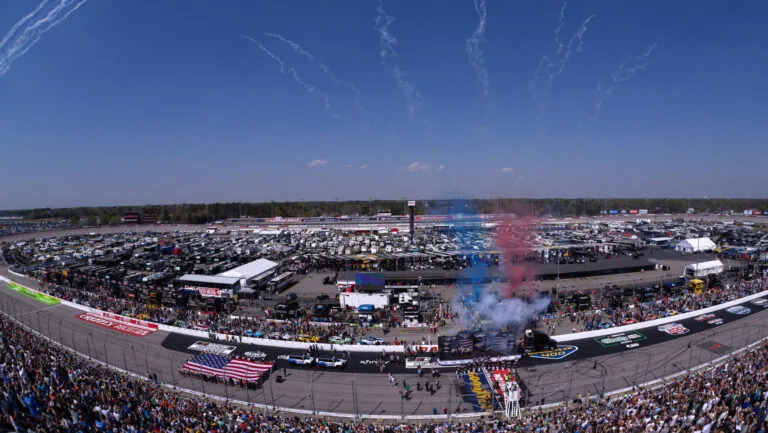
Darlington Raceway doesn’t need much of an introduction to longtime NASCAR fans.
For everyone else, the South Carolina track can take some explaining.
Why does it look like an egg? Why do drivers talk about earning a “Darlington Stripe”? Where did “The Lady in Black” come from? And what exactly makes a 1.366-mile oval so difficult that NASCAR has spent decades calling it “The Track Too Tough to Tame”?
Advertisement
With the Cup Series returning to Darlington this weekend for the Cook Out Southern 500 and the opening race of the 2026 Chase, consider this your Darlington Raceway 101.
From the track’s unusual dimensions and famous nicknames to its history, records and quirks, here’s everything NASCAR fans need to know about one of the sport’s most recognizable race tracks.
Darlington Raceway Fast Facts
Let’s start with the basics.
-
Location: Darlington, South Carolina
-
Track length: 1.366 miles
-
Turns 1 and 2 banking: 25 degrees
-
Turns 3 and 4 banking: 23 degrees
-
Straightaway banking: 6 degrees
-
Famous nicknames: “The Lady in Black” and “The Track Too Tough to Tame”
-
Signature race: Southern 500
-
All-time Cup wins leader: David Pearson, 10
-
All-time Cup poles leader: David Pearson, 12
But those numbers only begin to explain what makes Darlington different.
Why Is Darlington Raceway Egg-Shaped?
You don’t need to know much about race-track design to look at Darlington and realize something unusual happened here.
Advertisement
It did.
Track founder Harold Brasington purchased the land after becoming convinced that NASCAR needed a major paved speedway. But there was a problem when he began laying out the track: a minnow pond on the property.
Brasington had reportedly promised the land’s former owner that the pond would remain undisturbed. His solution was to design the speedway around it.
The result was Darlington’s unmistakable egg shape.
That quirk created a challenge that remains more than 75 years later. Turns 1 and 2 feature 25 degrees of banking, while Turns 3 and 4 have 23. Instead of preparing for two nearly identical ends of an oval, teams have to find a setup capable of handling two distinctly different corners.
Advertisement
In other words, one of NASCAR’s strangest tracks exists partly because somebody wanted to protect a fish pond.
Why Is Darlington Called ‘The Lady in Black’?
Darlington has accumulated several nicknames during its history, but “The Lady in Black” may be its most famous.
The name is tied to the track’s notoriously unforgiving walls and the dark tire marks left behind as NASCAR’s cars repeatedly make contact with them.
Those walls are rarely far away.
Drivers frequently run inches from the outside barrier because that’s where the speed is. Over the course of a race weekend, the once-white wall becomes marked by rubber and contact.
Advertisement
Hence, the Lady in Black.
And that brings us to another piece of Darlington vocabulary.
What Is a Darlington Stripe?
If you’ve watched NASCAR at Darlington, you’ve almost certainly heard someone say a driver “earned his Darlington Stripe.”
It’s not an award he wants.
A Darlington Stripe is the scrape or damage running along the right side of a car after it makes contact with the outside wall.
What makes it different from simply wrecking?
At Darlington, wall contact is practically part of doing business. Drivers spend so much time running inches from the barrier that even some of the fastest cars in the field leave the weekend wearing evidence of it.
Advertisement
A light stripe may barely affect the car. Hit the wall harder and suddenly a driver’s afternoon can unravel.
The difference can be a matter of inches.
Why Is Darlington Called ‘The Track Too Tough to Tame’?
There’s no single trick to beating Darlington.
That’s essentially the point.
Its two ends are different. Tire wear is significant. The fastest line puts drivers against the wall. Grip changes throughout a run. Passing can be difficult. And the Southern 500 asks drivers to manage all of it for roughly 500 miles.
A driver can have one of the fastest cars in the field and still lose the race by using too much tire, misjudging the wall or failing to keep up with the changing track.
Advertisement
That’s why “Too Tough to Tame” has endured as more than a catchy marketing slogan.
Darlington punishes mistakes.
How Old Is Darlington Raceway?
Darlington opened in 1950, making it one of NASCAR’s oldest race tracks.
The first race was held on Sept. 4, 1950, and it was unlike anything NASCAR had staged before.
The Southern 500 became NASCAR’s first 500-mile race, with Johnny Mantz winning the inaugural event. Mantz famously used more durable tires to survive a race in which tire problems plagued much of the field, eventually winning by multiple laps.
That first Southern 500 helped establish Darlington as NASCAR’s first true superspeedway.
Advertisement
More than 75 years later, NASCAR is still racing there.
Why Is the Southern 500 One of NASCAR’s Biggest Races?
Some races are worth more than their place on the schedule.
The Southern 500 is one of them.
Traditionally associated with Labor Day weekend, Darlington’s 500-mile race is considered one of NASCAR’s crown-jewel events alongside races such as the Daytona 500 and Coca-Cola 600.
Winning it means beating the field while surviving one of the most demanding tracks in stock-car racing.
The names on its winners list span NASCAR generations, from Johnny Mantz and David Pearson to Dale Earnhardt, Jeff Gordon and today’s Cup stars.
Advertisement
For 2026, the Southern 500 carries another distinction: Darlington opens the 10-race Chase for the NASCAR Cup Series championship.
Who Has the Most NASCAR Cup Series Wins at Darlington?
David Pearson remains the king of Darlington.
“The Silver Fox” won 10 Cup Series races at the track and also holds Darlington’s record with 12 poles.
Among active drivers, however, Denny Hamlin has assembled an extraordinary Darlington résumé of his own.
Hamlin enters this weekend with five Cup victories at the track. In 28 starts, he has 14 top-five finishes, 20 top-10s and an 8.0 average finish.
That means the driver beginning the 2026 Chase as its No. 1 seed also happens to be one of the best active Darlington racers.
Advertisement
One of NASCAR’s Closest Finishes Happened at Darlington
You can’t tell the story of Darlington without Ricky Craven and Kurt Busch.
On March 16, 2003, the two raced side-by-side, made contact and dragged battered race cars toward the finish line in one of NASCAR’s most unforgettable final laps.
Craven won. The margin was 0.002 seconds.
More than two decades later, Darlington lists it as the second-closest finish in NASCAR history.
It’s also a pretty good encapsulation of the place itself.
Two damaged race cars. Drivers fighting for every inch. The wall never far away. And almost nothing separating winning from losing.
Advertisement
NASCAR Heads Back to Darlington This Weekend
The Cup Series returns Sunday for the Cook Out Southern 500, and this trip to the Lady in Black comes with championship consequences from the moment the green flag falls.
Darlington is the first of 10 races in NASCAR’s revived Chase format, with Denny Hamlin beginning the postseason as the No. 1 seed ahead of Ryan Blaney and Tyler Reddick.
It’s fitting that NASCAR’s championship run begins here.
The sport has changed dramatically since Johnny Mantz won that first 500-mile race in 1950. Darlington hasn’t become much easier.
Its shape is still strange. Its walls are still unforgiving. Its nicknames still fit.
Advertisement
And more than 75 years later, NASCAR is still trying to tame it.
Read the full article here


