




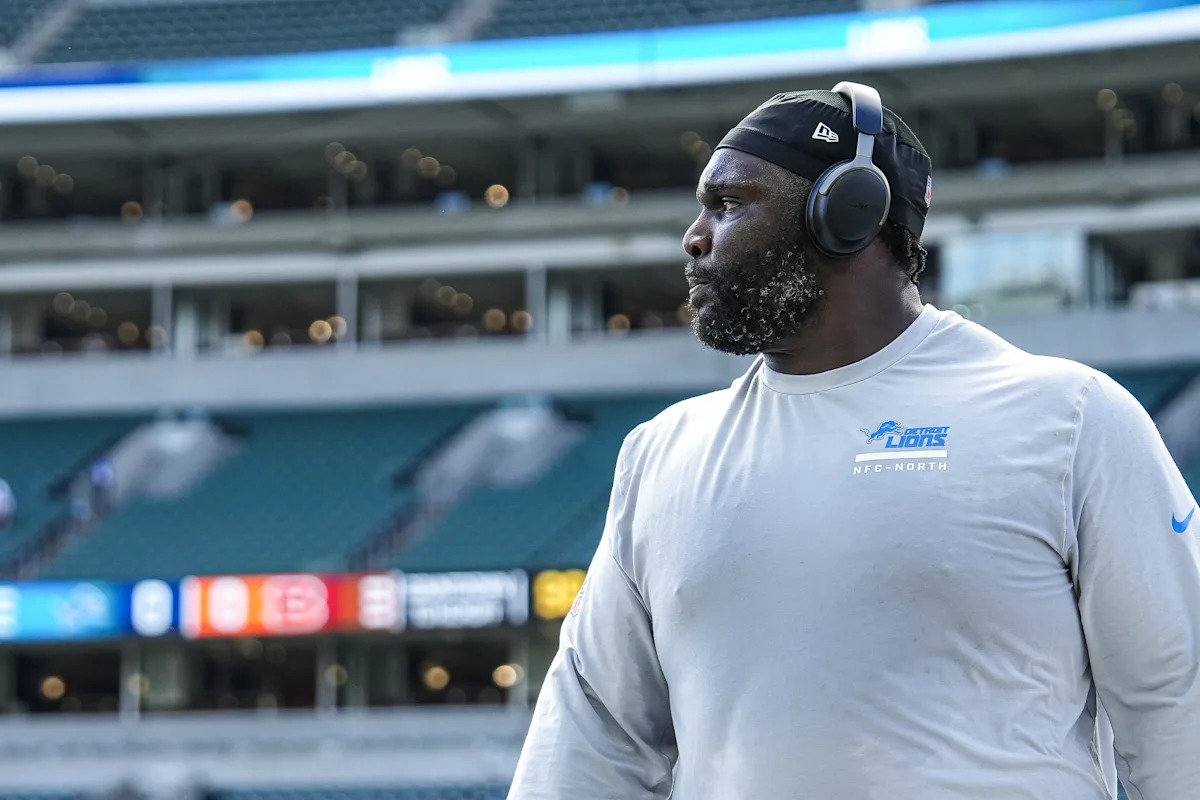
In surprising news this week, the New York Giants signed a veteran defensive tackle, but not the one they were rumored to be signing.
Check that. They signed two veteran defensive tackles.
This was after D.J. Reader was rumored to be heading to the Giants after the draft. The reason why pretty much everyone left in free agency was waiting until at least this week to sign is to avoid impacting compensatory draft picks. Beginning on the Tuesday following the NFL Draft, players that sign no longer impact compensatory pick calculations (there is a narrow exception that the Steelers executed with their weird Aaron Rodgers maneuver, but we’ll ignore that here).
Advertisement
Signing Harris and Fotu doesn’t guarantee that the Giants are out of the D.J. Reader market, as both players played the majority of their snaps in the B-gap last season rather than traditional nose tackle, but Fotu has been more nose-heavy in prior seasons. Compare this to Reader, who played the fourth most snaps in the A-gap in 2025 during his season with the Detroit Lions.
With Reader still out there, it would seem wise that Green Bay should kick the tires on him. The Packers did add some interior depth in the draft via Chris McClellan in the third round, but even he is not seen as a slam-dunk nose tackle for base downs. McClellan played about 93% of his snaps in 2025 at 3-tech/4i and across his entire collegiate career that number was just shy of 90%.
In college, playing in the B-gap is a little different than it is in many NFL systems. Many teams, particularly in the SEC, play a lot of mint/tite fronts that involve those B-gap defenders essentially playing the same gap-plugging roles that nose tackles often occupy in the NFL. And at lesser schools, this is how you end up with 240-pound Will McDonald taking on combo blocks in the B-gap as a 4i. College football is not a good steward of our game at the moment.
But even if McClellan does come in and plays primarily nose tackle, that doesn’t leave Green Bay a ton of great options. First of all, that’s relying pretty heavily on a mid-round rookie to be the foundation of the run defense. Secondly, the options beyond McClellan are not inspiring. Javon Hargrave made it known that he was not pleased with his role as the primary nose tackle in Brian Flores’ defense last season. Hargrave retweeted the below tweet just prior to his release in Minnesota:
Hargrave has worked with new Packers defensive coordinator Jonathan Gannon before, back in Philadelphia, where Hargrave played nearly all of his snaps as a 3-tech. Hargrave’s entire game is built on disruption and suddenness, not the type of skills that typically translate well to playing nose tackle in a two-high structure, but better to the 3-tech role. Devonte Wyatt is clearly not a nose tackle, and I don’t think I need to explain that one to anyone who watches the Packers.
Advertisement
The bundle of options we’re left with are Jordon Riley, who will probably miss the entirety of the 2026 season due to a torn Achilles tendon late last year, Jonathan Ford, the 2022 Packers seventh round pick who found his way back to Green Bay after being released from the Bears porous defensive tackle room last season, and Nazir Stackhouse, the 2025 UDFA who, to say the least, did not have an inspiring 2025. Green Bay is also in a position where they can comfortably add modest veteran talent to this roster for 2026. Packers Twitter cap expert Ken Ingalls has the Packers cap position below:
It’s worth noting that a Wyatt extension would likely reduce his 2025 cap hit since he is currently playing on his fifth-year option and an extension would defer cap hits to the future, so it wouldn’t even eat into that $11.65M effective space number.
This brings us back to Reader, the whole topic of this article in the first place. He’s nearly a perfect fit for what Green Bay needs to add to the room. In past seasons, Reader has ranked in the following spots for total A-gap snaps on defense in each season for this decade: 4th, 5th, 34th (played 14 games), 30th (played 13 games), 11th, 66th (played 5 games). Reader has consistently been a true nose and his size fits the bill. At 6’3” 335, he is prototypical nose tackle size, but he also isn’t just a run stuffer — Reader ranked 4th in total pressures amongst those ranked in the top 15 for nose tackle snaps in 2025. He’s not going to be dynamic, but he’s not as much of a specialist as someone like TJ Slaton.
Advertisement
From a cost perspective, Reader’s last contract with Detroit was for two years and $22M. It remains unclear as to what the price would be to add Reader, and I’d imagine cost had quite a bit to do with New York pivoting to a lesser option than Reader in Fotu. For what it’s worth, Spotrac has his market value price at two years and $7.7M. A contract like that would likely involve around a $3M signing bonus and a league minimum salary in year one, with the remainder being some combination of salary and roster bonus for year two (Reader would push for early league year roster bonus, Green Bay would push for base salary).
For a modest cost, it would be fruitful for Green Bay to look towards this option. They currently do not have a dedicated base-down nose tackle on the roster. And that doesn’t just include downs where they’re running a 3-4. Even on early down nickel packages, Green Bay is going to want some run-stuffing bodies on the field. Reader can give Green Bay that in a way that Ford and Stackhouse simply cannot, and his presence would allow the team to bring along McClellan at an appropriate pace and keep Hargrave in the role he is best suited to.
Read the full article here


